TL;DR:
- Outsourcing logistics can significantly reduce costs and improve order accuracy.
- Clear goals and KPIs are essential for successful 3PL partnerships.
- Proper onboarding, monitoring, and ongoing collaboration drive long-term fulfillment success.
Growing an e-commerce business is exciting until your logistics can’t keep up. Late shipments, picking errors, and warehousing costs that spiral upward are signs your fulfilment operation is becoming a bottleneck rather than an asset. Many brands reach a tipping point where managing logistics in-house actively limits their ability to scale. The good news is that a structured approach to outsourcing your logistics can dramatically reduce costs, improve accuracy, and free your team to focus on growth. This guide walks you through each stage, from auditing your current setup to managing a 3PL partner for long-term results.
Table of Contents
Key Takeaways
| Point |
Details |
| Assess logistics readiness |
Identify your pain points and what you need to improve before outsourcing logistics. |
| Set measurable KPIs |
Define clear success benchmarks like cost, speed, and accuracy for logistics partnerships. |
| Choose partners carefully |
Vet potential 3PLs on reliability, technology, and match for your business goals. |
| Prioritise ongoing management |
Regularly review performance and improve processes for optimal results. |
Understand your current logistics and readiness
With the challenge clear, your first move is understanding what’s holding your logistics back. Before you contact a single third-party logistics provider, you need an honest picture of where your operation stands today. Skipping this step means you risk outsourcing the wrong things, or worse, locking yourself into a contract that doesn’t solve your actual problems.
Start by mapping your current fulfilment process from the moment an order is placed to the moment it arrives at your customer’s door. Where do delays occur? Where do errors creep in? Which tasks consume the most time or money? Auditing current operations to identify pain points like delays and support tickets is widely recognised as step one in any effective logistics outsourcing plan.
Common pain points to look for:
- Consistently high order error rates or mispicks
- Slow processing times during peak trading periods
- Rising warehouse rent or storage costs
- Poor returns handling leading to customer complaints
- Manual inventory management causing stock discrepancies
Once you’ve mapped your process, use metrics to quantify the problem. Even basic data tells a story. Check your fulfilment cost checklist to benchmark where your costs currently sit versus what efficient operations look like.
| Logistics function |
Can be outsourced? |
Priority to review |
| Warehousing and storage |
Yes |
High |
| Pick and pack |
Yes |
High |
| Order fulfilment and shipping |
Yes |
High |
| Returns management |
Yes |
Medium |
| Inventory planning |
Partially |
Medium |
| Customer service |
Partially |
Low |
Pro Tip: If your support inbox is flooded with “Where is my order?” messages, that’s a reliable signal your fulfilment process needs attention before it damages your brand reputation.
Define clear outsourcing goals and KPIs
Once you’ve pinpointed the gaps in your operation, it’s time to anchor your outsourcing plan around clear goals. Without defined targets, outsourcing becomes an expensive gamble. You hand off operations, hope for improvement, and have no reliable way to measure whether the change has worked.
Every successful logistics outsourcing arrangement starts with specific, measurable objectives. Think beyond “we want faster shipping.” Instead, define exactly what faster means for your business and your customers.
Essential KPIs for e-commerce logistics outsourcing:
- Fulfilment cost per order: Know your current cost and set a target for reduction
- Order accuracy rate: The percentage of orders shipped without errors
- On-time delivery rate: Orders delivered within the promised window
- Customer satisfaction (CSAT): Post-delivery survey scores
- Return rate: Percentage of orders returned and average processing time
Industry data gives you a realistic baseline. 3PL benchmarks show that businesses typically achieve 20 to 30% cost savings on fulfilment, with per-order costs dropping from around $4.00 in-house to $2.50 via a 3PL. Order accuracy reaches as high as 99.8%, on-time delivery sits at 95%, and processing speeds improve by roughly 25%. Strong outsourcing ROI benchmarks suggest an ROI of 3.5x within the first year is achievable.
These numbers matter because they give you and your 3PL partner a shared language. When both sides know what success looks like, accountability becomes natural rather than adversarial.
Pro Tip: Set clear KPIs including delivery times, CSAT scores, and return rates before you sign any agreement. Revisit and update them at least every quarter as your business evolves.
Selecting the right logistics (3PL) partner
With goals defined, the next step is partnering with someone who enables your business to scale seamlessly. Choosing a 3PL is one of the most consequential decisions you’ll make in your logistics journey. The wrong partner can amplify every problem you already have.

Research confirms that the strongest 3PL selection frameworks evaluate providers across five areas: business reputation and strength, service excellence and reliability, pricing transparency, technology and integration capability, and sustainability commitments. Use these as your evaluation pillars.
Numbered due diligence steps:
- Request references from current clients in your sector
- Visit the warehouse facility in person where possible
- Review the service level agreement (SLA) line by line
- Test system integrations before committing to a full contract
- Confirm reporting capabilities and real-time visibility tools
- Assess scalability for peak periods like Black Friday
| Feature |
In-house |
3PL |
4PL |
| Operational control |
Full |
Shared |
Minimal |
| Upfront cost |
High |
Low to medium |
Low |
| Scalability |
Limited |
High |
Very high |
| Technology investment |
Required |
Included |
Managed |
| Expertise |
Varies |
Specialist |
Comprehensive |
When exploring your options, resources like our guide on choosing a 3PL partner and comparisons of best 3PL providers can sharpen your shortlist. Use the 3PL evaluation guide to structure your final assessment.
Red flags to avoid: providers who are vague about pricing, reluctant to share client references, or lack direct integrations with your e-commerce platform.
Pro Tip: Ask each 3PL candidate how they handle sudden volume spikes. Their answer tells you more about operational maturity than any brochure will.
Onboarding, monitoring, and continuous improvement
After choosing your partner, it’s essential to transition operations methodically for sustained success. A strong 3PL selection means little if the onboarding phase is rushed or poorly structured. The first 90 days set the tone for the entire relationship.
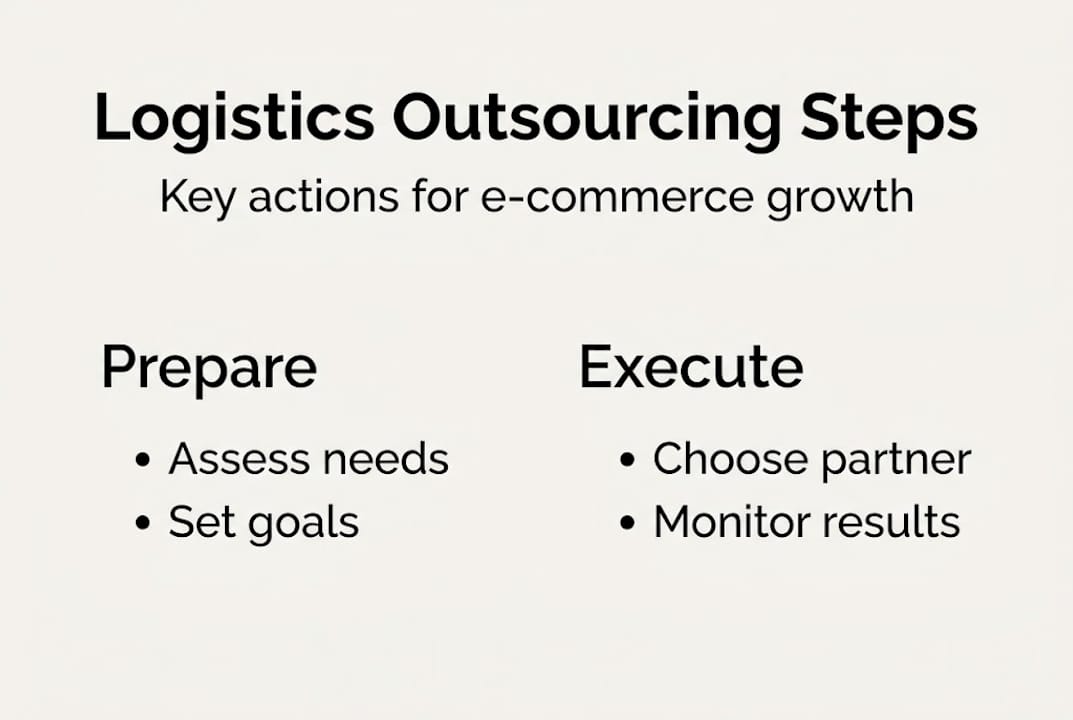
A robust onboarding plan should include clearly documented standard operating procedures (SOPs), confirmed system integrations, a responsibility matrix that defines who owns each task, and agreed escalation paths for errors. Developing your onboarding plan with full documentation and training on both sides significantly reduces costly mistakes in the early weeks.
A structured onboarding checklist:
- Share product catalogue, SKU data, and packaging requirements
- Complete warehouse management system (WMS) integration and test thoroughly
- Run a pilot batch of orders before full go-live
- Hold a joint kick-off meeting with clear roles assigned
- Establish a weekly review cadence for the first three months
Common first-90-day challenges include system data mismatches, communication gaps, and occasional picking errors while staff familiarise themselves with your product range. Address these quickly with structured weekly calls rather than reactive emails. Referring to our guide on onboarding fulfilment partners provides a structured framework to avoid the most common early pitfalls.
Logistics outsourcing is not a one-time handover. It’s a continuous, collaborative process where both parties iterate together to drive better results for the customer.
Once operations are stable, shift to monthly performance reviews using your agreed KPIs. Celebrate wins, flag gaps, and evolve your targets as your business grows. The brands that extract the most value from 3PLs are those that treat the relationship as a genuine partnership.
Pro Tip: Create a shared performance dashboard that both your team and your 3PL can access in real time. Visibility keeps both sides accountable without the need for lengthy status meetings.
Why logistics outsourcing is not a silver bullet — what most business owners get wrong
Stepping back, let’s consider a candid perspective on the realities and misconceptions around logistics outsourcing. Many businesses outsource logistics expecting an immediate transformation, then feel let down when the results take longer to materialise or require more active management than anticipated.
The truth is, outsourcing removes the physical burden of fulfilment. It does not remove the responsibility. We’ve seen brands hand off their operations to a 3PL and then disengage completely, assuming the partner will manage everything perfectly without any input. That rarely works.
The biggest mistakes we observe include neglecting to update SLAs as the business evolves, failing to review KPIs regularly, and relying too heavily on automated reporting without human oversight. Technology is a tool, not a manager.
The benefits of third-party logistics are genuinely significant, but they compound when you treat your 3PL as a strategic partner rather than a service vendor. Push for joint problem-solving sessions. Share your growth plans. Ask for their insights on improving your packaging or reducing returns. The brands achieving the strongest results are those using their 3PL’s expertise as a competitive advantage, not just a cost line.
Unlock effortless growth with expert logistics outsourcing
If you’re ready to turn your logistics into a growth engine, the right partner is just a step away. Navigating logistics outsourcing alone is time-consuming, and every week spent managing fulfilment in-house is a week not spent on product, marketing, or customer experience.

At ParcelPlanet, we specialise in helping e-commerce brands scale confidently through reliable, integrated fulfilment solutions. From warehousing and pick-and-pack to real-time tracking and returns management, our order fulfilment solutions are built around your business goals. Whether you’re just starting to outsource or looking to switch providers, our team is ready to help. Speak with an expert today and discover how becoming an order fulfilment partner with ParcelPlanet can simplify your operations and accelerate your growth.
Frequently asked questions
What is the most common mistake when outsourcing logistics?
Failing to set clear KPIs and regular communication routines is the primary reason outsourcing fails to deliver the expected ROI. Without defined targets, it’s nearly impossible to hold a partner accountable or identify where improvements are needed.
How much can e-commerce companies really save using a 3PL?
Switching to a 3PL typically cuts fulfilment costs by 20 to 30% and brings order accuracy up to 99.8%, which directly reduces costly errors and customer complaints. The savings compound further as order volumes grow.
How quickly can logistics outsourcing make an impact?
Most businesses begin to see measurable improvements within the first 30 to 90 days, particularly in processing speed and error rates, provided they monitor performance weekly and address issues promptly during the onboarding phase.
Is it better to outsource all logistics or only some parts?
A phased approach works best for most businesses. Start by outsourcing fulfilment first based on your biggest pain points, then expand to returns management and other functions once the core relationship is running smoothly.
Recommended


