TL;DR:
- Fulfilment is the key touchpoint that influences customer trust and long-term loyalty through accuracy, transparency, and seamless returns.
- Integrating loyalty data with fulfilment systems enhances personalized service and proactive communication, strengthening customer retention.
- Partnering with specialist 3PL providers offers scalable, accurate, and optimized fulfilment solutions essential for sustained brand growth and advocacy.
Fulfilment is the single most direct touchpoint between your brand promise and your customer’s lived experience, making it a primary driver of repeat purchase behaviour and long-term loyalty. The role of fulfilment in customer retention extends well beyond picking, packing, and shipping. It shapes whether a customer trusts you enough to return. Swift, accurate shipments and easy returns convert one-time buyers into loyal advocates, a fact that leading 3PL providers, loyalty programme designers, and real-time tracking platforms have built entire service models around. If your post-purchase experience disappoints, no discount or marketing campaign will compensate for it.
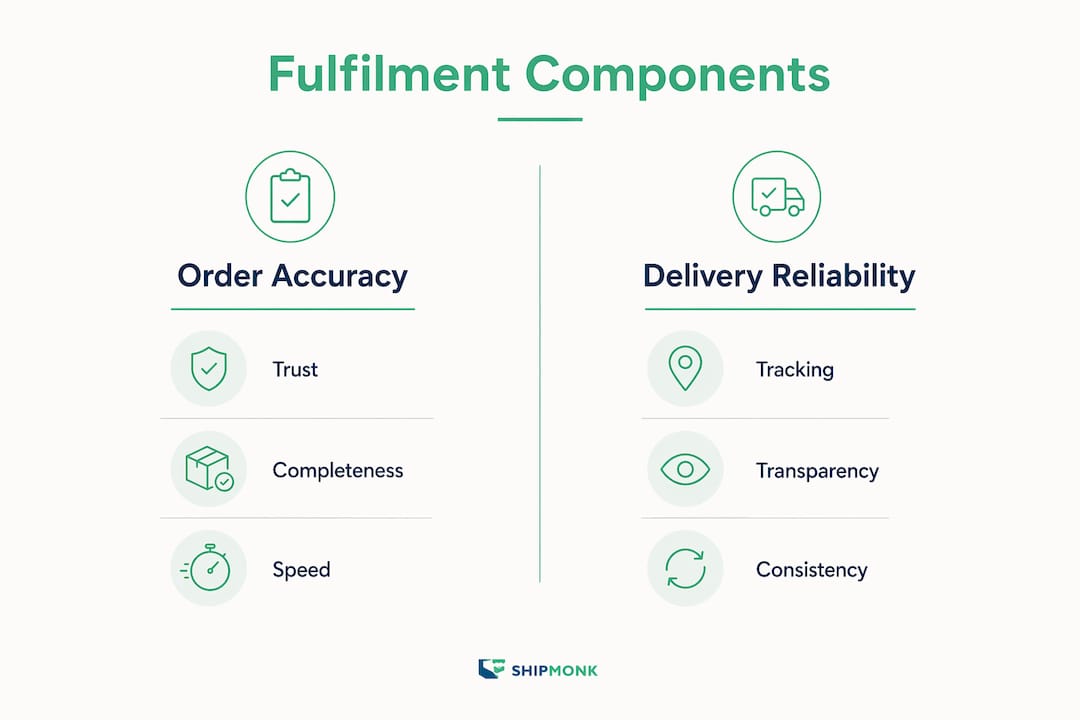
What are the key fulfilment components that drive customer retention?
Order accuracy is the foundation of customer trust. When a customer receives the wrong item or an incomplete order, the damage to their confidence is disproportionate to the error itself. 3PL partners maintaining 99%+ accuracy rates transform fulfilment from a backend function into a genuine loyalty driver. That level of precision signals to customers that your operation is dependable, and dependability is what earns repeat business.
Delivery speed matters, but reliability matters more. Nearly half of online shoppers track order updates and expect delivery within a defined schedule. This means that clear, accurate delivery windows outperform vague promises of “fast shipping.” When customers know exactly when to expect their order, their anxiety drops and their confidence in your brand rises.
Real-time order tracking is now a baseline expectation, not a premium feature. Transparent order tracking reduces support queries and increases perceived reliability, which directly supports retention. Customers who can monitor their parcel’s progress are far less likely to contact your support team in frustration, and far more likely to reorder.
Returns design is where many brands lose customers they should have kept. Well-designed return policies reduce revenue leakage and strengthen goodwill. A returns process that feels punitive, complicated, or slow signals to the customer that you only care about the sale, not the relationship.
- Order accuracy: Even a single fulfilment error can break customer trust permanently. Invest in warehouse management systems that cross-check orders before despatch.
- Delivery transparency: Provide specific delivery windows rather than broad estimates. Customers who feel informed are more forgiving of minor delays.
- Real-time tracking: Integrate tracking notifications via SMS or email at each stage of the delivery journey.
- Returns accessibility: Make returns self-service, label-free where possible, and refund timelines clear from the outset.
Pro Tip: Audit your returns process from the customer’s perspective at least once per quarter. Time how long it takes to initiate a return, print a label, and receive a refund confirmation. Every minute of friction you remove is a retention gain.
How does fulfilment integrate with loyalty programmes to enhance repeat purchases?
The role of fulfilment in loyalty programmes is shifting from passive reward delivery to active retention strategy. Brands that integrate loyalty programme data with their fulfilment systems can offer differentiated service tiers that outperform price discounts in driving repeat purchases. A customer who receives priority processing because of their loyalty tier feels valued in a way that a 10% discount code simply cannot replicate.
Here is how to build fulfilment into your loyalty programme architecture:
- Assign priority shipping to high-tier members. High-tier members receiving faster shipping and proactive communication during stockouts creates a tangible, non-monetary benefit that reinforces their decision to remain loyal. This is the kind of treatment that generates word-of-mouth advocacy.
- Automate reward fulfilment. Automated systems handle reward distribution and real-time notifications efficiently, removing the delays that erode customer satisfaction after a reward is earned. Manual reward fulfilment creates gaps between expectation and delivery that damage programme credibility.
- Use loyalty data to personalise packaging and inserts. If your fulfilment system can read loyalty tier data, you can include tier-specific thank-you notes, early access cards, or product samples. These touches cost very little but carry significant emotional weight.
- Communicate proactively during disruptions. When stock is delayed or a courier issue arises, loyalty members should be the first to know and the first to receive a resolution. Proactive communication during problems builds more trust than flawless delivery alone.
The shift here is from transactional loyalty to experiential loyalty. Discounts attract customers; fulfilment experiences retain them. Brands that build customer loyalty through logistics understand that the post-purchase moment is where emotional connection is either cemented or lost.
Pro Tip: Connect your loyalty platform API directly to your warehouse management system so that tier status is visible at the point of pick and pack. This enables real-time, tier-aware fulfilment without manual intervention.
What are the common fulfilment challenges impacting retention, and how can they be overcome?
Vague delivery timeframes are one of the most underestimated retention risks in e-commerce. When a customer cannot predict when their order will arrive, they perceive the purchase as higher risk. That perceived risk suppresses repeat purchase intent even when the order eventually arrives on time. Specificity in delivery communication is not a nice-to-have; it is a retention mechanism.
Return friction is the second major challenge. QR-code based printerless returns markedly improve net promoter scores and repeat purchase likelihood compared to traditional return methods. The logic is straightforward: if returning a product requires printing a label, finding a box, and queuing at a post office, many customers will simply absorb the loss and never buy from you again. Removing those steps changes the emotional calculus entirely.
“Fulfilment is now regarded as a core part of loyalty strategy, with cross-functional teams co-managing the post-purchase experience to drive advocacy. Flawless delivery has become more impactful than discounts.”
The third challenge is organisational. Most fulfilment failures are not warehouse failures; they are coordination failures. Marketing promises a delivery window that operations cannot meet. A courier integration breaks and no one in the technology team is accountable for the customer impact. Shared accountability involving marketing, operations, and logistics is a critical enabler of flawless fulfilment. Without it, each team optimises for its own metrics while the customer experience suffers.
- Vague delivery windows: Implement carrier-level tracking integrations that surface real-time estimated delivery dates at checkout and in post-purchase emails.
- Return friction: Adopt printerless, QR-code based return solutions and clearly communicate the process at the point of purchase, not just after a problem arises.
- Siloed accountability: Create a post-purchase performance metric that is shared across marketing, operations, and logistics teams. Tie it to retention KPIs, not just despatch speed.
- Manual bottlenecks: Automate order confirmation, despatch notifications, and returns initiation to reduce human error and processing delays.
How can e-commerce businesses turn fulfilment into a long-term advocacy strategy?
The distinction between fulfilment as a cost centre and fulfilment as a loyalty growth lever is the most consequential strategic decision a retail brand can make. Brands that treat fulfilment as a commodity compete on price. Brands that treat it as a customer experience asset compete on loyalty, lifetime value, and advocacy.
The table below compares in-house fulfilment against partnering with a specialist 3PL provider across the dimensions that matter most for retention:
| Dimension |
In-house fulfilment |
3PL partnership |
| Order accuracy |
Dependent on internal staffing and training |
Specialist providers target 99%+ accuracy rates |
| Scalability at peak |
Requires capital investment and temporary labour |
Scales on demand without fixed cost increases |
| Real-time tracking |
Requires custom integration build |
Pre-built integrations with major courier networks |
| Returns management |
Often manual and slow |
Structured returns processing with customer-facing portals |
| Loyalty tier integration |
Requires internal development resource |
Some 3PLs offer API-level loyalty data connectivity |
The data strongly favours 3PL partnerships for brands prioritising customer satisfaction and retention at scale. The capital and operational overhead of matching specialist accuracy rates in-house is prohibitive for most growing brands.
Beyond the build-versus-partner decision, the most effective fulfilment strategies for loyalty share three characteristics. They prioritise the customer’s delivery and returns experience over internal operational convenience. They use real-time inventory visibility to set accurate expectations rather than optimistic ones. And they embed post-purchase performance into the accountability structures of every team that touches the customer relationship.
Key takeaways
Fulfilment is the most direct determinant of whether a customer returns, making it a strategic asset that demands cross-functional ownership, technology investment, and loyalty programme integration.
| Point |
Details |
| Accuracy drives trust |
3PL partners achieving 99%+ order accuracy rates convert fulfilment into a measurable loyalty driver. |
| Transparency retains customers |
Clear delivery windows and real-time tracking reduce anxiety and increase repeat purchase intent. |
| Returns are a retention tool |
Printerless, QR-code returns improve net promoter scores and reduce permanent customer loss after errors. |
| Loyalty integration adds value |
Connecting loyalty tier data to fulfilment systems enables priority service that outperforms discounts. |
| Cross-team accountability matters |
Post-purchase performance must be a shared metric across marketing, operations, and logistics teams. |
Fulfilment as a loyalty lever: what I’ve learned from the inside
Having worked closely with e-commerce brands at various stages of growth, the pattern I see most consistently is this: brands underinvest in fulfilment experience until a retention crisis forces the conversation. By that point, they have already lost customers they could have kept with relatively modest operational changes.
The insight that surprises most brand managers is how much returns design influences forward purchasing behaviour. Most teams treat returns as a cost to minimise. The brands with the strongest retention metrics treat returns as a confidence signal. A generous, frictionless returns process tells the customer that you stand behind your product. That confidence is what makes them willing to try a new product line or refer a friend.
The second lesson is about organisational structure. Fulfilment performance cannot be owned exclusively by the operations team. When marketing sets delivery expectations in campaigns that operations cannot meet, the customer pays the price. The brands I have seen build genuine loyalty through logistics are the ones where a shared post-purchase metric sits in every team’s quarterly review. That single structural change does more for retention than any technology upgrade.
The third lesson is about partnership choices. Growing brands that attempt to match specialist 3PL accuracy rates with in-house operations almost always find that the resource cost is unsustainable. The smarter move is to partner early, before fulfilment failures have already damaged your retention metrics.
— Lukasz
How Parcelplanet supports your retention strategy
If the insights in this article have prompted you to review your fulfilment operation, Parcelplanet is built precisely for this moment. As a specialist 3PL and order fulfilment provider, Parcelplanet delivers the accuracy, real-time tracking, and platform integrations that growing e-commerce brands need to turn their post-purchase experience into a retention asset.
Parcelplanet’s infrastructure handles peak-season volume spikes without compromising accuracy, integrates with major e-commerce platforms and courier networks, and supports the kind of flexible fulfilment that loyalty programme tiers demand. Whether you are scaling domestically or expanding internationally, Parcelplanet provides the operational foundation your retention strategy requires. Get in touch today for a tailored quote.
FAQ
What is the role of fulfilment in customer retention?
Fulfilment directly determines whether a customer trusts your brand enough to purchase again. Accurate orders, clear delivery windows, and frictionless returns are the three fulfilment factors most strongly linked to repeat purchase behaviour.
How does delivery transparency affect customer loyalty?
Customers who receive real-time tracking updates and accurate delivery estimates report higher satisfaction and are more likely to reorder. Transparent delivery communication reduces support contacts and increases perceived brand reliability.
Can returns management improve customer retention?
Yes. Printerless, QR-code based returns significantly improve net promoter scores and repeat purchase rates compared to traditional return methods. A frictionless returns process signals brand confidence and reduces permanent customer loss after a product issue.
How do loyalty programmes benefit from fulfilment integration?
Integrating loyalty tier data with fulfilment systems allows brands to offer priority processing and proactive communication to high-value members. These non-monetary benefits retain customers more effectively than discount-based rewards alone.
When should an e-commerce brand consider a 3PL partner for retention?
A brand should consider a 3PL partner when in-house fulfilment accuracy, scalability, or returns management is creating customer experience gaps. Specialist 3PL providers offer pre-built integrations, higher accuracy rates, and scalable infrastructure that most growing brands cannot replicate cost-effectively in-house.
Recommended