TL;DR:
- Logistics is the key operational driver of customer retention, with service reliability influencing 35.4% of loyalty. Tracking OTIF weekly and ensuring proactive communication during delivery issues build trust and prevent loyalty erosion. Investing in reliable, transparent fulfillment processes significantly boosts long-term customer lifetime value and brand reputation.
Logistics is the single most direct operational driver of customer retention in e-commerce and retail. Every order a customer places is a test of your brand’s reliability, and the delivery experience is the result they judge you by. The role of logistics in customer retention goes far beyond moving parcels from A to B. It determines whether a customer buys again, recommends your brand, or quietly defects to a competitor. Research from Bain & Company confirms that acquiring a new customer costs five times more than retaining one, which means every logistics failure carries a compounding financial cost that extends well beyond the immediate transaction.
Which logistics factors most influence customer retention?
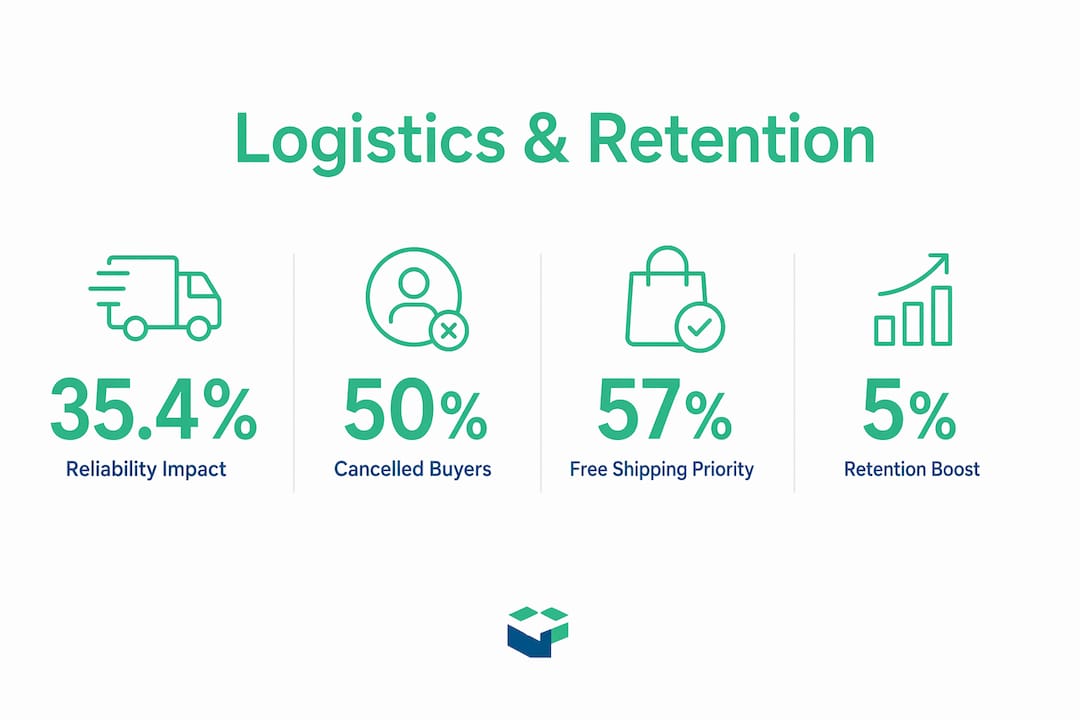
Service reliability is the dominant driver of customer loyalty in logistics, accounting for 35.4% of loyalty influence, followed by customer satisfaction at 26.6% and service value at 19.0%. These figures come from a 2026 systematic literature review of 79 scientific articles on corporate logistics loyalty. Taken together, they confirm that operational consistency, not price or speed, is what keeps customers coming back.
The industry term for this operational consistency is OTIF: on-time in full. OTIF measures whether an order arrives at the right time and contains exactly what was ordered. When OTIF rates are high, customers experience your brand as trustworthy. When they drop, even occasionally, the damage to loyalty is disproportionate to the scale of the failure.
- Service reliability (35.4% loyalty influence): Consistent, accurate fulfilment across every order builds the trust that underpins repeat purchasing.
- Customer satisfaction (26.6%): Satisfaction acts as the intermediary between a good delivery experience and a repeat purchase decision.
- Service value (19.0%): Customers weigh the perceived value of the delivery experience against what they paid, including shipping costs and returns ease.
- Operational fundamentals: Accurate picks, inventory availability, carrier handoffs, and consistent delivery form the foundation of loyalty-focused logistics.
Pro Tip: Track your OTIF rate weekly, not monthly. A monthly view masks short-term spikes in failures that erode customer trust before you have a chance to respond.
The supply chain and customer loyalty connection is not abstract. When your warehouse picks the wrong SKU, when a carrier misses a delivery window, or when a customer receives a damaged item, the loyalty cost is immediate. Customers do not separate “the courier’s fault” from “your brand’s fault.” They hold you accountable for the entire experience.
Delivery quality outperforms speed as a loyalty driver, and the data is unambiguous. According to Bringg’s 2026 Delivery Experience Study of over 1,000 consumers, on-time arrival and a responsive experience rank higher in loyalty importance than how fast the delivery was. This is a critical distinction for e-commerce owners who invest heavily in next-day or same-day marketing.
Speed marketing can backfire when it sets expectations that your fulfilment operation cannot consistently meet. A customer who expects next-day delivery and receives it 70% of the time will be more frustrated than a customer who expects two-day delivery and receives it 98% of the time. Reliability builds trust; speed without reliability destroys it.
“Customers prefer realistic delivery promises supported by proactive communication during delays over ambitious speed claims that lead to broken expectations.” — Bringg, 2026 Delivery Experience Webinar
The role of delivery in customer retention becomes most visible when something goes wrong. Bringg’s 2026 survey of 1,040 consumers found that 54% abandoned a brand when support after a delivery issue was inadequate, and 42% stopped shopping after a single late delivery. These are not marginal losses. They represent nearly half your customer base walking away after one poor experience.
Responsive communication during exceptions, such as a missed delivery window or a delayed shipment, is the primary tool for reducing that churn. Customers who receive proactive updates during a delay are significantly more likely to remain loyal than those who discover the problem themselves. The communication gap during delivery windows, including unclear access instructions and absent real-time updates, is the leading cause of delivery failures according to Cigo platform analytics.
What is the financial impact of logistics failures on retention?
Logistics failures carry a direct and measurable financial cost that most e-commerce owners underestimate. A failed delivery reattempt costs approximately £14 per attempt, and each customer service inquiry generated by a delivery problem adds £4 to £8 in overhead. These costs accumulate quickly across high-order volumes.
The more significant cost, however, is retention loss. Bain & Company’s research establishes that the long-term revenue lost from a churned customer far exceeds the direct operational cost of the failure that caused the churn. A customer with a lifetime value of £500 who defects after one poor delivery represents a loss that no reattempt fee can capture.
| Failure type |
Direct cost |
Retention cost |
| Failed delivery reattempt |
~£14 per attempt |
Churn risk if unresolved |
| Customer service inquiry |
£4–£8 per contact |
Loyalty erosion if slow |
| Late delivery (no recovery) |
Minimal direct cost |
42% stop buying (Bringg, 2026) |
| Inadequate post-delivery support |
Staff time overhead |
54% abandon the brand |
Retention-focused logistics justifies spending on prevention and rapid resolution. Investing in real-time tracking, proactive exception alerts, and trained customer service teams is not a cost centre. It is a retention mechanism that protects lifetime value.
Pro Tip: Calculate your average customer lifetime value before setting your logistics budget. If a customer is worth £400 over three years, spending £20 more per order on reliable fulfilment is a straightforward return on investment.
The importance of logistics in retention is clearest when you model the compounding effect. A 5% improvement in retention rates can increase profits by 25% to 95%, according to Bain & Company’s foundational research on customer loyalty. Logistics is one of the few operational levers that directly influences that retention rate at scale.
How do shipping policies and returns affect customer loyalty?
Shipping cost transparency and returns ease are two of the most underestimated factors in customer loyalty. Bizrate Insights’ 2026 survey of 1,000 consumers found that free shipping is the number one driver of online purchase decisions at 57%, ahead of lowest price at 45%. Free shipping is not just a marketing tactic. It is a retention signal that communicates value and reduces friction at checkout.
The reverse is equally powerful. Unexpected fees at checkout cause immediate abandonment, and paid return policies cause long-term defection. The same Bizrate survey found that 72% of shoppers drop off when faced with unexpected return costs, and 52% actively switch to a competitor offering free returns.
- Free shipping thresholds: Setting a minimum order value for free shipping (for example, £40) increases average order value while meeting customer expectations.
- Transparent fee communication: Display all shipping costs before the final checkout step. Surprise fees at payment are the leading cause of cart abandonment.
- Free or low-cost returns: Treat return logistics as a reverse logistics investment. Customers who return easily are more likely to repurchase.
- Flexible delivery options: Offering click-and-collect, nominated day delivery, or locker pickup reduces failed deliveries and increases satisfaction.
| Policy |
Positive retention impact |
Negative retention impact |
| Free shipping above threshold |
Higher AOV, lower abandonment |
None if threshold is reasonable |
| Paid returns |
Short-term cost saving |
52% defect to competitors |
| Surprise checkout fees |
None |
Immediate cart abandonment |
| Flexible delivery options |
Fewer failed deliveries |
Requires carrier integration |
Return logistics is a reverse logistics strategy that directly affects repeat purchasing. A customer who returns an item easily and receives a prompt refund is a customer who trusts your brand enough to buy again. A customer who struggles through a paid, complicated return process is a customer you have likely lost.
How can e-commerce owners optimise logistics for stronger retention?
Optimising logistics for retention requires treating delivery performance as a customer experience metric, not just an operational one. The brands with the strongest loyalty invest in on-time delivery, flexibility, and rapid problem resolution rather than competing solely on speed or price. Here is a practical framework for e-commerce and retail owners:
- Set OTIF as your primary fulfilment KPI. Track on-time in full rates weekly and set a minimum acceptable threshold, typically 95% or above. Treat any week below that threshold as a retention risk event requiring immediate investigation.
- Build exception management into your operations. When a delivery fails, the recovery speed determines whether you retain the customer. Automate alerts to your customer service team the moment a delivery exception is flagged by your carrier.
- Invest in real-time tracking and proactive communication. Customers who receive real-time updates during their delivery window report significantly higher satisfaction than those who do not, even when the delivery is delayed.
- Align your free shipping threshold with your average order value. If your AOV is £45, a free shipping threshold of £40 is a retention tool. If it is set at £80, it becomes a barrier.
- Treat returns as a loyalty investment. Audit your returns process annually. If customers report friction, the cost of fixing it is lower than the cost of losing them.
- Partner with a fulfilment provider that treats OTIF and exception recovery as retention KPIs. Your 3PL partner’s operational standards directly determine your customers’ experience.
Enhancing retention through logistics is not a one-time project. It is an ongoing operational discipline that requires consistent measurement, honest reporting, and a willingness to invest in reliability over short-term cost savings.
Key takeaways
Logistics reliability, not speed, is the primary driver of customer retention in e-commerce and retail, with service reliability accounting for 35.4% of loyalty influence and delivery failures causing up to 54% of customers to abandon a brand.
| Point |
Details |
| Service reliability drives loyalty |
Reliability accounts for 35.4% of loyalty influence, outranking speed and price. |
| OTIF is a retention metric |
Track on-time in full rates weekly to identify and resolve retention risks early. |
| Delivery failures have compounding costs |
A failed reattempt costs ~£14, but the long-term retention loss is far greater. |
| Free shipping and easy returns retain customers |
57% cite free shipping as their top purchase driver; 52% defect over paid returns. |
| Service recovery prevents churn |
54% of customers abandon a brand when post-delivery support is inadequate. |
Why speed alone will never be enough: a practitioner’s view
I have worked with e-commerce brands that spent significant budget marketing next-day delivery, only to see their repeat purchase rates stagnate or decline. The pattern is consistent. Speed attracts first-time buyers. Reliability retains them.
The uncomfortable truth is that OTIF is a more honest measure of your brand’s promise than your fastest delivery option. When I audit a brand’s logistics performance, I look at OTIF first. A brand hitting 98% OTIF on three-day delivery will almost always outperform a brand hitting 80% OTIF on next-day delivery in terms of long-term customer loyalty.
What I also see consistently is that brands underinvest in communication during exceptions. A delayed parcel handled with a proactive message and a small goodwill gesture retains the customer. The same delay handled with silence loses them. The technology to automate this exists and is accessible to businesses of all sizes. The decision not to use it is a retention decision, whether you frame it that way or not.
My advice to any e-commerce owner reading this: stop treating logistics as a back-office function. Your delivery experience is your brand experience for the majority of your customers. Treat it accordingly.
— Lukasz
How Parcelplanet supports logistics-driven customer retention
If the research in this article has highlighted gaps in your current fulfilment operation, Parcelplanet is built to close them.

Parcelplanet’s order fulfilment services are designed specifically for e-commerce and omnichannel brands that need reliable, accurate, and scalable delivery performance. From real-time tracking and carrier integrations to flexible SKU handling and exception management, Parcelplanet treats every fulfilment metric as a customer retention metric. Whether you are managing high order volumes, expanding into new regions, or simply need a 3PL partner that prioritises OTIF, Parcelplanet has the infrastructure and expertise to support your growth. Get in touch for a tailored quote today.
FAQ
What is the role of logistics in customer retention?
Logistics directly determines whether customers buy again by shaping their delivery experience. Service reliability accounts for 35.4% of customer loyalty in logistics, making it the single most influential operational factor in retention.
How do delivery failures affect customer loyalty?
Delivery failures cause significant and rapid loyalty loss. Bringg’s 2026 survey found that 50% of shoppers stopped buying from a brand after a negative delivery experience, and 42% left after a single late delivery.
Is free shipping important for customer retention?
Free shipping is the number one driver of online purchase decisions at 57%, ahead of lowest price. Unexpected return costs cause 72% of shoppers to abandon a purchase, making transparent shipping and returns policies a direct retention tool.
What does OTIF mean and why does it matter for retention?
OTIF stands for on-time in full, measuring whether orders arrive on schedule and complete. It is the most direct operational KPI for customer retention because it tracks whether your brand keeps its delivery promise on every order.
Focus on three fundamentals: track OTIF weekly, automate exception alerts to your customer service team, and communicate proactively with customers during any delivery delay. These steps address the most common causes of loyalty loss without requiring large capital investment.
Recommended


