TL;DR:
- Shipping insurance provides full protection for goods in transit, covering their full invoice value against loss, theft, or damage. It offers broader coverage than carrier liability caps, ensures faster claims with proper documentation, and is cost-effective for e-commerce businesses of any size. Proper management and thorough documentation significantly increase the likelihood of claim success and financial recovery.
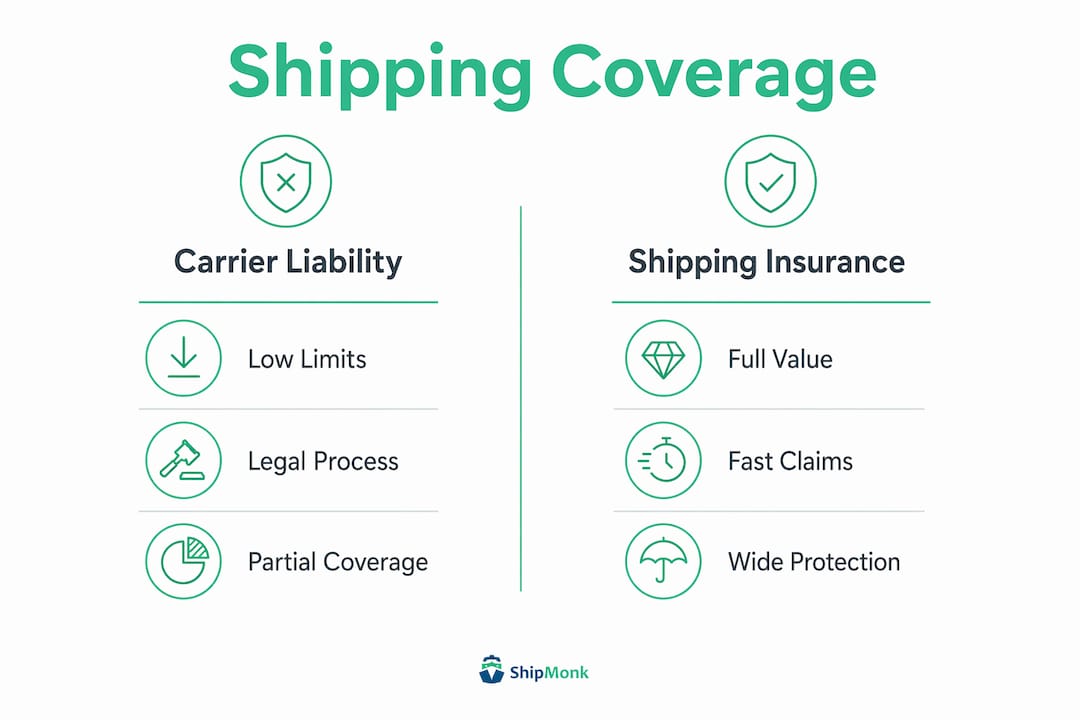
Shipping insurance is defined as a financial protection policy that covers the full commercial invoice value of goods in transit against loss, theft, or damage. Carrier liability, governed by conventions such as the Hague-Visby Rules, caps compensation at just 2 SDR per kilogram or £500 per package. Those limits cover a fraction of what most e-commerce shipments are actually worth. The role of shipping insurance is to close that gap, giving your business a reliable financial backstop when transit goes wrong. Whether you ship domestically or internationally, understanding cargo insurance, the recognised industry term for this coverage, is one of the most important decisions you will make as a logistics manager or e-commerce owner.
How does shipping insurance work in practice?
Shipping insurance coverage falls into two main categories. All-risk policies, governed by Institute Cargo Clauses (ICC) Clause A, cover virtually every peril except those specifically excluded. Named-perils policies, governed by ICC Clause C, cover only the risks listed in the policy document. 59% of exporters opt for all-risk coverage, particularly for high-value goods. That preference reflects a clear industry consensus: broader protection is worth the marginally higher premium.
The most frequent causes of claims include theft, wetting, contamination, and mishandling. These four categories account for over 40% of all cargo insurance claims. That figure tells you that routine transit events, not freak accidents, drive the majority of losses. Your policy needs to cover the ordinary risks, not just the dramatic ones.
Every policy carries exclusions. The two most common are inherent vice (goods that deteriorate by their own nature) and inadequate packaging. Inadequate packaging is a leading cause of claim denials, and insurers require photographic evidence of proper packing to validate a claim. This is not a technicality. It is the single most controllable factor in whether your claim succeeds.
What the claims process requires
When a loss occurs, the clock starts immediately. Claim success improves dramatically when you notify your insurer and gather evidence within 24–48 hours of discovering the loss. The documentation you need includes:
- Photographs taken at origin, showing goods and packaging condition
- Seal numbers recorded at loading
- Delivery exception notes from the carrier
- The commercial invoice and packing list
- A survey report from an independent loss adjuster where required
Once a claim is settled, the insurer typically pursues the carrier through subrogation, recovering costs where carrier fault can be proved. You receive your compensation regardless of that process.
Pro Tip: Take photographs of every shipment before it leaves your warehouse. This single habit resolves the majority of packaging disputes and protects your claim from the outset.

Why carrier liability is not enough for e-commerce shipments
Carrier liability is the legal obligation a carrier holds to compensate for goods lost or damaged in its care. The problem is that the compensation limits are set by international conventions written decades ago, not by the current value of your products.
Under the Hague-Visby Rules, liability is capped at 2 SDR per kilogram or £500 per package. On a shipment of electronics or fashion goods worth tens of thousands of pounds, that limit covers between 5% and 30% of actual cargo value. The remaining 70%–95% of your shipment’s value is simply uninsured.
Carrier liability caps were designed to protect carriers, not cargo owners. They reflect the economics of shipping at the time conventions were drafted, not the commercial realities of modern e-commerce. Relying on them is not a risk management strategy. It is an unacknowledged financial exposure sitting inside every shipment you send.
Proving carrier fault adds another layer of difficulty. Even when fault is clear, the legal process of establishing liability is time-consuming and uncertain. Cargo insurance removes that dependency entirely. You file a claim with your insurer, not a lawsuit against a carrier.
General Average events illustrate the risk most starkly. When a vessel encounters an emergency at sea, maritime law requires all cargo owners to share the cost of saving the ship and its remaining cargo. Without cargo insurance, you may have to post a large cash bond before your goods are released, even if your specific cargo suffered no damage. That liability is covered automatically under a standard cargo insurance policy.
| Risk scenario |
Carrier liability covers |
Cargo insurance covers |
| Theft of full container |
£500 per package cap |
Full commercial invoice value |
| Water damage in transit |
Partial, fault dependent |
All-risk: covered in full |
| General Average event |
Not covered |
Cash bond and contribution |
| Mishandling damage |
Requires proof of fault |
Covered without proving fault |
| Delay-related spoilage |
Rarely covered |
Covered with reefer endorsement |
What does shipping insurance cost, and is it worth it?
Cargo insurance typically costs between 0.1% and 0.5% of the total insured shipment value. On a £100,000 shipment, a 0.25% premium costs £250. That £250 buys coverage for the full commercial invoice value. The alternative is absorbing a potential £100,000 loss from your operating budget.
The benefits of cargo insurance extend beyond simple loss recovery:
- Financial protection. You recover the full invoice value of lost or damaged goods, not a fraction of it.
- Business continuity. A single large uninsured loss can disrupt cash flow for months. Insurance converts that unpredictable event into a manageable, budgeted expense.
- Access to trade finance. Banks and lenders often require proof of insurance for goods in transit before extending credit facilities. Insurance is a prerequisite for growth capital in many trade relationships.
- Supplier and buyer confidence. Insured shipments signal professionalism and reduce disputes when goods arrive damaged.
- Supply chain stability. Shifting unpredictable transit losses into a fixed, predictable premium cost makes your financial planning more reliable.
The strategic value of cargo insurance as a stability tool is increasingly recognised by logistics managers who treat it as a line item in their risk management budget, not an optional add-on. The maths are straightforward: a premium that costs less than half a percent of shipment value is one of the most cost-effective risk transfers available in logistics.
Practical tips for choosing and managing your coverage
Selecting the right policy requires more than picking the cheapest premium. The decisions you make at the outset determine whether your coverage actually pays out when you need it.
- Insure for full invoice value plus freight, and add 10%. The additional 10% accounts for anticipated profit and the cost of replacement sourcing. Underinsuring leaves a gap that no claim can recover.
- Choose all-risk (ICC Clause A) for high-value shipments. Named-perils policies are cheaper but leave significant gaps. For e-commerce insurance options, all-risk coverage is the standard recommendation for goods above a low-value threshold.
- Document packaging at origin. Photograph goods before packing, during packing, and after sealing. Photographic evidence at origin is the single most effective defence against packaging-related claim denials.
- Add endorsements for your route and cargo type. War and strikes clauses, reefer (refrigeration) clauses, and inland transit extensions are not standard in all policies. Check your route and cargo against available endorsements.
- Notify your insurer immediately on discovery of loss. The 24–48 hour window for notification and evidence gathering is not advisory. Missing it materially reduces your chance of a successful claim.
- Work with a logistics partner who understands claims discipline. The logistics and claims management process requires operational discipline at every stage, from loading to delivery.
Pro Tip: Keep a standardised pre-shipment checklist that captures seal numbers, packaging condition, and photographic records for every consignment. Consistency across shipments makes claim preparation faster and more reliable.
Key takeaways
Shipping insurance is the most cost-effective risk transfer available to e-commerce businesses, covering the full invoice value of goods for a premium that typically represents less than half a percent of shipment value.
| Point |
Details |
| Carrier liability is insufficient |
Hague-Visby caps leave 70%–95% of cargo value uninsured in most loss scenarios. |
| All-risk coverage is the standard |
ICC Clause A policies cover the broadest range of perils and suit high-value e-commerce shipments. |
| Documentation determines claim success |
Photos, seal numbers, and exception notes gathered within 24–48 hours are the difference between a paid and a denied claim. |
| Cost is minimal relative to exposure |
A 0.25% premium on a £100,000 shipment costs £250 and covers the full commercial invoice value. |
| Insurance enables trade finance |
Banks frequently require proof of cargo insurance before extending credit for goods in transit. |
Why I think most e-commerce businesses underestimate this risk
ChiefPlaneteer’s perspective
After working with hundreds of e-commerce brands on their logistics operations, the pattern I see most often is this: businesses spend weeks negotiating courier rates and days designing packaging, then spend about ten minutes on insurance. That imbalance is a mistake.
The misconception I encounter most is that carrier liability provides meaningful protection. It does not. The limits were set by conventions that predate modern e-commerce entirely. A £500 per package cap made sense when packages contained low-value industrial goods. It makes no sense for a shipment of premium skincare, electronics, or fashion goods.
What I have also observed is that claim outcomes are almost entirely predictable. Businesses that document every shipment thoroughly, notify insurers quickly, and treat insurance as an operational discipline rather than a paperwork exercise recover their losses. Businesses that treat insurance as a box-ticking exercise find their claims disputed or denied.
The competitive advantage here is real. When your supply chain absorbs a loss without disrupting cash flow or customer fulfilment, you operate from a position of stability that underprepared competitors cannot match. Cargo insurance, managed well, is not a cost. It is a structural advantage.
— ChiefPlaneteer
How Parcelplanet supports your shipping protection
Protecting your shipments starts before a parcel leaves the warehouse. Parcelplanet’s order fulfilment services are built around the operational disciplines that make insurance coverage work: accurate documentation, careful packing, real-time tracking, and courier integrations that create a clear audit trail for every consignment.

When you partner with Parcelplanet, your fulfilment process is designed to support successful claims from the outset. Every shipment is handled with the documentation standards that insurers require, reducing the risk of denial and giving you confidence that your coverage will pay out when it matters. If you are ready to build a fulfilment operation that takes shipping risk management seriously, get in touch with the Parcelplanet team for a tailored quote.
FAQ
What is the role of shipping insurance in e-commerce?
Shipping insurance covers the full commercial invoice value of goods lost, stolen, or damaged in transit. It closes the gap left by carrier liability limits, which typically cover only 5%–30% of actual cargo value.
How does shipping insurance differ from carrier liability?
Carrier liability is capped by international conventions such as the Hague-Visby Rules at 2 SDR per kilogram or £500 per package. Cargo insurance covers the full declared value without requiring you to prove carrier fault.
What types of shipping insurance are available?
The two main types are all-risk policies (ICC Clause A), which cover most perils except specific exclusions, and named-perils policies (ICC Clause C), which cover only the risks listed. All-risk coverage is recommended for high-value e-commerce shipments.
How do I make a successful shipping insurance claim?
Notify your insurer within 24–48 hours of discovering a loss and submit photographs, seal numbers, delivery exception notes, and the commercial invoice. Timeliness and documentation quality are the primary factors in claim success.
Is shipping insurance necessary for small e-commerce businesses?
Cargo insurance is cost-effective at any shipment volume, with premiums typically between 0.1% and 0.5% of shipment value. Even a single uninsured loss on a modest shipment can exceed the total annual premium cost many times over.
Recommended