TL;DR:
- Wholesale fulfilment manages bulk order processing and delivery for business clients at scale. It relies on EDI document compliance, accurate inventory management, and multi-SKU workflows to meet retailer expectations. Outsourcing to specialized third-party providers enhances operational efficiency, scalability, and compliance for growing brands.
Wholesale fulfilment is defined as the end-to-end management of bulk order processing, from order intake through to delivery, for business clients such as retailers and distributors. The role of wholesale fulfilment sits at the heart of any e-commerce supply chain that serves B2B customers at scale. Standard operations in 2026 require managing complex EDI document sets including Purchase Orders (850), Order Changes (860), Advance Ship Notices (856), and Invoices (810). These documents are not administrative formalities. They are the digital compliance backbone that major retail partners demand before they will process a single shipment. Parcelplanet supports e-commerce brands in meeting these requirements, making wholesale fulfilment both accessible and operationally sound.
What is the role of wholesale fulfilment in the supply chain?
Wholesale fulfilment acts as the intermediary between manufacturers and the retailers or distributors who sell to end consumers. Without this function, bulk orders would stall at the point of manufacture, unable to reach the shelves or warehouses of retail partners efficiently.
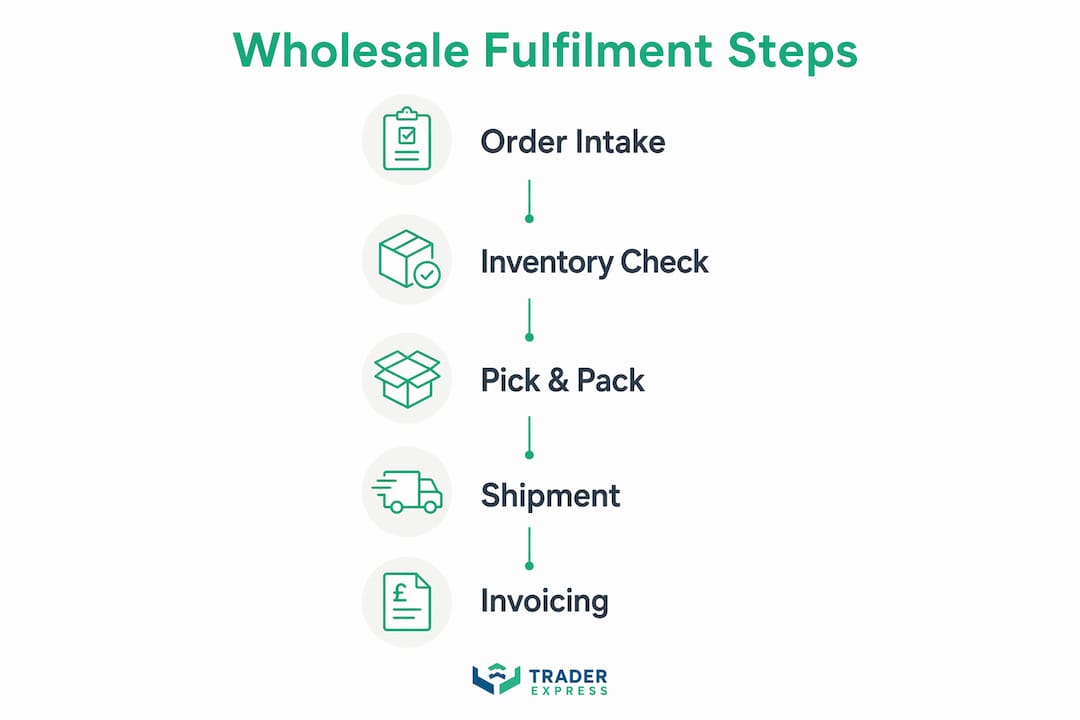
The core tasks within wholesale fulfilment cover five distinct areas:
- Order processing: Receiving and validating purchase orders, typically via EDI 850 documents, and confirming stock availability before committing to fulfilment.
- Inventory management: Allocating stock accurately across orders, tracking availability in real time, and preventing overselling or shortfalls.
- Packaging and labelling: Preparing goods to meet retailer-specific routing guide requirements, including carton labels, packing slips, and compliance markings.
- Shipping and despatch: Coordinating carrier bookings, generating Advance Ship Notices (EDI 856), and managing outbound logistics to multiple destinations.
- Invoicing: Issuing EDI 810 invoices that match the agreed purchase order terms to avoid payment disputes and chargebacks.
What separates wholesale fulfilment from retail fulfilment is volume and complexity. A single wholesale purchase order may contain hundreds of SKUs destined for multiple distribution centres. Retail fulfilment, by contrast, typically handles individual consumer orders going to a single address.
Effective coordination between sales, inventory, operations, and finance departments is critical to managing wholesale order lifecycles successfully. When these teams operate in silos, orders slip, invoices are disputed, and retailer relationships suffer.
Pro Tip: Map your order lifecycle from EDI 850 receipt to EDI 810 invoice before you select a fulfilment partner. Any gap in that chain will become a chargeback.
What are the key benefits of wholesale fulfilment?
Effective wholesale fulfilment delivers measurable advantages across every part of your supply chain. The gains are not marginal. They compound over time as order volumes grow and retailer expectations rise.
The most significant benefits include:
- Accuracy at scale: EDI validation catches document errors before they reach the retailer, reducing chargebacks and routing guide violations that erode margins.
- Cost efficiency: Optimised inventory allocation and shipping routing cut unnecessary freight spend. Stock placed closer to demand points ships faster and cheaper.
- Scalability: A well-structured wholesale fulfilment operation handles seasonal demand spikes without requiring proportional increases in headcount or warehouse space.
- Retailer satisfaction: Real-time tracking of outbound shipments and prompt resolution of delivery discrepancies maintain high service levels and protect long-term retail partnerships.
- Operational focus: Outsourcing fulfilment to a specialist provider frees your internal team to focus on product development, sales, and customer relationships.
Outsourcing wholesale fulfilment to specialist third-party logistics providers offers enhanced operational efficiency, scalability, and expert compliance management. Third-party providers bring advanced systems and B2B fulfilment expertise that most growing brands cannot replicate in-house at a comparable cost.
Monitoring KPIs such as order processing accuracy, fulfilment performance, on-time delivery, and invoicing timelines drives operational excellence. Continuous KPI tracking identifies bottlenecks before they become retailer complaints.

What are the main challenges in wholesale fulfilment?
Wholesale fulfilment carries a distinct set of operational pressures that do not exist in direct-to-consumer logistics. Understanding them is the first step to managing them.
Handling multi-SKU purchase orders
Large purchase orders containing dozens or hundreds of SKUs require precise pick-and-pack workflows. A single mispick can trigger a retailer chargeback that wipes out the margin on an entire order.
Maintaining EDI compliance
Retailer EDI requirements change. A routing guide update from a major retail partner can invalidate your current document templates overnight. EDI compliance failures result in costly chargebacks and routing guide violations that damage supplier scorecards.
Inventory visibility across channels
Brands selling through both wholesale and direct-to-consumer channels face constant allocation conflicts. Without a unified inventory view, the same stock gets promised to two buyers simultaneously.
Managing returns and authorisations
Wholesale returns are more complex than consumer returns. Retailers issue Return Merchandise Authorisations (RMAs) with specific conditions, and processing them incorrectly creates credit note disputes.
How technology addresses these challenges is straightforward. Automation platforms that centralise order intake and perform validation reduce manual errors and accelerate wholesale order processing. Unified workflows handling procurement platforms and marketplaces improve fulfilment reliability.
Pro Tip: Integrate your fulfilment automation tools with your EDI layer before you scale. Fixing integration gaps under high order volume is significantly more costly than building them correctly from the start.
The table below shows how common wholesale fulfilment challenges map to technology-driven solutions:
| Challenge |
Technology solution |
| Multi-SKU order errors |
Automated pick validation and barcode scanning |
| EDI document failures |
Real-time EDI validation and error alerts |
| Inventory allocation conflicts |
Unified inventory management across all channels |
| Shipment discrepancy resolution |
Real-time outbound tracking with exception alerts |
| Returns processing delays |
Automated RMA workflows with credit note generation |
KPI dashboards tracking backorders, allocation accuracy, and shipment performance enable continuous improvement and operational transparency. Stakeholders make better decisions when they can see performance data in real time rather than reviewing it weekly in a spreadsheet.
Best practices for wholesale fulfilment operations
Getting wholesale fulfilment right requires deliberate process design, not just good intentions. The following practices separate high-performing wholesale operations from those that struggle under growth pressure.
Establish cross-departmental communication. Coordinated workflows between sales, inventory, operations, and finance prevent supply chain delays and ensure accurate order fulfilment and invoicing. A weekly order review meeting between these four functions catches problems before they escalate.
Invest in EDI capabilities. EDI is not optional for brands selling to major retailers. Build or buy EDI capability that covers the full document set: 850, 860, 856, and 810. Partial EDI compliance creates gaps that retailers will penalise.
Adopt a multi-warehouse strategy. Strategically locating stock closer to demand points enhances fulfilment speed and reduces freight costs. A single central warehouse works at low volume. At scale, it becomes a bottleneck.
Monitor the right KPIs. Order accuracy, on-time delivery, invoice timeliness, and backorder rate are the four metrics that matter most in wholesale fulfilment. Track them weekly, not monthly.
Integrate procurement and marketplace channels. Integrating procurement platforms and indirect sales channels into a unified workflow prevents siloed data and improves wholesale fulfilment efficiency. A single platform approach simplifies order routing and validation across multiple B2B channels.
Partner with a specialist 3PL. Growing brands consistently underestimate the operational complexity of wholesale fulfilment. A specialist provider brings warehouse infrastructure, carrier relationships, and compliance expertise that takes years to build internally. You can read more about the common fulfilment obstacles that growing companies face when they attempt to manage this in-house.
The logistics sector also operates within specific regulatory and employment frameworks. Understanding transport and logistics compliance requirements in your operating region affects how you structure warehouse staffing and carrier contracts.
Key takeaways
Wholesale fulfilment is the operational function that determines whether your B2B supply chain delivers on its commercial promises, and the brands that treat it as a core capability consistently outperform those that treat it as an afterthought.
| Point |
Details |
| EDI compliance is non-negotiable |
Managing EDI documents (850, 856, 860, 810) is required to meet major retailer standards and avoid chargebacks. |
| KPI tracking drives improvement |
Monitoring order accuracy, on-time delivery, and invoice timeliness identifies bottlenecks before they become costly. |
| Technology reduces errors at scale |
Automation platforms centralise order intake and validation, cutting manual errors across high-volume wholesale workflows. |
| Multi-warehouse strategy reduces risk |
Placing stock closer to demand points improves speed and prevents fulfilment shortfalls during peak periods. |
| Outsourcing accelerates capability |
Specialist 3PL providers deliver compliance expertise and infrastructure that growing brands cannot replicate quickly in-house. |
Wholesale fulfilment as a competitive advantage: my view
Most e-commerce brands treat wholesale fulfilment as a back-office function. That is a costly mistake. The brands I have seen grow consistently are the ones that treat fulfilment as a commercial capability, not a cost centre.
The uncomfortable truth is that your retail partners judge you on operational performance, not just product quality. A retailer that receives accurate, on-time shipments with clean EDI documentation will reorder faster and give you better shelf placement. A supplier that generates chargebacks and shipment discrepancies gets deprioritised, regardless of how good the product is.
Data-driven decision-making is what separates the brands that scale from those that plateau. KPI dashboards are not bureaucratic overhead. They are the early warning system that tells you a process is breaking before your retail partner tells you the same thing in a chargeback notice.
The other pitfall I see repeatedly is partial technology adoption. Brands invest in a warehouse management system but leave EDI on a manual process, or they automate order intake but leave returns on a spreadsheet. Every gap in your technology stack is a gap in your service reliability. Wholesale fulfilment works as a system. Fix the whole chain, not just the parts that are currently causing pain.
— ChiefPlaneteer
How Parcelplanet supports your wholesale fulfilment operations
Parcelplanet is built for e-commerce brands that need dependable, accurate fulfilment across multiple channels and order types. Whether you are managing complex wholesale purchase orders or scaling into new retail partnerships, Parcelplanet’s order fulfilment services cover the full operational chain, from goods-in through to despatch and tracking.

Parcelplanet integrates with leading e-commerce platforms and courier services, giving you real-time visibility across your entire order flow. The team handles multi-SKU orders, retailer-specific packaging requirements, and outbound shipment coordination so your internal team can focus on growth. If you are ready to build a wholesale fulfilment operation that performs under pressure, Parcelplanet is the partner to do it with. Get in touch for a tailored quote today.
FAQ
What is wholesale fulfilment?
Wholesale fulfilment is the process of managing bulk order processing from intake to delivery for business clients such as retailers and distributors. It covers order processing, inventory management, packaging, shipping, and invoicing.
Why is EDI compliance important in wholesale fulfilment?
EDI compliance ensures seamless order flow and helps avoid costly chargebacks and routing guide violations. Major retail partners require EDI documents including Purchase Orders (850), Advance Ship Notices (856), and Invoices (810) as a condition of trading.
What KPIs should I track in wholesale fulfilment?
The most important KPIs are order processing accuracy, on-time delivery, invoice timeliness, backorder rate, and allocation accuracy. Tracking these weekly gives you the data to identify and fix bottlenecks before they affect retailer relationships.
How does outsourcing wholesale fulfilment help growing brands?
Outsourcing to a specialist third-party logistics provider gives you access to warehouse infrastructure, carrier relationships, and compliance expertise without the capital investment of building it in-house. It also allows your team to focus on sales and product development.
What is the difference between wholesale and retail fulfilment?
Wholesale fulfilment handles large, multi-SKU orders destined for multiple retail or distribution locations. Retail fulfilment handles individual consumer orders going to a single address. Wholesale operations require EDI compliance, retailer-specific packaging, and more complex inventory allocation.
Recommended


