TL;DR:
- Shipping from the UK to the EU now requires detailed customs documentation, HS codes, and proof of origin. Starting July 2026, a €3 customs duty and an additional €2 handling fee will significantly increase shipping costs and complexity. Using EU-based warehousing and automated compliance processes help businesses reduce delays, costs, and maintain customer satisfaction.
UK to EU shipping post Brexit is defined by mandatory customs declarations, import VAT, and new per-parcel duties that apply to every commercial shipment crossing the border. The old frictionless trade is gone. Every parcel now needs correct documentation, a valid Harmonised System (HS) code, and a clear commercial invoice. From july 2026, a new €3 customs duty replaces the previous €150 low-value exemption, adding direct cost to each shipment. Understanding these rules is not optional. It is the foundation of profitable cross-border e-commerce between the UK and EU.
What customs documentation is required for UK to EU shipments?
Every shipment from the UK to the EU requires a customs declaration. For low-value items, that means a CN22 or CN23 form. For commercial goods above the relevant threshold, a full commercial invoice is required alongside the customs declaration.
The commercial invoice must include the sender and receiver details, a precise product description, the declared value, and the correct HS code. Generic descriptions like “clothing” or “electronics” are not acceptable. Errors in customs forms cause immediate rejections or returns at EU borders. That means delays, unhappy customers, and additional return shipping costs.
HS codes are the backbone of customs classification. Each product category carries a specific six-digit code that determines the applicable duty rate and any import restrictions. Getting this wrong is one of the most common and costly mistakes UK sellers make.
Proof of origin is also required if you want to claim zero tariffs under the UK-EU Trade and Cooperation Agreement (TCA). Without it, your goods may attract standard import duties even if they qualify for preferential treatment. Accurate commercial invoices, HS codes, and proof of origin are all essential to avoid customs delays and additional duties.
Key documents required for every UK to EU shipment:
- CN22 or CN23 customs declaration form (depending on parcel value and weight)
- Commercial invoice with full sender and receiver details, product description, and declared value
- HS code for every product line in the shipment
- Proof of origin statement to claim TCA preferential tariff rates
- EORI number for the exporting business, registered with HMRC
Pro Tip: Keep a master product catalogue with pre-assigned HS codes for every SKU you sell. This removes the guesswork at despatch and prevents misclassification errors that trigger border holds.
How do VAT and the new €3 duty affect shipping costs UK to EU?
VAT on cross-border sales is one of the most misunderstood areas of post-Brexit logistics. UK VAT is zero-rated on exports, but import VAT applies in the destination EU country at the local rate. For B2C sellers, that VAT must be collected at the point of sale or paid by the customer on delivery.
The Import One Stop Shop (IOSS) scheme is the most practical solution for B2C sellers. IOSS allows you to register in one EU member state, collect VAT at checkout, and file a single monthly return covering all EU sales. This removes the risk of customers receiving unexpected VAT demands at the door, which is a leading cause of abandoned deliveries and returns. IOSS simplifies VAT collection significantly, but it does not exempt sellers from the new €3 customs duty.

From 1 july 2026, the EU abolishes the €150 customs duty exemption for low-value parcels. In its place, a €3 fixed duty per tariff heading applies to every parcel, regardless of value. This is a structural change, not a temporary measure.
The cost impact compounds further. An additional €2 handling fee is expected to come into effect by late 2026, bringing the total friction cost to over €5 per parcel plus VAT. For sellers operating on thin margins, this is a material hit to profitability.
| Cost component |
Amount |
Applies from |
| IOSS VAT registration |
Varies by country |
Now |
| €3 customs duty per tariff heading |
€3.00 |
1 july 2026 |
| EU ecommerce handling fee |
~€2.00 |
Late 2026 |
| Total estimated per-parcel friction cost |
€5.00+ |
Late 2026 |
Failing to budget for these costs risks margin compression that cannot be recovered through pricing adjustments alone. Model these figures into your EU pricing now, before they take effect.
What are the logistics and fulfilment options for cross-border EU delivery?
The right fulfilment model determines how much of the customs burden your business absorbs and how quickly your customers receive their orders. There is no single answer, but the options differ significantly in cost, complexity, and customer experience.
Direct shipping with customs declarations is the most straightforward model on paper. You ship from the UK, file the customs declaration, and the parcel clears the EU border. In practice, this model carries the highest administrative load and exposes every parcel to the new €3 duty and potential delays from documentation errors.
Courier services with built-in customs brokerage reduce the paperwork burden. Major courier networks handle the customs filing on your behalf, but this convenience comes at a cost. Brokerage fees add up quickly, particularly for high-volume sellers sending hundreds of parcels per week.
Pan-EU warehousing is the most effective model for businesses with consistent EU sales volume. By storing inventory inside the EU before orders are placed, you eliminate the customs declaration at point of sale entirely. EU-based fulfilment avoids customs duties and delays for both seller and buyer. The €3 duty does not apply because the goods are already inside the EU customs territory. Cross-border administrative and duty costs exceed €5 per parcel by mid-2026, making Pan-EU warehousing financially attractive for any seller shipping more than a few hundred units per month to EU customers.
Northern Ireland occupies a unique position under the Windsor Framework. Goods qualifying under the UK Internal Market Scheme can move without customs declarations to the EU, distinct from Great Britain shipments. For businesses with operations or suppliers in Northern Ireland, this is a logistics advantage worth building into your supply chain planning.
Pro Tip: If your EU sales volume justifies it, model the total annual cost of direct shipping including the €3 duty and €2 handling fee against the cost of EU warehouse storage. The break-even point is lower than most sellers expect, particularly after july 2026.
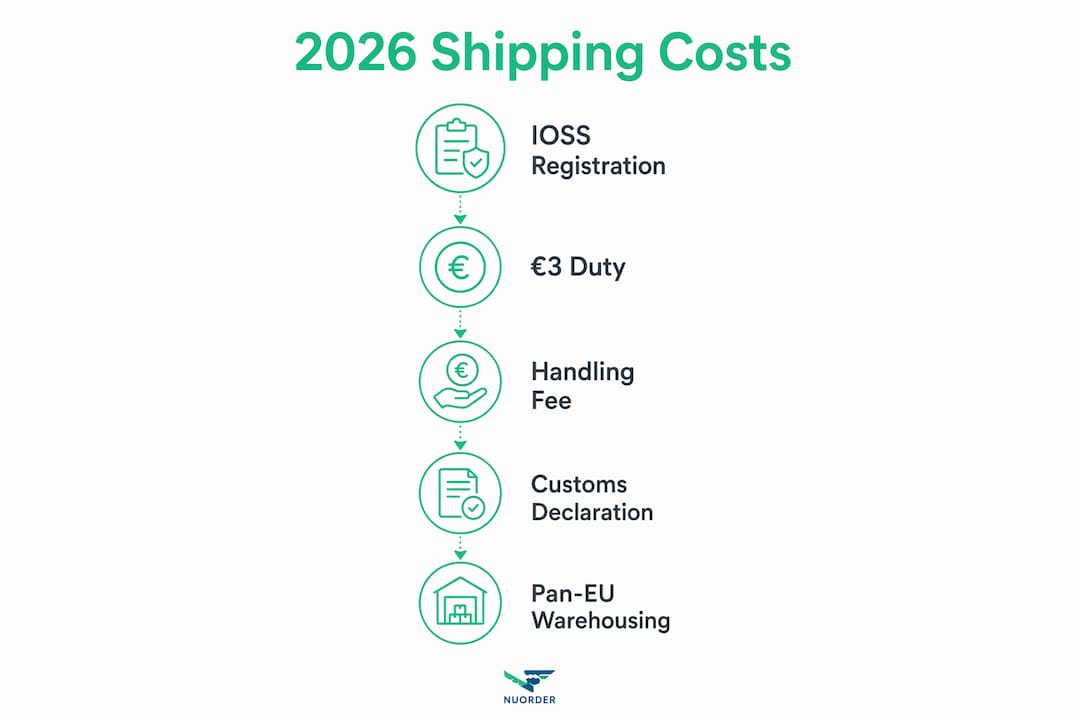
For advice on reducing shipping costs in 2026, the specific duty and fee changes are the starting point for any meaningful cost review.
How do you ensure compliance and avoid common pitfalls?
Customs compliance is now a core operational function, not an accounting afterthought. Automated customs systems reject shipments with incomplete or inaccurate forms immediately. There is no human review to catch a missing HS code or an incorrect declared value. The parcel simply stops.
The most common pitfalls UK sellers encounter when shipping to the EU:
- Misclassified HS codes. Using a broad or incorrect code triggers wrong duty rates and potential seizure of goods. Review your codes against the EU Combined Nomenclature tariff schedule regularly.
- Generic product descriptions. “Gift” or “sample” descriptions are rejected outright. Every line on the commercial invoice needs a specific, accurate description.
- Missing proof of origin. Without a valid origin statement, TCA zero-tariff rates do not apply and standard duties are charged.
- Incorrect declared values. Undervaluing goods to reduce duty is illegal and triggers penalties. Overvaluing creates unnecessary VAT charges.
- No EORI number. Every UK business exporting commercially to the EU needs an Economic Operators Registration and Identification (EORI) number from HMRC.
- Failure to retain export evidence. HMRC requires proof that goods left the UK for VAT zero-rating to apply. Keep despatch records, tracking confirmations, and customs receipts for at least six years.
Monitoring regulatory updates is equally important. The €2 handling fee expected by late 2026 is one example of a change that will affect pricing and margin if it catches businesses unprepared. Subscribe to HMRC and EU Customs updates directly, and review your customs processes at least quarterly.
Reducing return-to-origin rates is also part of compliance. Parcels rejected at the border or refused by customers due to unexpected charges drive up costs significantly. Practical guidance on cutting return-to-origin rates is directly relevant to any business managing high EU return volumes.
Key takeaways
Effective UK to EU cross-border shipping in 2026 requires accurate customs documentation, IOSS VAT registration, and a fulfilment model that accounts for the new €3 duty and upcoming €2 handling fee.
| Point |
Details |
| Customs documentation is mandatory |
Every shipment needs a CN22/CN23, commercial invoice, HS code, and proof of origin. |
| IOSS removes delivery VAT surprises |
Register for IOSS to collect EU VAT at checkout and avoid customer-facing charges on delivery. |
| €3 duty applies from july 2026 |
The old €150 low-value exemption is abolished; budget for €5+ per parcel in total friction costs by late 2026. |
| Pan-EU warehousing eliminates border duties |
Storing goods inside the EU before fulfilment bypasses the €3 duty and speeds up delivery. |
| Compliance is an operational function |
Automated border systems reject errors instantly; HS code accuracy and complete documentation are non-negotiable. |
What I have learned from watching businesses get this wrong
ChiefPlaneteer’s perspective
The businesses that struggle most with post-Brexit EU shipping are not the ones who lack resources. They are the ones who treated customs as a one-time setup task rather than an ongoing operational discipline.
I have seen well-run UK e-commerce brands invest in great products and marketing, then lose EU customers because a parcel sat at a German customs facility for two weeks due to a missing HS code. The customer did not wait. They bought from an EU-based seller instead. That is a permanent loss, not a temporary inconvenience.
The €3 duty change from july 2026 is the moment that will separate businesses that have done the work from those that have not. Sellers who have modelled their EU pricing around the old €150 exemption will face a genuine margin problem. Those who have already moved inventory into EU fulfilment centres, or who have built the new costs into their pricing, will barely notice.
My honest view is that Pan-EU warehousing is underused by mid-sized UK sellers. The upfront logistics cost feels significant, but the per-parcel savings from avoiding the €3 duty and €2 handling fee, combined with faster delivery times, make the economics work at lower volumes than most people expect. The impact of Brexit on e-commerce fulfilment has been gradual enough that many businesses have adapted incrementally rather than rethinking their model entirely. That incremental approach is now running out of road.
Northern Ireland’s position under the Windsor Framework is also genuinely underappreciated. If your supply chain can route through Northern Ireland, the customs advantages are real and material.
— ChiefPlaneteer
How Parcelplanet supports your EU fulfilment after Brexit
Managing customs paperwork, VAT registration, and EU delivery logistics alongside running your business is a significant operational load. Parcelplanet’s order fulfilment services are built specifically for UK and EU e-commerce businesses that need reliable cross-border fulfilment without the administrative burden.

Parcelplanet handles customs documentation, provides access to EU-based warehouses that eliminate border duties, and integrates directly with your e-commerce platform for accurate, real-time order processing. Pricing is transparent and includes VAT and duty considerations upfront, so there are no surprises at the border or on your margin report. If you are shipping to EU customers and want a fulfilment partner who understands the post-Brexit regulatory environment, get in touch with the Parcelplanet team for a tailored quote.
FAQ
What documents do I need to ship from the UK to the EU?
Every UK to EU commercial shipment requires a customs declaration (CN22 or CN23), a commercial invoice, a valid HS code for each product, and a proof of origin statement to claim TCA preferential tariff rates.
What is IOSS and do I need it?
IOSS (Import One Stop Shop) is an EU VAT scheme that lets B2C sellers collect VAT at checkout and file a single monthly return for all EU sales. It prevents customers from facing unexpected VAT charges on delivery, which reduces abandoned parcels and returns.
What is the new €3 customs duty and when does it start?
From 1 july 2026, the EU replaces the €150 low-value customs duty exemption with a €3 fixed duty per tariff heading on every parcel. An additional €2 handling fee is expected by late 2026, bringing total per-parcel friction costs to over €5.
How does Pan-EU warehousing reduce shipping costs?
Storing inventory inside the EU before orders are placed means goods are already within the EU customs territory. This eliminates the customs declaration at point of sale and bypasses the €3 duty entirely, reducing per-parcel costs and speeding up delivery.
Does Northern Ireland have different shipping rules to the rest of the UK?
Yes. Under the Windsor Framework, goods qualifying under the UK Internal Market Scheme can move from Northern Ireland to the EU without customs declarations. This is distinct from Great Britain shipments, which require full customs processing.
Recommended


