Warehouse inefficiencies drain profitability and frustrate customers. For e-commerce and omnichannel brands, clunky layouts, poor slotting, and outdated processes create bottlenecks that stall growth. This guide delivers practical strategies for 2026: layout redesign, slotting optimisation, technology integration, and continuous improvement practices. You’ll learn how to transform your warehouse into a scalable, efficient fulfilment engine that meets rising demand without ballooning costs.
Table of Contents
Key takeaways
| Point |
Details |
| Layout and slotting drive productivity |
Strategic redesign and data-driven product placement yield double-digit efficiency gains without massive capital investment. |
| Technology integration reduces costs |
Robotics, AI forecasting, and cloud systems streamline operations, cutting labour hours and improving accuracy. |
| Data-driven inventory control minimises waste |
Real-time insights prevent overstocks and stockouts, protecting revenue and customer satisfaction. |
| Continuous optimisation sustains performance |
Regular KPI reviews and slotting adjustments keep warehouses responsive to fluctuating SKU counts and order patterns. |
Understanding your warehouse optimisation challenges
E-commerce warehouses face relentless pressure. Rising SKU complexity, unpredictable order volumes, and customer impatience create a perfect storm of operational strain. When processes lag, profitability suffers.
Inventory distortion from overstocks and stockouts drains an estimated $1.7 trillion each year, about 7% of retail sales. That’s not just wasted capital tied up in excess stock. It’s lost sales from empty shelves and dissatisfied customers who abandon your brand.
When products are unavailable, customers rarely wait. They move to a competitor. This harsh reality means every stockout directly impacts your market share and long-term retention.
Beyond revenue, operational costs spiral when warehouses lack optimisation. Wasted space, inefficient picking routes, and manual processes consume resources without adding value. Staff spend extra hours searching for products, orders get delayed, and customer satisfaction plummets.
The challenges intensify as brands scale. More SKUs mean more complexity in storage decisions. Seasonal spikes test capacity limits. Omnichannel fulfilment demands rapid, accurate order processing across multiple sales channels simultaneously.
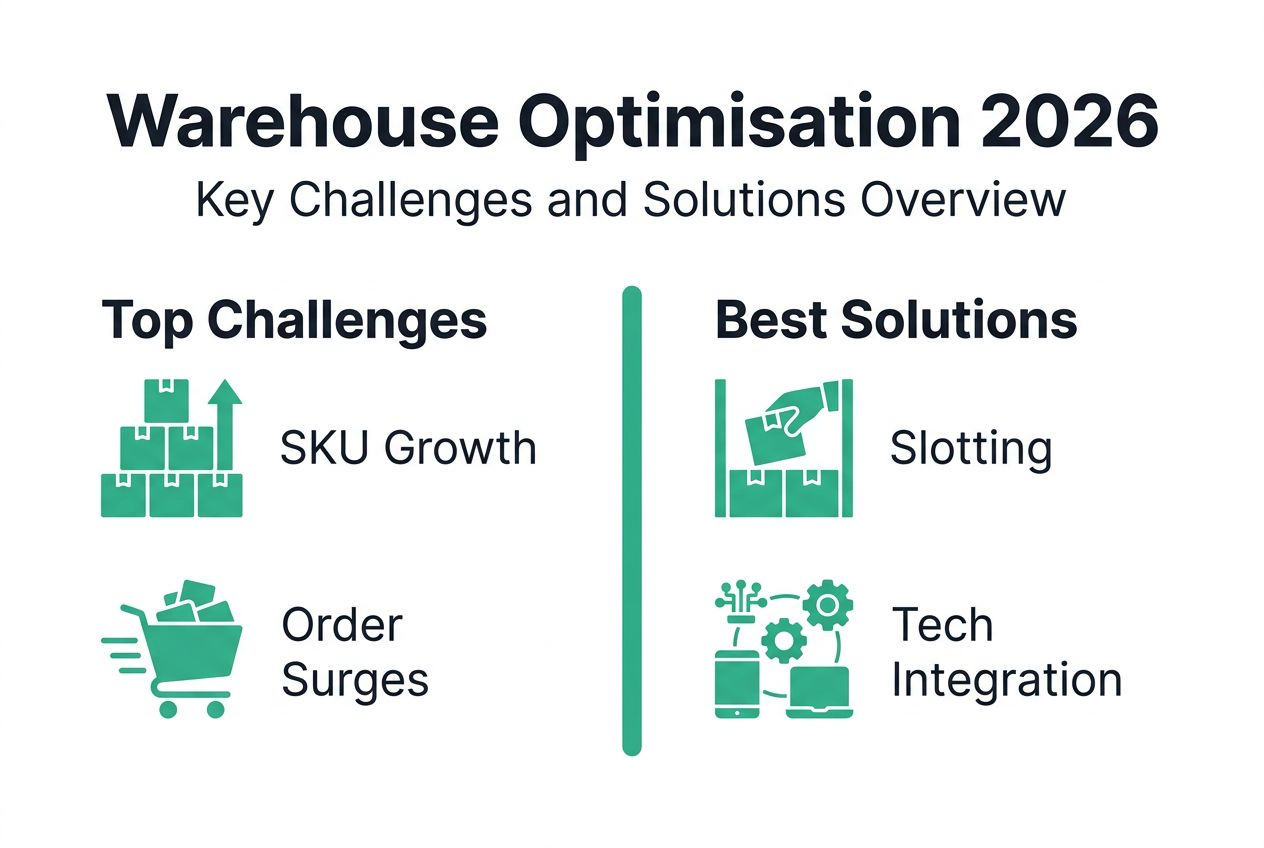
Resilience becomes essential. Supply chain disruptions, labour shortages, and evolving customer expectations require adaptable, efficient operations. Without continuous optimisation, warehouses become bottlenecks that limit growth potential.
For operations managers, these challenges aren’t abstract concerns. They’re daily battles affecting everything from cost per order to customer reviews. Addressing them systematically unlocks scalability, reduces waste, and positions your warehouse as a competitive advantage rather than a liability. Strategic intervention in layout, technology, and processes transforms these pain points into opportunities for reducing fulfilment costs and enhancing service quality.
Preparing your warehouse for optimisation: layout and slotting fundamentals
Before implementing advanced technologies, nail the basics. Layout and slotting form the foundation of warehouse efficiency. Get these right, and you’ll see immediate productivity gains.
Start with a comprehensive audit. Walk your warehouse floor and document current space utilisation, product flow patterns, and bottlenecks. Measure travel distances for high-frequency picks. Identify dead zones where valuable space sits underused.
Maximising space utilisation through layout redesign and high-density storage solutions is a proven strategy. Consider vertical storage systems, mezzanine levels, and compact shelving that multiply capacity without expanding your footprint.
Layout redesign follows three principles:
- Minimise travel time by positioning fast-moving items near packing stations
- Create logical product groupings based on order affinity
- Design clear, wide aisles that prevent congestion during peak periods
Slotting takes layout optimisation deeper. It’s the strategic assignment of products to specific locations based on data-driven criteria:
- Velocity: Place high-turnover SKUs in easily accessible zones
- Size and weight: Store bulky items near loading docks to reduce handling
- Affinity: Group frequently ordered together items to enable batch picking
- Replenishment frequency: Position fast-depleting stock near reserve areas
- Special handling: Allocate climate-controlled or secure zones for sensitive products
Warehouse slotting can yield double-digit productivity gains without significant capital expenditure. That’s a remarkable return from reorganising existing assets.
| Slotting criterion |
Impact on efficiency |
Implementation priority |
| SKU velocity |
Reduces pick time by 20-30% |
High |
| Product affinity |
Enables batch picking, cuts travel |
High |
| Size optimisation |
Maximises space utilisation |
Medium |
| Replenishment logic |
Reduces stockouts, improves flow |
Medium |
Treat slotting as an ongoing discipline, not a one-time project. SKU velocities shift with seasons, promotions, and market trends. Regular reviews keep your warehouse responsive.
Pro Tip: Run quarterly slotting analyses using your warehouse management system data. Identify velocity changes and reassign locations before inefficiencies accumulate.
Integrate these fundamentals with your broader fulfilment strategy. A well-slotted warehouse supports rapid order processing, which becomes even more critical when selecting a fulfilment partner for scalable operations. Layout and slotting create the physical infrastructure that technology and automation will amplify in the next phase.
Executing optimisation through technology integration and automation
Technology transforms warehouse potential. Once layout and slotting establish your foundation, robotics, AI, and cloud systems amplify efficiency and enable true scalability.
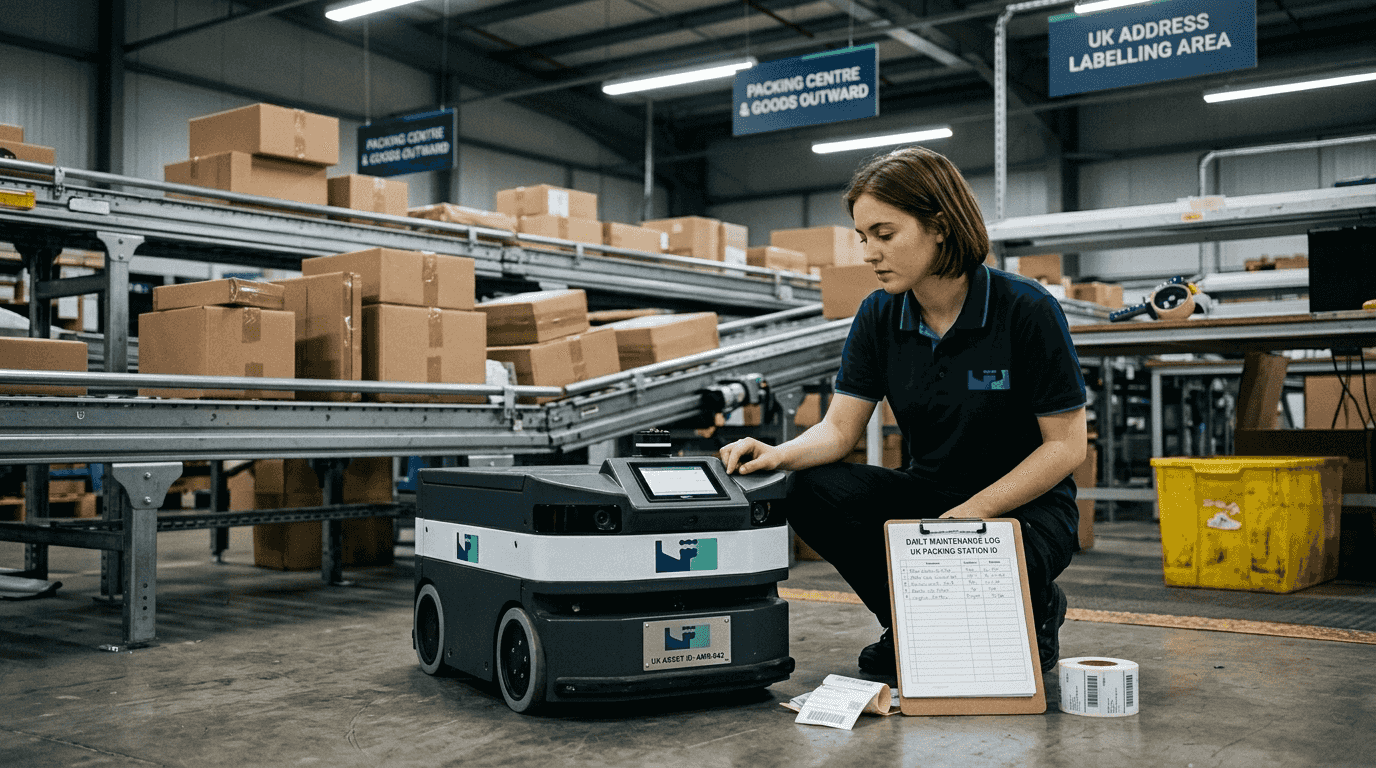
Robotics revolutionise picking operations. AutoStore systems boost productivity, delivering 100% faster fulfilment without warehouse expansion. Automated storage and retrieval systems eliminate manual searching, bringing products directly to pickers at ergonomic workstations.
Benefits extend beyond speed. Robotics reduce labour costs by handling repetitive tasks, freeing staff for value-added activities like quality control and exception handling. Accuracy improves dramatically when machines execute picks based on digital instructions rather than human interpretation of paper lists.
Artificial intelligence takes optimisation further. Machine learning models analyse historical order data to forecast demand with precision, preventing both stockouts and overstock situations. Predictive maintenance algorithms monitor equipment performance, flagging potential failures before they cause downtime.
Cloud integration connects every system. Warehouse automation employs AWS RoboMaker for robotics application development and AWS IoT Greengrass for local compute and machine learning at the edge. This architecture enables real-time data processing whilst maintaining reliable operation even during network interruptions.
Key technologies to integrate:
- Warehouse Management Systems (WMS): Centralise inventory visibility and orchestrate workflows
- Automated Guided Vehicles (AGVs): Transport goods efficiently between zones
- Pick-to-light and voice picking: Guide workers with hands-free, error-reducing interfaces
- IoT sensors: Track environmental conditions and asset locations in real time
- AI-powered demand forecasting: Optimise stock levels and replenishment timing
Combining these technologies creates adaptable workflows. When order volumes spike, systems automatically adjust task allocation and prioritisation. During quiet periods, they identify maintenance windows and inventory optimisation opportunities.
Pro Tip: Start technology adoption with high-impact, lower-risk implementations like barcode scanning upgrades before tackling full robotics deployments. Build confidence and demonstrate ROI incrementally.
Reliability matters as much as capability. Ensure your technology stack includes redundancy for critical systems. Cloud-based platforms offer inherent failover capabilities, but local edge computing provides resilience when connectivity falters.
Scalability considerations are crucial. Choose platforms that grow with your business, handling increased SKU counts and order volumes without performance degradation. Modular systems allow you to add capacity incrementally rather than requiring wholesale replacements.
Technology integration aligns perfectly with broader automation in e-commerce logistics trends. As you implement these systems, you’re not just optimising current operations. You’re building infrastructure that supports expansion into new markets, channels, and fulfilment models without proportional cost increases.
The transformation from manual to automated warehousing isn’t instantaneous. Plan phased rollouts, train staff thoroughly, and maintain parallel systems during transitions. This careful approach minimises disruption whilst building organisational capability to leverage advanced technologies effectively.
Verifying and sustaining optimisation: monitoring, continuous improvement, and best practices
Optimisation isn’t a destination. It’s a continuous journey requiring vigilant monitoring, regular adjustments, and commitment to improvement. Establishing robust verification processes ensures your warehouse maintains peak performance.
Define clear key performance indicators (KPIs) that align with business objectives:
- Order accuracy rate: Target 99.5% or higher to minimise returns and customer complaints
- Fulfilment lead time: Measure from order receipt to shipment dispatch
- Cost per order: Track total fulfilment expenses divided by order volume
- Space utilisation: Calculate used storage capacity as a percentage of total available
- Inventory turnover: Monitor how quickly stock cycles through your warehouse
- Pick rate: Measure units picked per hour to assess picker productivity
| KPI |
Industry benchmark |
Review frequency |
| Order accuracy |
99.5%+ |
Daily |
| Fulfilment lead time |
1-2 days |
Daily |
| Cost per order |
£3-£6 |
Weekly |
| Space utilisation |
80-90% |
Monthly |
| Inventory turnover |
4-12x annually |
Monthly |
Establish regular review cycles using data dashboards fed by your WMS and enterprise resource planning systems. Daily operational reviews catch immediate issues like processing bottlenecks. Weekly analyses identify emerging trends. Monthly deep dives assess strategic performance and inform optimisation decisions.
Leading practitioners treat slotting as a continuous capability, not a one-off project. Schedule quarterly slotting reviews that analyse velocity changes, affinity patterns, and space utilisation. Reassign locations proactively based on evolving demand rather than reacting to inefficiencies after they impact operations.
Continuous improvement methodologies accelerate progress. Implement Kaizen events where cross-functional teams identify and solve specific problems in focused bursts. Encourage frontline staff to submit improvement suggestions; they often spot inefficiencies invisible to management.
Pro Tip: Create visual management boards displaying real-time KPIs near workstations. Transparency builds accountability and helps teams self-correct before performance drifts.
Training investments pay dividends. As you introduce new technologies and processes, ensure every team member understands not just what to do, but why it matters. Skilled, engaged staff adapt more readily to changes and contribute more valuable improvement ideas.
Integrate feedback loops throughout operations. Conduct regular team huddles where pickers, packers, and supervisors discuss challenges and solutions. Act quickly on legitimate concerns to maintain morale and demonstrate commitment to continuous improvement.
Benchmarking against industry standards provides perspective. Join professional associations, attend conferences, and network with peers to understand how your performance compares. Don’t just measure internally; contextualise your metrics within broader logistics excellence standards.
Data-driven decision making separates effective optimisation from guesswork. Leverage data to optimise every aspect of your logistics operations. Advanced analytics reveal patterns human observation misses, enabling predictive rather than reactive management.
Document everything. Create standard operating procedures for all processes, update them as improvements are implemented, and ensure accessibility for training new staff. Documentation preserves institutional knowledge and prevents backsliding when personnel change.
Sustaining optimisation requires leadership commitment. Allocate budget for ongoing technology upgrades, staff development, and process refinement. Celebrate wins publicly to reinforce the importance of continuous improvement culture.
The verification and improvement cycle never ends. Markets evolve, customer expectations rise, and competitive pressures intensify. Warehouses that embrace continuous optimisation adapt successfully. Those that treat it as a one-time project fall behind.
Partner with ParcelPlanet for expert order fulfilment services
Optimising your warehouse is just one piece of the fulfilment puzzle. ParcelPlanet’s order fulfilment services complement your internal operations with expert 3PL support tailored to e-commerce and omnichannel brands.
We bring technology-driven efficiency, scalable capacity, and multi-channel integration that enhances your optimisation efforts. Whether you’re managing peak season surges or expanding into new markets, our flexible solutions adapt to your needs without the capital investment of warehouse expansion.
Explore how omnichannel selling strategies boost sales whilst our fulfilment network ensures consistent customer experiences across every channel. Discover the benefits of outsourcing order fulfilment to focus on growth whilst we handle logistics complexity.
Frequently asked questions
What is warehouse slotting and why is it important?
Warehouse slotting is the strategic placement of products in specific locations based on demand velocity, size, affinity, and handling characteristics. It optimises picking efficiency by minimising travel time and ensuring high-turnover items occupy the most accessible positions.
How can robotics improve warehouse operations?
Robotics increase picking speed dramatically, reduce labour costs, improve order accuracy, and enable scalability without warehouse expansion. Automated systems handle repetitive tasks reliably, freeing staff for higher-value activities like quality control and process improvement.
What key metrics should I track to measure optimisation success?
Essential KPIs include order accuracy rate (target 99.5%+), fulfilment lead time, cost per order, space utilisation percentage, inventory turnover, and pick rate. Track these daily for operational metrics and monthly for strategic performance to identify trends and opportunities.
How often should warehouse slotting be reviewed?
Slotting should be reviewed quarterly at minimum, with immediate adjustments when significant SKU changes or demand shifts occur. Leading warehouses treat slotting as an ongoing discipline, using real-time data to optimise locations proactively rather than reactively addressing inefficiencies.
Recommended