TL;DR:
- Third-party logistics (3PL) becomes cost-effective for brands processing over 500 monthly orders.
- 3PLs offer higher order accuracy, faster shipping, and better scalability than in-house fulfilment.
- Choosing and onboarding the right 3PL requires careful evaluation of technology, location, expertise, and support.
Most e-commerce founders assume third-party logistics is only for large enterprises. That assumption is costing them. 3PL becomes cost-effective at around 500 to 1,000 monthly orders, meaning fast-growing mid-sized brands are often the biggest beneficiaries. This guide cuts through the confusion and gives you a clear picture of what 3PL is, how it compares to in-house fulfilment, and when making the switch genuinely pays off. You will also find practical benchmarks, honest trade-offs, and the key factors that separate brands who scale smoothly from those who struggle.
Table of Contents
Key Takeaways
| Point |
Details |
| 3PL cost-effectiveness |
Outsourcing to a 3PL pays off for brands shipping over 500 orders per month due to shipping savings and scalability. |
| Compare before choosing |
Weigh in-house control against 3PL’s efficiencies, accuracy, and tech optimisation, focusing on service and disruption risks. |
| Growth through automation |
3PLs enable brands to automate processes, offer faster delivery, and scale globally without large upfront investments. |
| Choose partners wisely |
Select your 3PL for integration capabilities, returns handling, and reliability to avoid costly fulfilment disruptions. |
What is a 3PL and how does it work?
A third-party logistics provider, or 3PL, is a company that manages the physical and operational side of your supply chain on your behalf. Rather than running your own warehouse, hiring fulfilment staff, and negotiating individually with couriers, you hand those responsibilities to a specialist partner. That frees your team to focus on product, marketing, and growth.
When you partner with a 3PL, they typically handle the following services:
- Receiving and storage: Your stock arrives at their warehouse and is logged into their inventory system.
- Pick and pack: When an order comes in, their team picks the correct items, packs them securely, and prepares them for dispatch.
- Shipping: Orders are sent via integrated courier networks, often at negotiated rates.
- Returns management: Returned items are received, inspected, and either restocked or disposed of according to your instructions.
- Tech integration: Most modern 3PLs connect directly to your e-commerce platform, whether that is Shopify, WooCommerce, or another system, so orders flow automatically.
Understanding outsourcing fulfilment is important because the cost structure is quite different from running your own operation. Key pricing components typically include receiving at £20 to £45 per pallet, storage at around £0.40 to £1.20 per cubic foot per month, pick and pack at £2.50 to £5 per order, and returns handling at £2 to £8 per return. There are also setup and integration fees to factor in at the start.
However, one of the most compelling arguments for 3PL is the shipping savings. Because 3PLs ship at high volumes across many clients, they negotiate significantly better carrier rates than most individual brands can achieve. This means 15 to 40% shipping savings are realistic for brands moving to a 3PL model.
“The real value of a 3PL is not just in what they do. It is in what they have already built. You are buying into infrastructure, relationships, and expertise that would take years and significant capital to replicate in-house.”
For a deeper look at the fundamentals, order fulfilment explained covers the full process from purchase to delivery. The break-even point matters here. Below 500 monthly orders, in-house fulfilment is usually cheaper due to lower fixed costs. Above that threshold, 3PL increasingly wins on unit economics, flexibility, and speed.
3PL vs in-house fulfilment: Key differences
With a definition in hand, let us see how 3PL stacks up against in-house solutions for your growing e-commerce business.
| Factor |
3PL |
In-house |
| Upfront cost |
Low (no warehouse lease) |
High (space, equipment, staff) |
| Scalability |
High (flex with demand) |
Limited by fixed capacity |
| Order accuracy |
99% or above |
95% to 98% |
| Control |
Moderate |
Full |
| Tech integration |
Built-in WMS and APIs |
Requires investment |
| Seasonal flexibility |
Excellent |
Difficult |
The accuracy gap is worth pausing on. A 1 to 4 percentage point difference in order accuracy sounds small, but at 1,000 orders per month, that translates to 10 to 40 additional errors. Each error costs you in returns, customer service time, and lost trust.
Key operational considerations for each model include:
- 3PL suits brands processing over 500 orders per month, selling across multiple channels, or planning international expansion.
- In-house suits brands under 500 monthly orders that need granular control over packaging, branding, or product handling.
- Hybrid models work well when you have a mix of high-velocity SKUs (handled by 3PL) and slow-moving or highly customised products (managed in-house).
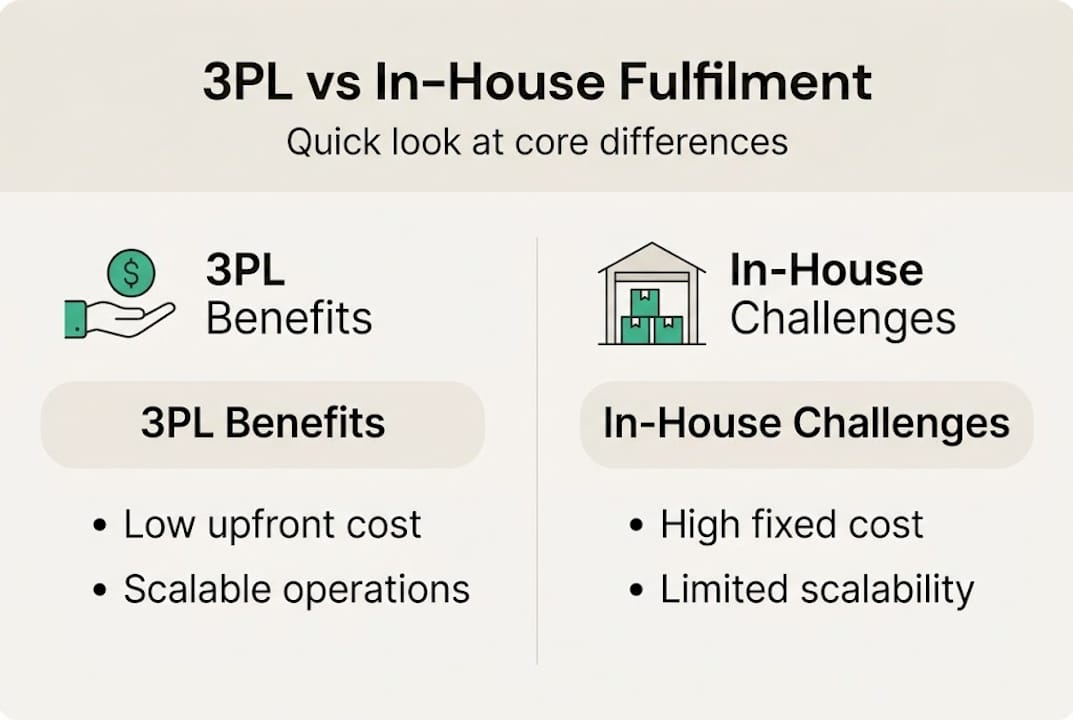
In-house fulfilment offers full control but comes with high fixed costs and real scalability constraints as your order volume grows. Understanding saving costs with 3PL is key to making an informed decision. Many brands also explore why brands need 3PL when they hit operational ceilings.
Pro Tip: Switching fulfilment models mid-growth is one of the most disruptive operational changes you can make. Inventory needs to be physically moved, systems need to be reconfigured, and your team needs retraining. Choose your model based on where you expect to be in 18 months, not just where you are today.
How 3PLs drive growth and operational efficiency
Understanding the differences, let us look at how a modern 3PL actually accelerates your brand’s growth and streamlines everyday logistics.
| Metric |
With 3PL |
Without 3PL |
| Labour cost reduction |
Up to 30% via WMS automation |
Higher manual overhead |
| Shipping speed |
1 to 2 days (distributed network) |
Varies by location |
| Customer satisfaction |
Higher (faster, accurate delivery) |
Inconsistent |
| Peak season handling |
Seamless scale-up |
Strained capacity |
Automation is central to how modern 3PLs operate. Warehouse management systems (WMS) handle inventory tracking, order routing, and picking optimisation automatically. This reduces human error, speeds up processing, and gives you real-time visibility into stock levels without manual counting.
Here are the key growth catalysts a good 3PL provides:
- Speed to market: Distributed warehouse networks mean shorter distances to your customers, cutting delivery times significantly.
- Flexible capacity: You scale up during peak seasons and scale back down without carrying the overhead of permanent staff or warehouse space.
- Global reach: Established 3PLs have carrier relationships and customs expertise that make international expansion far more accessible for growing brands.
- Returns efficiency: Streamlined returns processes reduce friction for customers and improve restocking speed.
- Tech connectivity: Direct integrations with your sales channels mean orders are processed faster and with fewer manual touchpoints.
“58% of shoppers abandon their cart when two-day shipping is not available. A 3PL with a distributed fulfilment network directly addresses this.”
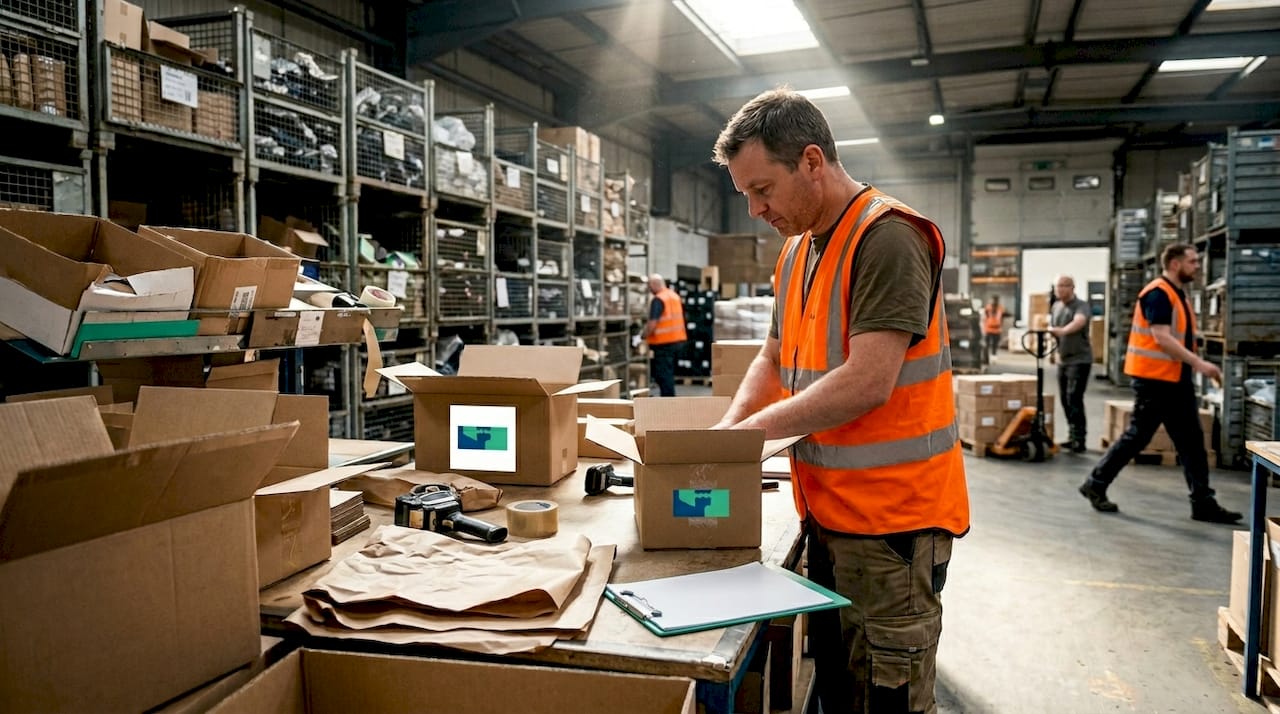
Returns and seasonality are two areas where in-house operations frequently buckle. A 3PL absorbs the volume spikes of peak trading periods without you needing to hire temporary staff or rent additional space. For brands thinking about logistics scalability, this flexibility is one of the strongest arguments for outsourcing. Brands already using 3PL to scale consistently report smoother peak periods and improved customer retention.
How to choose the right 3PL partner
Ready to benefit from 3PL? Here is how to narrow your options and choose a partner who will support, not slow, your growth.
Use these five factors to shortlist providers:
- Technology integration: Does the 3PL connect seamlessly with your e-commerce platform and order management system? EDI and WMS compatibility are non-negotiable for smooth operations.
- Returns handling: How does the provider process returns? Speed and accuracy here directly affect your customer experience and restocking efficiency.
- Location and network: Where are their fulfilment centres? Proximity to your customer base reduces shipping times and costs.
- Category experience: Have they worked with brands in your product category? Fragile, temperature-sensitive, or high-value goods require specialist handling.
- Support quality: What does their client support look like day-to-day? You need a responsive contact, not just a ticketing system.
When speaking to potential partners, ask for client references in your sector, request a walkthrough of their technology stack, and ask specifically how they handle disruptions such as courier failures or system outages. These conversations reveal far more than a sales pitch will.
For complex or fragile products, seasonal peaks, or international shipping requirements, a specialist 3PL will nearly always outperform a generalist provider. The expertise gap is significant. A detailed guide on choosing a 3PL can help you structure your evaluation process. If you are still deciding when to use a 3PL service, reviewing your current order volume and operational pain points is the right starting point.
Pro Tip: Before switching 3PLs, run a parallel operation for at least four to six weeks if possible. Transfer a portion of your SKUs first, validate accuracy and speed, then migrate fully. Rushing a full migration is one of the most common and costly mistakes growing brands make.
Our take: The overlooked realities of 3PL for scaling brands
Most 3PL guides focus on cost comparisons and service lists. What they rarely address is how much the transition itself determines whether you succeed or struggle.
We have seen brands choose a 3PL based purely on price, only to spend months firefighting integration failures, inaccurate inventory counts, and slow returns processing. The savings they expected were wiped out by operational disruption. Tech compatibility, specifically WMS and EDI alignment, matters far more than the headline rate per pick.
The brands that scale most smoothly treat 3PL onboarding the way they would treat hiring a senior operations lead. They invest time in the relationship, communicate expectations clearly, and build processes collaboratively. Those who treat it as a simple hand-off almost always pay the price later. Understanding the outsourcing fulfilment benefits is straightforward. Executing the transition well is where the real work lies. Choose a partner, not just a provider.
Unlock scalable fulfilment with expert 3PL solutions
If this guide has made one thing clear, it is that the right 3PL partner does more than move boxes. They become a core part of how your brand delivers on its promise to customers.

At ParcelPlanet, we provide tailored order fulfilment solutions designed specifically for growing e-commerce and omnichannel brands. From real-time inventory tracking to seamless software integrations with your existing platforms, we make the transition straightforward and the ongoing operation reliable. Whether you are processing 500 orders a month or scaling towards 50,000, our team is ready to support your next stage of growth. Get in touch today for a personalised fulfilment consultation.
Frequently asked questions
What does a 3PL company do?
A 3PL company manages storage, order processing, shipping, and returns on your behalf, allowing your e-commerce business to scale without building its own logistics infrastructure.
How much does 3PL cost in 2026?
Typical costs cover receiving, storage, pick and pack, and returns handling. Thanks to carrier volume negotiations, most brands also benefit from 15 to 40% lower shipping rates compared to arranging couriers independently.
When should my brand use a 3PL?
Brands processing over 500 monthly orders, managing complex shipping requirements, or targeting international markets will typically find 3PL more cost-effective and scalable than in-house fulfilment.
What makes 3PL better than in-house fulfilment?
3PLs consistently deliver 99% or above order accuracy compared to 95 to 98% in-house, while also offering superior scalability, built-in technology, and no upfront infrastructure investment.
Recommended


