TL;DR:
- A courier manifest summarizes all parcels in a shipment and proves collection at handover.
- Creating an accurate manifest ensures verifiable records, reduces disputes, and supports claims for lost or damaged goods.
A courier manifest is defined as a summary document listing every parcel in a shipment, providing formal proof of collection at the point of handover to a courier. You may also encounter it under names such as SCAN form, End of Day form, or Order Summary, but the function is identical across all carriers. For e-commerce and logistics professionals, understanding what a courier manifest means in practice is the difference between a verifiable, dispute-proof handoff and a gap in your shipping records. Parcelplanet works with manifests daily, and this guide covers everything from courier manifest definition to creation, compliance, and common pitfalls.
What is a courier manifest and what does it contain?
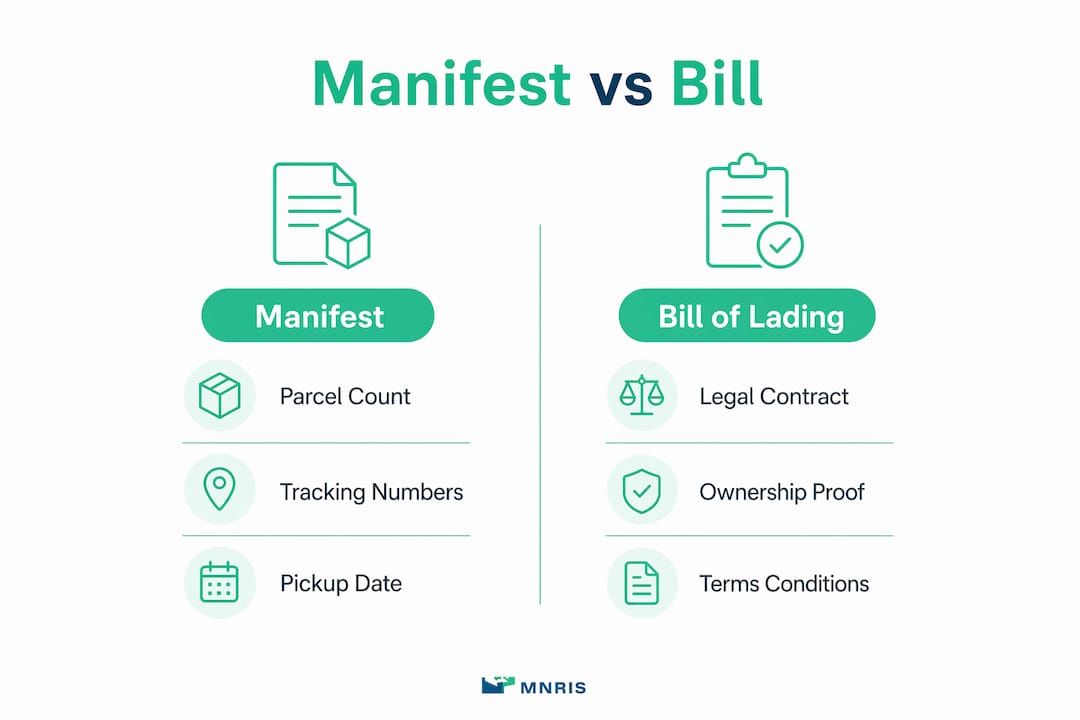
A courier manifest is an operational document, not a legal contract. It records the total number of packages, package types, individual tracking numbers, destination details, gross weight, and a description of goods. For cross-border shipments, it also captures consignor details, container operator information, and export data required for HMRC compliance.

The table below summarises the core data elements and why each one matters in practice.
| Data element |
Purpose |
| Total package count |
Confirms the full batch was handed over to the courier |
| Tracking numbers |
Links each parcel to its individual shipment record |
| Destination details |
Supports routing accuracy and customs declarations |
| Gross weight |
Required for carrier rate calculation and regulatory filings |
| Goods description |
Enables customs clearance and loss or damage claims |
| Consignor details |
Identifies the sender for liability and compliance purposes |
Every field earns its place. Missing a tracking number, for example, means a parcel cannot be traced if it goes astray. Inaccurate weight data can trigger carrier surcharges or delay clearance at customs.
Pro Tip: Before closing a manifest, cross-check your package count against the physical items on the dispatch bench. A one-unit discrepancy at this stage is far easier to fix than a missing parcel investigation three days later.
How does a courier manifest differ from a bill of lading?
Delivery manifests are often confused with bills of lading, but the two documents serve entirely different purposes. A manifest is an operational tracking record. A bill of lading is a legal contract between shipper and carrier that also acts as a document of title, transferring ownership of goods.
The practical implications of this distinction are significant for e-commerce professionals.
- Manifest: Created at the point of dispatch, used internally by warehouse teams and couriers, not legally binding, updated per shipment batch.
- Bill of lading: Issued for freight and cargo shipments, legally enforceable, governs liability and ownership transfer, required for international freight.
- Audience: Manifests are used by warehouse operatives and courier drivers. Bills of lading are reviewed by freight forwarders, banks, and legal teams.
- Dispute use: A manifest supports a claim for a lost parcel. A bill of lading is the document used in formal cargo disputes and letters of credit.
- Format: Manifests are typically digital or printed summaries. Bills of lading follow standardised legal formats recognised under international trade law.
Understanding this distinction improves compliance and logistics clarity. Treating a manifest as a legal document, or expecting a bill of lading to serve as proof of courier collection, creates gaps in both your records and your liability position.
Pro Tip: Keep your manifests and bills of lading in separate filing systems. Mixing them up during a claim investigation wastes time and can weaken your case with the carrier.
How to create and manage a courier manifest
Generating a manifest follows a clear sequence. Most modern shipping platforms and warehouse management systems automate the bulk of this process, but knowing each step helps you catch errors before they become problems.
-
Consolidate shipment data. Pull all orders scheduled for dispatch into a single batch within your shipping software. Verify that every order has a printed label and a confirmed tracking number before proceeding.
-
Generate the manifest. Most platforms produce the manifest automatically once you trigger an End of Day or Close Shipments action. The system compiles all active tracking numbers into a single document, often represented by one scannable barcode.
-
Choose electronic or physical format. Electronic manifests are standard across most UK carriers and integrate directly with carrier systems. Printing a physical copy or saving a PDF is still best practice for claims, particularly if goods are lost or damaged in transit.
-
Hand over to the courier driver. The driver scans the manifest barcode, which logs acceptance of the entire batch in one action rather than scanning each parcel individually. This speeds up driver pickup and creates a timestamped record of collection.
-
Close the manifest. Once the driver scans and departs, the manifest is closed. At this point, the shipment batch is locked. You cannot void individual shipping labels through your software after this stage. Any corrections require direct courier coordination, which adds time and complexity.
-
Archive the manifest. Store the manifest record against the relevant order batch in your warehouse management system. Link it to your inventory tracking records for full end-to-end visibility.
The most common error at this stage is manifesting too early, before all parcels for the batch are labelled and ready. Build a physical check into your dispatch workflow before triggering the close action.
What are the benefits of using a courier manifest?
Manifests deliver concrete operational advantages that go beyond a simple paperwork exercise. The benefits are most visible when something goes wrong, but they also improve day-to-day efficiency in measurable ways.
Major carriers recommend manifests for all merchants shipping multiple packages, precisely because they produce a cleaner, more verifiable handover. Here is where the value shows up in practice.
- Faster courier pickups. A single barcode scan covers the entire batch. The driver does not need to scan 50 individual parcels, which reduces dwell time at your dispatch point.
- Proof of collection. The manifest scan is the seller’s critical checkpoint, confirming parcels have physically moved from your warehouse into courier control. Label creation alone does not provide this proof.
- Claim support. Manifests serve as primary evidence when filing compensation claims for lost or damaged goods. A manifest with a confirmed scan timestamp is far stronger than a label record alone.
- Inventory reconciliation. Matching manifest records against your outbound order list confirms which stock has left the building. This feeds directly into accurate inventory management and reduces phantom stock errors.
- Compliance readiness. For exports, accurate manifest data supports HMRC declarations and customs clearance without requiring you to reconstruct shipment details after the fact.
“The manifest scan is the true evidence of shipment transfer. Treating label creation as the final step is the single most common misconception in e-commerce dispatch operations.”
The misconception that a printed label equals a dispatched parcel costs businesses time and money every week. A manifest with a confirmed driver scan is the only reliable proof that goods left your facility.
Common challenges and how to avoid them
The most significant operational challenge with manifests is the point of no return after closure. Once a shipment is manifested, you cannot void the shipping label through your software. Any post-manifest correction requires contacting the carrier directly, which delays resolution and increases administrative effort. Accuracy before manifesting is not optional.
A second common issue is relying solely on electronic records. Electronic manifests are standard, but printing or saving a PDF copy is the safest approach for any shipment where loss or damage is a realistic risk. Digital systems can have access issues, and a physical copy removes any ambiguity during a claim investigation.
Data capture errors are the third pitfall. A wrong tracking number, an incorrect package count, or a missing destination postcode can cause downstream scanning failures and delay delivery. Build a two-person verification step into your dispatch process for high-volume days.
Pro Tip: Set a daily manifest cut-off time, for example 3pm, and do not accept new orders into the batch after that point. This gives your team time to verify every label before the driver arrives, rather than rushing the close action.
Reducing shipping costs also depends on accurate manifests. Carrier surcharges for weight discrepancies and address corrections are avoidable when manifest data is verified before closure.
Key takeaways
A courier manifest is the definitive proof of collection in e-commerce dispatch, and accuracy before closure is the single most important factor in avoiding costly corrections and claim failures.
| Point |
Details |
| Manifest definition |
A summary document listing all parcels in a batch, serving as proof of courier collection. |
| Key data elements |
Include tracking numbers, package count, gross weight, destination details, and goods description. |
| Manifest vs bill of lading |
Manifests are operational records; bills of lading are legal contracts governing ownership transfer. |
| Post-closure corrections |
Once manifested, labels cannot be voided via software; contact the carrier directly for any changes. |
| Retain copies |
Always save a digital or printed manifest copy to support claims for lost or damaged goods. |
The manifest is the moment that matters most
After years working in e-commerce fulfilment, the pattern I see most often is businesses treating the shipping label as the finish line. It is not. The label is preparation. The manifest scan is the event.
I have seen disputes where a seller had 50 labelled parcels, a confirmed collection booking, and no manifest record. The carrier had no timestamped acceptance scan. The seller had no proof the goods ever left their warehouse. The claim went nowhere. That situation is entirely avoidable, and it comes down to one process step.
The shift to electronic manifests has made this easier, but it has also made it easier to skip the physical verification. When your system auto-generates a manifest, it is tempting to trust the software entirely. The smarter approach is to use the software as a tool and keep the human checkpoint in place. Count the parcels. Confirm the tracking numbers match. Then close the manifest.
What I find encouraging is that more e-commerce teams are now integrating manifest management into their broader order tracking workflows rather than treating it as a standalone admin task. That is the right direction. A manifest is not a form to fill in. It is the operational record that connects your warehouse to your customer’s door.
— ChiefPlaneteer
How Parcelplanet supports efficient manifest management
Parcelplanet handles manifest generation, courier coordination, and digital record-keeping as part of its order fulfilment services, so your team does not need to manage these processes manually.

Every shipment processed through Parcelplanet generates a verified manifest at the point of courier handover, with records linked directly to your order data. This gives you full visibility across your dispatch operations without the administrative overhead of managing manifests in-house. Whether you ship 50 parcels a day or 5,000, the same verification process applies. Get in touch with the Parcelplanet team to find out how our fulfilment services can take the complexity out of your daily dispatch workflow.
FAQ
What is the courier manifest purpose?
A courier manifest serves as formal proof that a batch of parcels has been handed over to a courier. It records all tracking numbers, package counts, and destination details for the shipment.
What does “manifested” mean in shipping?
“Manifested” means a shipment batch has been closed and accepted by the carrier. Once manifested, the courier has taken responsibility for the parcels and individual labels can no longer be voided through shipping software.
How does a courier manifest differ from a shipping label?
A shipping label identifies a single parcel with its destination and tracking number. A courier manifest groups all parcels in a batch into one summary document, providing a single proof of collection for the entire handover.
Do I need a manifest for every shipment?
Major carriers do not technically require a manifest for every shipment, but they strongly recommend it for merchants sending multiple parcels. A manifest produces a cleaner, more verifiable handover and supports any future claims.
A courier manifest typically includes the total package count, individual tracking numbers, destination details, gross weight, goods description, and consignor information. For exports, it also supports HMRC and customs compliance requirements.
Recommended