TL;DR:
- A delivery exception indicates a package has been temporarily delayed due to an unforeseen event during transit. Most exceptions are resolved within a week, and only a small percentage of parcels are lost. Prompt action from recipients and accurate address data significantly reduce delays and prevent returns.
A delivery exception is a shipping status indicating your package is temporarily delayed due to an unforeseen event during transit. The term appears across all major carriers and is the standard industry label for any disruption that pulls a parcel off its planned delivery route. Crucially, exceptions are temporary pauses, not lost shipments. Delivery exceptions affect roughly 11% of shipments, yet 94% of those parcels are still delivered within seven business days. Only 2.4% are ever lost. That context matters enormously when you see the status appear on your tracking page.
What is a delivery exception and why does it happen?
A delivery exception signals that a carrier has diverted your parcel to manual handling after something disrupted its planned route. Carriers use exception codes to alert both senders and recipients of this deviation. The code is logged automatically when high-speed sorting systems flag a package as needing human intervention. Exception codes notify all parties of the disruption and keep tracking updates active until the parcel reaches its final outcome.
Seven factors account for 89% of delivery exceptions, and understanding them helps you act quickly when one appears on your order:
- Weather disruptions (31%): Storms, flooding, and extreme temperatures ground vehicles and close depots. This is the single largest cause and is entirely outside anyone’s control.
- Address failures (23%): Missing apartment numbers, invalid postcodes, or illegible labels prevent carriers from completing delivery. These are preventable with a simple address check before dispatch.
- Recipient unavailability (18%): Nobody is home to sign for the parcel, or access to the delivery location is blocked. Carriers typically make three attempts over five business days before initiating a return.
- Holiday congestion: Peak periods like Christmas and Black Friday overload carrier networks, causing backlogs that trigger exception statuses across thousands of parcels simultaneously.
- Customs delays: International shipments can be held for documentation checks, duty assessments, or compliance reviews. Customs holds add between 3 and 15 business days to international delivery timelines.
Pro Tip: Before placing an order or dispatching stock, verify every address field including the postcode, building name, and any access instructions. Address errors are the second most common cause of exceptions and are entirely avoidable.
How does a delivery exception differ from a shipment exception?

A delivery exception and a shipment exception are related but not identical. Confusing the two leads to unnecessary worry or, worse, the wrong response from a merchant’s customer service team.
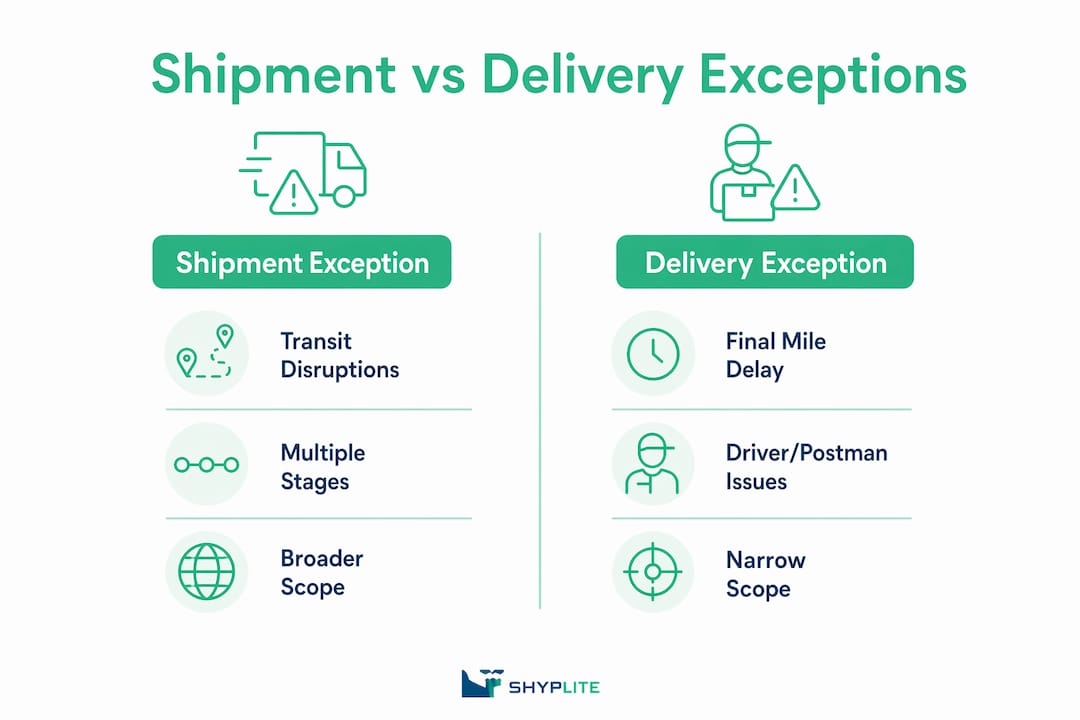
A shipment exception is a broader category. It covers any disruption that occurs during the entire transit journey, including problems at pickup, at a sorting facility, or during line-haul transport between depots. A shipment exception can occur before a parcel ever reaches the final delivery stage.
A delivery exception is narrower. It occurs specifically during the final delivery attempt, when a driver or postal worker is trying to get the parcel to its destination address. The distinction matters because the required action differs.
| Feature |
Shipment exception |
Delivery exception |
| Stage of transit |
Pickup, sorting, or line-haul |
Final delivery attempt only |
| Common triggers |
Carrier processing errors, damaged labels |
Recipient absent, address unreadable |
| Who acts first |
Carrier resolves internally |
Recipient or sender must respond |
| Typical resolution time |
Often resolved before delivery window |
2–7 business days for domestic parcels |
| Risk if ignored |
Parcel may reroute automatically |
Parcel may be returned to sender |
The practical takeaway is clear. If you see a shipment exception, monitor tracking and wait for carrier updates. If you see a delivery exception, act promptly. Contact the carrier, confirm your address, or arrange a redelivery before the return window closes.
What does a delivery exception mean for you and your business?
For recipients, a delivery exception usually means a delay of two to seven business days on domestic orders. For international shipments, customs holds can extend that to several weeks. The good news is that 97.6% of exceptions result in successful delivery within 7–14 days. The exception status simply means your parcel has moved to manual handling, not that it is lost.
Not every exception causes a visible delay. Some exceptions are resolved before the original estimated delivery date, meaning the parcel arrives on time despite the flag. Recipients who check tracking and see an exception status often assume the worst, when in reality the carrier has already corrected the issue.
For e-commerce merchants, the stakes are higher. A single unresolved exception can trigger a customer complaint, a negative review, or a chargeback. Carriers make three delivery attempts over five business days before returning a parcel. Merchants who do not notify customers during that window risk losing the sale entirely, paying return shipping costs, and damaging their brand reputation.
Here is what recipients should do when they receive a delivery exception notification:
- Check the exception code. Your tracking page will show a reason code. Identify whether the issue is weather, address, or availability related.
- Contact the carrier directly. Use the carrier’s website or customer service line to confirm your address details and request redelivery.
- Update your delivery instructions. If access is the problem, add a safe place note or authorise a neighbour to accept the parcel.
- Notify the merchant. If the carrier cannot resolve the issue within two business days, contact the seller so they can intervene on your behalf.
- Act before the return window closes. Carriers initiate return-to-sender after three failed attempts. Acting within the first 48 hours of notification prevents this outcome.
Understanding return-to-origin risks is equally important for merchants, as unresolved exceptions are one of the primary drivers of costly returns.
How can you manage and reduce delivery exceptions?
Reducing delivery exceptions requires action from both senders and recipients. The majority of exceptions stem from preventable data errors, which means the right processes cut exception rates significantly before a parcel even leaves the warehouse.
What senders can do
- Validate addresses at checkout. Use address validation tools that flag incomplete or unrecognised entries before an order is confirmed. This directly targets the 23% of exceptions caused by address failures.
- Add clear delivery instructions. Include access codes, safe place preferences, and contact numbers on every label. Carriers use this information when recipients are unavailable.
- Choose carriers with strong exception management. Carriers vary significantly in how quickly they resolve exceptions and how clearly they communicate status updates to both senders and recipients.
- Send proactive notifications. Alert customers the moment an exception is flagged. Customers who receive timely updates are far less likely to escalate to a complaint or chargeback.
- Review your delivery accuracy practices. Systematic checks on label quality, packaging integrity, and dispatch data reduce the frequency of carrier-side exceptions.
What recipients can do
- Track orders actively rather than waiting for delivery day. Most carriers update exception statuses within hours of the disruption occurring.
- Respond to carrier notifications immediately. A missed redelivery window is the fastest route to a return-to-sender outcome.
- Provide a secondary contact number when placing orders. Carriers can reach you directly when access or availability is the issue.
Pro Tip: Merchants who use order tracking communications to send exception alerts within two hours of a flag being raised see significantly fewer escalations and negative reviews. Speed of communication is the single biggest factor in customer satisfaction during an exception event.
Treating delivery exceptions as a customer experience opportunity rather than a logistics failure changes outcomes. Proactive customer outreach reduces negative feedback and turns a frustrating moment into evidence that your brand is attentive and reliable.
Key takeaways
Delivery exceptions affect 11% of shipments, but 97.6% of those parcels are still delivered successfully, making fast communication and correct address data the two most effective tools for managing them.
| Point |
Details |
| Definition is specific |
A delivery exception occurs at the final delivery stage, not during earlier transit phases. |
| Most exceptions resolve quickly |
94% of affected parcels are delivered within seven business days of the exception being flagged. |
| Address errors are preventable |
23% of exceptions stem from incorrect address data, which validation at checkout eliminates. |
| Recipients must act fast |
Carriers attempt delivery three times over five days before returning a parcel to the sender. |
| Communication reduces damage |
Proactive exception alerts from merchants cut complaint rates and protect brand reputation. |
The real lesson delivery exceptions teach us
Most people treat a delivery exception notification as bad news. I understand why. The language sounds alarming, and nobody wants to see their order flagged as disrupted. But after years of working in logistics and fulfilment, I have come to see exceptions differently.
The exception status exists because carriers built systems that catch problems before they become permanent losses. That is a feature, not a failure. The 2.4% loss rate for excepted parcels is remarkably low given the volume of packages moving through global networks daily. The system works.
What I have seen cause the most damage is not the exception itself. It is the silence that follows. Merchants who say nothing while a parcel sits in a carrier’s exception queue lose customers who would have stayed loyal with a single honest update. Recipients who ignore the notification until day five lose their redelivery window entirely. The exception is manageable. The inaction is not.
The other thing worth saying plainly: not every exception causes a delay. I have seen parcels flagged with an exception status arrive on their original estimated delivery date because the carrier resolved the issue within hours. Checking your tracking page once and assuming the worst is the wrong response. Monitor it. Act on it. And if you are a merchant, build the processes that mean your customers never have to wonder what is happening to their order.
— ChiefPlaneteer
How Parcelplanet helps reduce delivery exceptions
Parcelplanet’s order fulfilment services are built to reduce the errors that cause delivery exceptions in the first place. Address validation, accurate label generation, and real-time tracking integrations are standard across every fulfilment operation Parcelplanet manages. When an exception does occur, Parcelplanet’s carrier network and communication tools mean your customers are notified quickly and your team has the information needed to act.

Growing e-commerce brands that partner with Parcelplanet benefit from warehousing, picking, packing, and dispatch processes designed to keep exception rates low and customer satisfaction high. If delivery exceptions are affecting your order fulfilment performance, get a tailored quote and see how Parcelplanet’s fulfilment expertise can support your growth.
FAQ
What does “delivery exception” mean on a tracking page?
A delivery exception means your parcel has been temporarily diverted from its planned delivery route due to an unexpected event. It does not mean the parcel is lost. The vast majority of excepted shipments are delivered successfully within 7–14 days.
What are the most common causes of delivery exceptions?
Weather disruptions cause 31% of delivery exceptions, address failures cause 23%, and recipient unavailability accounts for 18%. Together, these three factors drive the majority of all exceptions recorded by carriers.
How long does a delivery exception last?
Domestic delivery exceptions typically resolve within 2–7 business days. International exceptions involving customs holds can last between 3 and 15 business days depending on the destination country and documentation requirements.
Will my parcel be returned if I have a delivery exception?
Carriers make three delivery attempts over five business days before initiating a return-to-sender process. Contacting your carrier within 48 hours of the exception notification is the most reliable way to prevent a return.
How can e-commerce merchants reduce delivery exceptions?
Merchants reduce exceptions by validating addresses at checkout, adding clear delivery instructions to every label, and sending proactive exception alerts to customers. These steps directly target the preventable causes that account for the majority of all exceptions.
Recommended


