TL;DR:
- Distributed warehousing involves storing inventory across multiple locations to shorten delivery times and reduce costs. It relies on technology, SKU rationalization, and deliberate network design to balance benefits against increased complexity and safety stock needs. Proper implementation enables faster delivery, better service, and supply chain resilience for expanding e-commerce brands.
Distributed warehousing is defined as a logistics strategy where inventory is stored across multiple, geographically spread locations to reduce delivery distances and improve fulfilment speed for e-commerce customers. Rather than shipping every order from a single central warehouse, you position stock closer to where demand actually exists. Platforms like ShipBob, Extensiv, and Linnworks have made this approach accessible to mid-market sellers, not just enterprise retailers. The result is faster last-mile delivery, lower transit costs, and stronger service levels across your entire customer base. For any e-commerce business growing beyond a single region, understanding distributed warehousing is no longer optional.
How does distributed warehousing work?
Distributed warehousing, also referred to as decentralised inventory management in supply chain literature, operates through a coordinated multi-node network of different facility types. Each node plays a specific role in getting orders to customers quickly.
The main node types in a distributed network
- Regional distribution centres (DCs): Large facilities that receive bulk stock from suppliers and replenish smaller nodes. They handle high-volume, lower-frequency movements.
- Local fulfilment centres: Smaller sites positioned within metropolitan or regional zones. These pick, pack, and ship individual customer orders directly.
- Micro-fulfilment centres: Compact urban facilities, sometimes inside retail stores or dark stores, designed for same-day or next-day delivery in dense areas.
- Drop-ship points: Supplier or partner locations that ship directly to customers on your behalf, extending your network without holding additional stock.
These nodes connect through two common structures. The hub-and-spoke model uses regional DCs as hubs that feed local centres. Multi-echelon networks add further layers, allowing replenishment to flow between tiers based on demand signals.
Inventory placement strategy sits at the heart of how the model performs. You do not distribute every SKU to every location. SKU rationalisation means allocating only fast-moving, predictable products to multiple nodes, while slower lines stay centralised. This controls safety-stock costs and prevents unnecessary complexity.
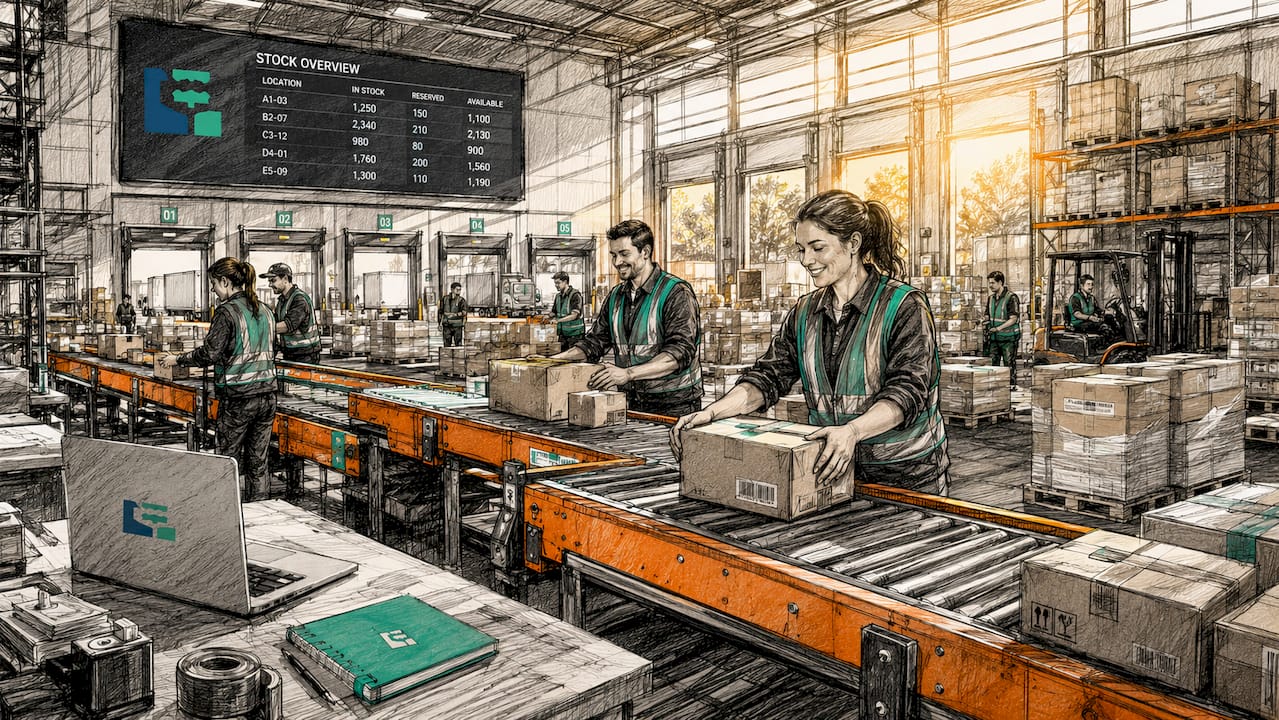
Technology ties the whole network together. A multi-site Warehouse Management System (WMS) provides real-time visibility across all locations. Without it, you are essentially running separate, disconnected operations that cannot respond to demand shifts as a unified system.
Pro Tip: Start by mapping your top 20% of SKUs by order volume. These are your candidates for distributed placement. Everything else stays central until demand patterns justify the move.
What are the advantages of distributed warehousing?
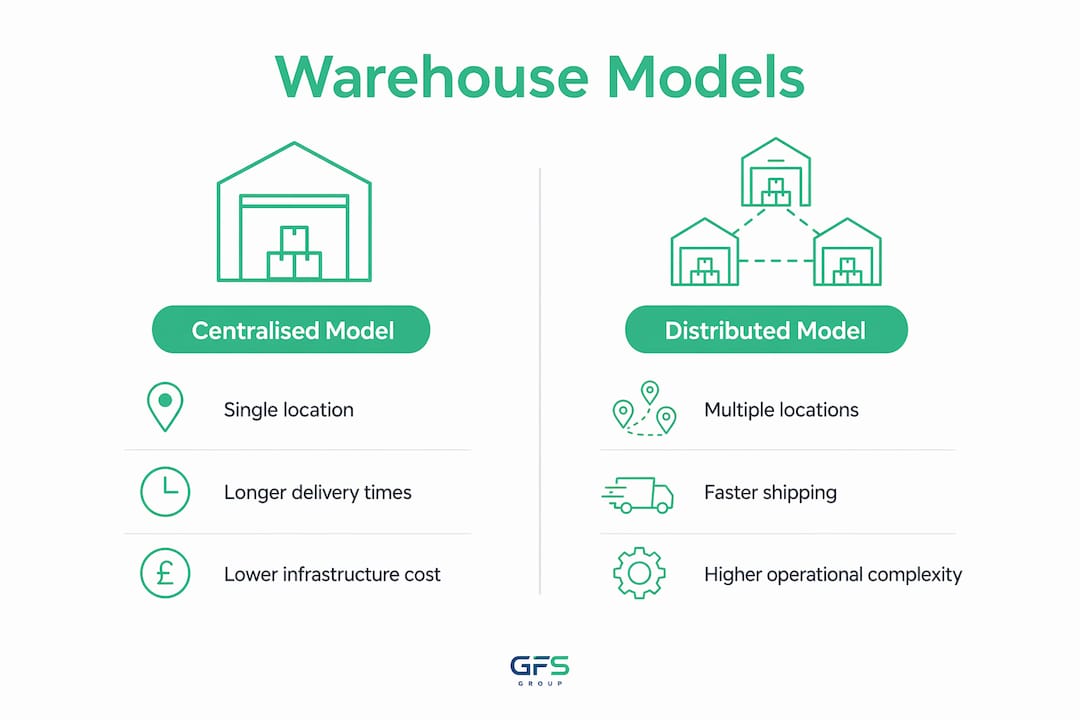
The core advantage of distributed warehousing is proximity. Localised stock positioned closer to customer demand points reduces stockout risk and improves fulfilment service levels compared to single-origin models. That improvement compounds across several dimensions.
- Shorter transit times. Orders travel fewer kilometres to reach customers. This directly enables same-day and next-day delivery promises that shoppers now expect.
- Lower last-mile shipping costs. Carriers charge less for short-zone deliveries. Multi-node strategies reduce last-mile delivery costs, though they require rigorous operational discipline to realise those savings consistently.
- Reduced stockout risk. Stock held near demand points means a regional surge does not drain your entire inventory. One node running low does not automatically mean a customer-facing stockout.
- Supply chain resilience. Distributed warehousing offers redundancy: if one node faces disruption through a flood, a labour dispute, or a carrier failure, other nodes compensate to maintain service levels.
- Competitive delivery promises. Amazon’s fulfilment network has trained customers to expect fast delivery. A distributed model gives independent e-commerce brands the infrastructure to compete on those terms.
Consider a UK fashion brand selling nationally. Shipping every order from a single Midlands warehouse means customers in Scotland and the South West face longer transit times and higher carrier costs. Adding a fulfilment node in Glasgow and another near Bristol cuts those times and costs simultaneously. The flexible warehousing approach that supports this kind of regional coverage is precisely what growing e-commerce brands need.
What are the trade-offs of distributed warehousing?
Distributed warehousing is not without real costs. Operating multiple warehouses increases inventory management complexity and requires holding more safety stock than a centralised model. That additional buffer stock ties up working capital at every node.
The main challenges break down as follows:
- Higher safety stock requirements. Each location needs its own buffer to guard against demand variability and replenishment delays. Across five nodes, that buffer multiplies significantly.
- Inventory visibility gaps. Without a unified WMS, you risk having aggregate stock that looks sufficient but is distributed in the wrong locations. Separate inventory tools per warehouse risk stockouts despite overall cover appearing adequate.
- Split shipment costs. When a customer orders two items held at different nodes, you may need to ship two parcels. That doubles your outbound cost for that order and frustrates the customer.
- Replenishment coordination. Reorder-point and routing logic must be updated in a coordinated manner across all sites to manage stockout risk and replenishment lead times effectively. Doing this manually across multiple locations is error-prone.
- Technology and process investment. Deploying a multi-site WMS requires upfront configuration, staff training, and ongoing maintenance across every location.
These challenges are manageable, but they require deliberate design. SKU rationalisation is the most effective mitigation. Keeping slow-moving lines centralised prevents the worst of the safety-stock inflation and split-shipment problems.
Pro Tip: Before adding a second warehouse location, audit your split-shipment rate from your current setup. If it is already high due to supplier drop-shipping, a distributed model may actually reduce it by consolidating more stock under your control.
Is distributed warehousing right for your business?
The decision between centralised and distributed inventory has wide-ranging implications beyond warehousing alone, touching transportation economics, inventory carrying costs, and replenishment complexity. Use the following factors to assess your situation.
| Factor |
Centralised Model |
Distributed Model |
| Customer geography |
Concentrated in one region |
Spread across multiple regions or nationally |
| SKU profile |
Wide range, many slow movers |
High-velocity, predictable top sellers |
| Delivery expectation |
3–5 day standard acceptable |
Next-day or same-day required |
| Technology readiness |
Basic WMS or spreadsheets |
Multi-site WMS or 3PL with real-time visibility |
| Capital availability |
Limited working capital |
Sufficient to fund additional safety stock |
A business selling bulky, low-frequency items to a regional audience has little to gain from distributing inventory. A brand selling fast-moving consumer goods nationally, where next-day delivery is a purchase driver, has a strong case for multiple nodes.
Geography is the most decisive factor. If more than 30% of your orders travel beyond two carrier zones from your current warehouse, the transit cost and time penalties are already hurting your conversion and repeat purchase rates. That is the clearest signal that distributed storage solutions deserve serious evaluation.
Technology readiness matters equally. A distributed network without real-time stock visibility across all nodes creates more problems than it solves. Assess your current WMS capability honestly before committing to additional locations.
What technology powers successful distributed warehousing?
Technology is what separates a well-run distributed network from an expensive inventory management headache. The right systems provide the visibility and coordination that multiple physical locations cannot achieve through manual processes alone.
Centralised versus decentralised WMS deployment
Deploying a WMS across multiple distribution centres with a decentralised architecture means running independent instances per site. Each site makes its own decisions, which complicates reporting and integration. A centralised, cloud-hosted WMS provides uniform visibility and simpler maintenance across all locations. For most e-commerce businesses, the cloud model is the right starting point.
Multi-site WMS deployments influence not just technology but how operational decisions are made, requiring alignment between your IT team and your logistics operations. This is a people and process challenge as much as a software one.
Key technology capabilities to prioritise
- Real-time stock visibility: Every node’s inventory position must be visible from a single dashboard. This prevents over-ordering at one site while another runs short.
- API integrations with 3PLs and carriers: Platforms like Extensiv and Linnworks connect your order management system to multiple fulfilment partners, automating routing decisions based on proximity and stock availability.
- Coordinated reorder-point logic: Replenishment triggers must account for each node’s individual demand rate and lead time, not just aggregate stock levels.
- Order routing rules: Your system should automatically assign each order to the nearest node with available stock, minimising transit distance and cost.
For brands working with third-party logistics providers, API connectivity is non-negotiable. A 3PL that cannot share real-time stock data with your systems is a visibility black hole. When evaluating 3PL partners for a distributed network, ask specifically about their WMS integration capabilities and how they handle warehouse optimisation across multiple client locations.
Amazon’s FBA network is the most widely recognised example of distributed warehousing at scale. Understanding how Amazon distributes inventory across its fulfilment centres illustrates the routing logic and node placement principles that any distributed network must replicate, at whatever scale suits your business.
Key takeaways
Distributed warehousing delivers faster delivery and lower last-mile costs, but only when inventory allocation, technology, and network design are deliberately aligned from the outset.
| Point |
Details |
| Core definition |
Distributed warehousing stores inventory across multiple locations to reduce delivery distance and improve service levels. |
| SKU allocation is critical |
Only fast-moving, predictable SKUs should be distributed; slow movers stay centralised to control safety-stock costs. |
| Technology is non-negotiable |
A centralised, cloud-hosted WMS with real-time visibility across all nodes prevents stockouts and split-shipment errors. |
| Trade-offs are real |
Higher safety stock, split shipment risk, and replenishment complexity must be managed through deliberate network design. |
| Geography drives the decision |
Businesses with customers spread across multiple regions gain the most from distributed storage solutions. |
The uncomfortable truth about distributed warehousing
Most articles on this topic make distributed warehousing sound like a straightforward upgrade. In practice, the businesses that struggle most are those that distribute too broadly, too quickly.
The single biggest mistake I see is treating distributed warehousing as an inventory duplication exercise. Brands push their full SKU catalogue to every new node, safety stock multiplies, and the working capital impact hits before the delivery improvements show up in the numbers. The correct approach is surgical. Identify your top-velocity SKUs, the ones that drive 70–80% of your order volume, and distribute those first. Everything else stays central.
The second pitfall is underestimating the technology alignment required. Your WMS, your order management system, and your 3PL’s systems must share data in real time. When they do not, you end up with phantom stock situations where a node shows available inventory that has already been committed elsewhere. That creates the exact stockouts you were trying to prevent.
My practical advice: treat your first distributed node as a pilot. Choose one region where your delivery performance is weakest, move your top 20 SKUs there, and measure the impact on transit times and carrier costs over 90 days. The data from that pilot will tell you more than any network modelling exercise. Scale from evidence, not from ambition.
The brands that get this right treat scalable logistics as an ongoing operational discipline, not a one-time infrastructure decision.
— ChiefPlaneteer
How Parcelplanet supports your distributed fulfilment strategy
If you are ready to move beyond a single warehouse and build a fulfilment network that matches where your customers actually are, Parcelplanet is built for exactly that challenge.

Parcelplanet provides order fulfilment services across multiple locations, with real-time stock visibility and direct integrations with leading e-commerce platforms and courier networks. Whether you are managing high-velocity SKUs across two regions or scaling to a national multi-node operation, Parcelplanet’s team handles the picking, packing, and shipping so you can focus on growth. You also get the store integrations needed to connect your sales channels directly to your fulfilment network. Get in touch with Parcelplanet today for a tailored quote.
FAQ
What is distributed warehousing in simple terms?
Distributed warehousing is the practice of storing inventory across multiple locations rather than one central warehouse. The goal is to position stock closer to customers, reducing delivery times and shipping costs.
How does distributed warehousing differ from a single distribution centre?
A single distribution centre ships all orders from one location, which increases transit times for distant customers. Distributed warehousing uses several nodes positioned regionally, so most orders travel a shorter distance to reach the customer.
Which skus should be distributed across multiple warehouse nodes?
Only fast-moving, predictable SKUs should be allocated to multiple nodes. Slower-moving lines should remain centralised to avoid inflating safety-stock costs and increasing split-shipment risk.
What technology do i need to run a distributed warehouse network?
A cloud-hosted, multi-site WMS with real-time inventory visibility is the foundation. API integrations with your 3PL partners and order management system are also required to automate routing and replenishment decisions accurately.
Is distributed warehousing suitable for small e-commerce businesses?
It depends on your customer geography and order volume. If a significant share of your orders travel long distances from your current warehouse, a second fulfilment node may reduce costs. Platforms like Extensiv and Linnworks make multi-location inventory management accessible to mid-market sellers without enterprise-level budgets.
Recommended


