TL;DR:
- Inventory optimisation uses data-driven models to balance stock levels with market demand, reducing costs and improving service. It differs from basic inventory management by enabling continuous, network-wide, and predictive decision-making, especially for multi-warehouse e-commerce operations. Implementing effective strategies requires clean data, segmentation, simulation, and coordinated supply chain planning to achieve real improvements.
Inventory optimisation is defined as a strategic, data-driven approach that balances stock levels with market demand to minimise carrying costs, reduce obsolete stock, and maintain service levels across your supply chain. Unlike basic stock counting, it uses mathematical models and real-time data to make decisions across your entire network. For e-commerce businesses managing multiple SKUs, sales channels, and fulfilment locations, getting this right is the difference between profit and waste. Frameworks like ABC Analysis, Just-in-Time replenishment, and AI-driven forecasting are the tools that make it possible. Understanding how to optimise inventory is no longer optional for growing brands.
What is inventory optimisation vs. basic inventory management?
Inventory management and inventory optimisation are not the same thing. Many e-commerce businesses confuse the two, and that confusion costs them money.
Basic inventory management covers the fundamentals: tracking stock quantities, recording receipts and dispatches, and flagging when items run low. It answers the question “what do we have?” Inventory optimisation answers a harder question: “what should we have, where, and when?” It uses advanced analytics and real-time data to make those decisions continuously, not just at month-end stock counts.
The practical gap between the two shows up in several ways:
- Reactive vs. predictive: Basic systems alert you when stock drops below a threshold. Optimisation systems predict when that threshold will be hit, accounting for lead times, demand variability, and seasonal shifts.
- Single node vs. network-wide: Basic management often looks at one warehouse or location in isolation. Optimisation takes a multi-echelon view across suppliers, distribution centres, and retail points simultaneously.
- Uniform policies vs. segmented strategies: Basic systems apply the same reorder rules to every SKU. Optimisation applies different policies based on item value, demand pattern, and supply risk.
- Static vs. continuous: Basic management runs on periodic reviews. Optimisation runs continuously, adjusting parameters as conditions change.
The risk of treating tracking as optimisation is real. A business that simply automates its existing reorder points is not optimising. It is automating a guess. Without a network-wide perspective, you can reduce stock at one node only to create a shortage at another, which amplifies disruptions rather than preventing them.
What are the key inventory optimisation techniques?
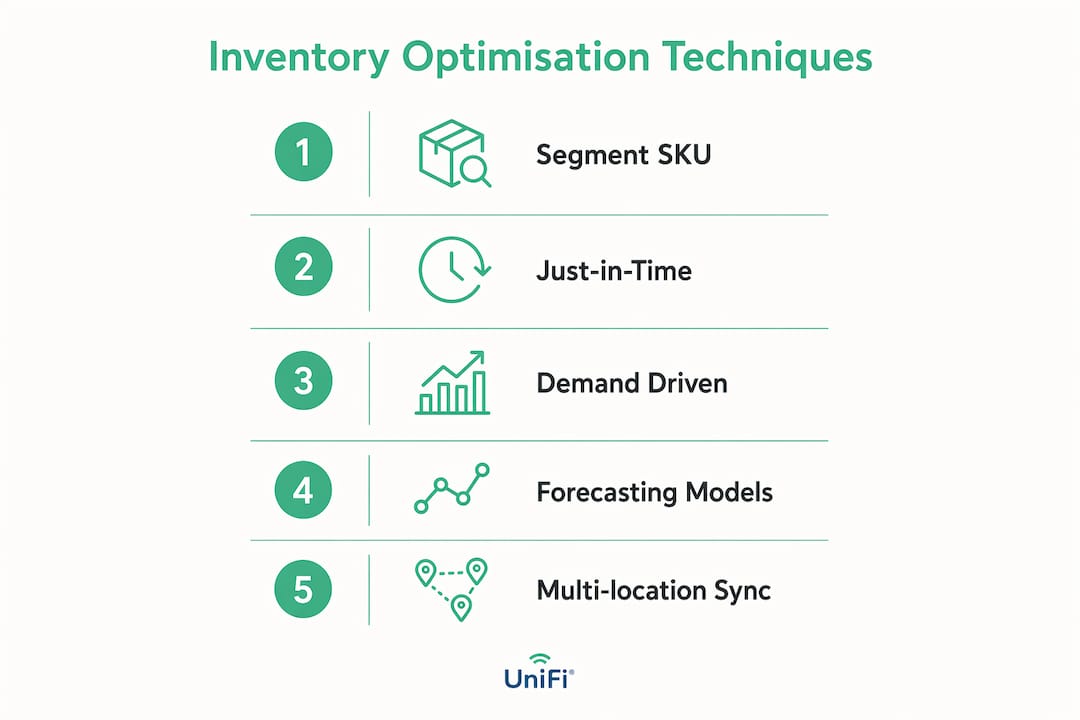
The most effective inventory optimisation techniques combine proven frameworks with modern technology. No single method works for every business, but the following approaches form the foundation of strong inventory management strategies.
-
ABC Analysis and XYZ Segmentation. ABC Analysis classifies SKUs by revenue contribution: A items are high value, B items are mid-range, and C items are low value. XYZ segmentation layers demand variability on top, rating items by how predictable their sales patterns are. Using an ABC/XYZ matrix allows you to apply precise forecasting and replenishment policies to each category rather than treating all products identically. A high-value, unpredictable item needs a very different safety stock policy than a low-value, steady seller.
-
Just-in-Time (JIT) Replenishment. JIT reduces holding costs by ordering stock only when it is needed, minimising the capital tied up in your warehouse. It works best for predictable, fast-moving SKUs with reliable suppliers. For e-commerce businesses with tight cash flow, JIT can free up significant working capital.
-
Demand-Driven Material Requirements Planning (DDMRP). DDMRP positions strategic buffer stock at key points in the supply chain based on actual demand signals rather than forecasts alone. It is particularly useful for businesses with complex, multi-tier supply chains where traditional forecasting breaks down.
-
AI and Predictive Analytics. AI-driven forecasting predicts demand and lead-time variability with high precision, enabling continuous optimisation rather than periodic manual reviews. Tools that use machine learning can factor in promotions, seasonality, and external market signals simultaneously, something no spreadsheet can replicate.
Pro Tip: Before selecting a technique, map your SKU catalogue using the ABC/XYZ matrix. This single exercise will reveal which products deserve sophisticated forecasting and which can be managed with simple reorder points. Most businesses find that 20% of their SKUs drive 80% of their complexity.
Why does multi-location optimisation matter for e-commerce?
Single-location thinking is one of the most expensive mistakes in e-commerce supply chains. Optimising one warehouse in isolation does not reduce total network costs. It shifts them.

Optimising across multiple echelons simultaneously, covering suppliers, regional distribution centres, and last-mile fulfilment points, reduces total cost and improves service levels far more effectively than isolated node improvements. The reason is interdependence. Stock decisions at a distribution centre directly affect what your fulfilment centre needs to hold as safety stock. Ignore that relationship and you create inefficiency at both ends.
The bullwhip effect illustrates this clearly. Small fluctuations in customer demand get amplified as they travel up the supply chain, causing suppliers to over-produce and warehouses to over-stock. Network-wide visibility breaks that cycle by sharing real demand signals across every node rather than letting each one react to the distorted signal it receives from the node below it.
| Factor |
Single-Location Optimisation |
Multi-Location Optimisation |
| Cost focus |
Reduces costs at one node |
Reduces total network costs |
| Service levels |
May improve locally, worsen elsewhere |
Improves consistently across all channels |
| Bullwhip effect |
Amplifies demand distortion |
Reduces distortion through shared visibility |
| Safety stock |
Held redundantly at each location |
Pooled and positioned strategically |
| Complexity |
Lower to manage |
Higher, but yields greater returns |
For e-commerce brands selling across multiple channels and regions, the case for multi-location thinking is clear. The brands that win on fulfilment speed and cost are the ones treating their entire network as a single system, not a collection of independent warehouses.
How to implement inventory optimisation in practice
Knowing the techniques is one thing. Applying them to a live e-commerce operation is another. The following steps give you a practical path from where you are now to a functioning optimisation approach.
- Audit and clean your data first. Automation of broken processes leads to suboptimal outcomes. Before you implement any optimisation tool or replenishment policy, verify that your product data, stock counts, and sales history are accurate. A single source of truth across all sales channels is non-negotiable.
- Align replenishment policies with warehouse workflows. Inventory optimisation is not just software. It is a playbook connecting strategy to warehouse-floor execution. If your replenishment triggers generate purchase orders that your warehouse cannot process in time, the policy fails regardless of how mathematically sound it is. Use your warehouse optimisation guide to align both sides.
- Set KPIs that reflect real trade-offs. Good inventory optimisation quantifies trade-offs between service levels, safety stock, and working capital. Track inventory turns, fill rate, and days of supply alongside cost metrics. Apply higher service level targets only to your critical A-category SKUs.
- Include procurement in your strategy. Managing vendor contracts and rogue spend is critical to controlling acquisition costs. Procurement is a profit-driving function that many businesses exclude from their optimisation work entirely, leaving significant cost savings on the table.
- Use simulation before going live. Supply chain simulation tools allow you to test stocking and replenishment changes in a safe environment before applying them to real operations. Most basic inventory systems lack this capability. If yours does not have it, consider a dedicated supply chain design application.
Pro Tip: Run a 90-day retrospective on your top 20 SKUs before setting any new replenishment parameters. Compare what you actually sold against what your system predicted. The gap between forecast and reality tells you exactly where your current approach is weakest and where to focus first.
Scenario planning is particularly valuable for e-commerce businesses approaching peak trading periods. Simulating a 30% demand spike before it happens lets you pre-position stock, negotiate supplier lead times, and avoid the reactive, expensive decisions that erode margin during busy seasons. Pair this with data-driven logistics insights to build a fuller picture of where your supply chain is most exposed.
Key takeaways
Effective inventory optimisation requires combining segmentation frameworks, network-wide visibility, clean data, and simulation capabilities to reduce costs and maintain service levels across your entire supply chain.
| Point |
Details |
| Optimisation goes beyond tracking |
Use mathematical models and real-time data, not just reorder alerts, to manage stock. |
| Segmentation is non-negotiable |
Apply ABC/XYZ analysis to tailor replenishment policies to each SKU category. |
| Think network-wide |
Optimising one location in isolation shifts costs rather than reducing them. |
| Clean data comes first |
Audit product and stock data before implementing any automation or optimisation tool. |
| Simulate before you commit |
Test replenishment changes using scenario tools to avoid costly live mistakes. |
The part most businesses get wrong
I have worked with e-commerce brands at every stage of growth, and the pattern I see most often is this: a business invests in an inventory optimisation tool, connects it to their warehouse management system, and then wonders why nothing improves. The tool is not the problem. The process underneath it is.
Optimisation software cannot fix a catalogue with duplicate SKUs, inaccurate lead times, or supplier data that has not been updated in two years. When you automate a broken process, you get broken results faster. The businesses that see genuine improvement are the ones that treat the data audit as the actual project, not the preamble to it.
The second thing I would push back on is the instinct to apply the same service level target to every product. Holding 98% availability across your entire catalogue sounds impressive. In practice, it means tying up capital in slow-moving C-category items that your customers would happily wait an extra day for. Segment your policies. Protect your A items. Let your C items carry less safety stock and accept a slightly lower fill rate. Your cash flow will thank you.
Finally, do not ignore procurement. The cost of acquiring stock is as important as the cost of holding it. Vendor contracts, minimum order quantities, and payment terms all affect your true inventory cost. Bring your procurement team into the optimisation conversation from the start, not after the fact.
— ChiefPlaneteer
How Parcelplanet supports your inventory goals
Getting your inventory strategy right is only half the equation. You also need a fulfilment partner who can execute it accurately, at speed, and across multiple channels.

Parcelplanet’s order fulfilment services are built for e-commerce and omnichannel brands that need real-time stock visibility, flexible SKU handling, and integrations with platforms including WooCommerce and BigCommerce. As your business grows, Parcelplanet scales with you, handling increased order volumes without the overhead of managing your own warehouse. If you are ready to align your inventory strategy with a fulfilment operation that can deliver on it, get in touch with the Parcelplanet team for a tailored quote today.
FAQ
What is inventory optimisation in simple terms?
Inventory optimisation is the process of using data and analytics to hold the right amount of stock, in the right place, at the right time. It balances customer service levels against the cost of holding and acquiring stock.
How does inventory optimisation differ from inventory management?
Inventory management tracks what stock you have. Inventory optimisation uses mathematical models and real-time data to decide what stock you should have across your entire network, continuously adjusting for demand and supply variability.
What are the main inventory optimisation techniques?
The core techniques include ABC/XYZ segmentation, Just-in-Time replenishment, Demand-Driven Material Requirements Planning, and AI-driven demand forecasting. Most e-commerce businesses benefit from combining several of these rather than relying on one alone.
Why is multi-location inventory optimisation important?
Optimising a single warehouse in isolation can reduce costs locally while creating shortages or excess stock elsewhere in your network. A multi-echelon approach shares demand signals across all nodes, reducing the bullwhip effect and lowering total network costs.
Audit and clean your product and stock data first. Automating inaccurate data produces inaccurate results. Establish a single source of truth across all sales channels before connecting any optimisation or replenishment system.
Recommended


