TL;DR:
- Pick and pack is a structured warehouse process where orders are received, items are accurately retrieved, and parcels are sealed and labeled for dispatch. Maintaining high accuracy, especially at the line level, is crucial to prevent costly errors and ensure customer satisfaction. Outsourcing to a 3PL offers expertise, technology, and scalability for growing e-commerce businesses.
If you are running an online store, you will hear the term “pick and pack” repeatedly. But what is pick and pack, really? Most people assume it simply means grabbing a product off a shelf and putting it in a box. The reality is considerably more structured. Pick and pack, formally known as order picking and packing, is the core operational process inside a fulfilment warehouse that determines whether your customer receives the right product, on time, undamaged. Get it wrong and you are dealing with returns, angry reviews, and lost revenue.
Key takeaways
| Point |
Details |
| Pick and pack is multi-stage |
The process covers order receipt, item retrieval, packing, labelling, and carrier handoff, not just boxing. |
| Accuracy benchmarks matter |
Median pick and pack accuracy for e-commerce brands sits at 99.1% across Shopify 3PLs, so small errors compound fast. |
| Line-level errors are the right metric |
Measuring errors per line picked, not per order, gives you genuinely useful operational data. |
| Warehouse layout directly affects speed |
Slotting SKUs close to packing stations reduces picker travel time and cuts fulfilment costs. |
| 3PLs offer ready-built pick and pack services |
Outsourcing to a specialist means accessing trained staff, verified processes, and established technology from day one. |
What is pick and pack: the process explained
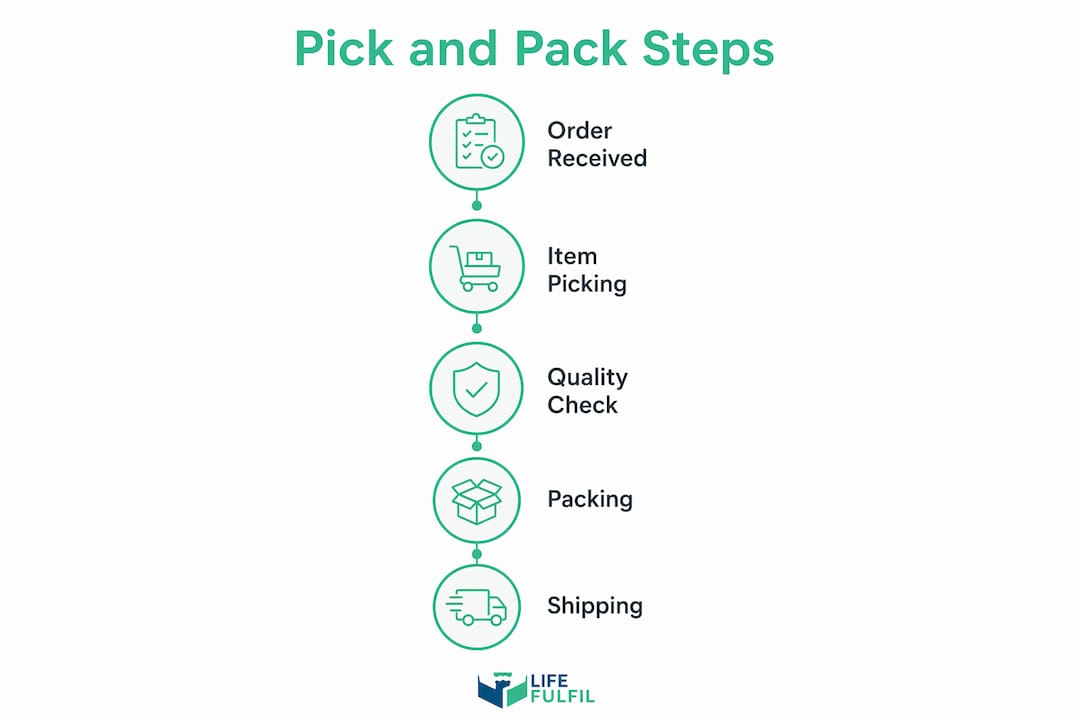
Pick and pack logistics describes the warehouse workflow that takes a customer order from a digital notification to a sealed, labelled parcel ready for the carrier. It is the heartbeat of e-commerce fulfilment, and warehouses process orders within hours of placement, handling thousands of unique orders daily. Each one follows the same structured sequence.
Here is how the process works in a typical warehouse:
- Order receipt. A customer places an order on your website. The warehouse management system (WMS) receives this instantly and generates a picking list. This list tells staff exactly which products are needed, the quantity, and where to find them in the warehouse.
- Picking. A picker navigates to each storage location identified on the list and retrieves the correct items. Accuracy at this stage is non-negotiable. A scanner confirms each product’s barcode against the order before the item moves forward.
- Transfer to packing station. Picked items travel to a dedicated packing area. This physical separation between picking and packing is not incidental. It creates a verification moment that catches errors before they reach the customer.
- Packing. At the packing station, staff check the items against the original order, add protective materials, include any inserts or documentation, seal the box, and apply the shipping label. This is the last chance to catch errors before the parcel leaves the building.
- Label and dispatch. Tracking information is generated at packing completion and communicated to the customer. The parcel then moves to the carrier collection area.
Pro Tip: Ask any fulfilment provider how they handle the handoff between picking and packing. If they cannot describe a clear verification step at that point, treat it as a red flag.
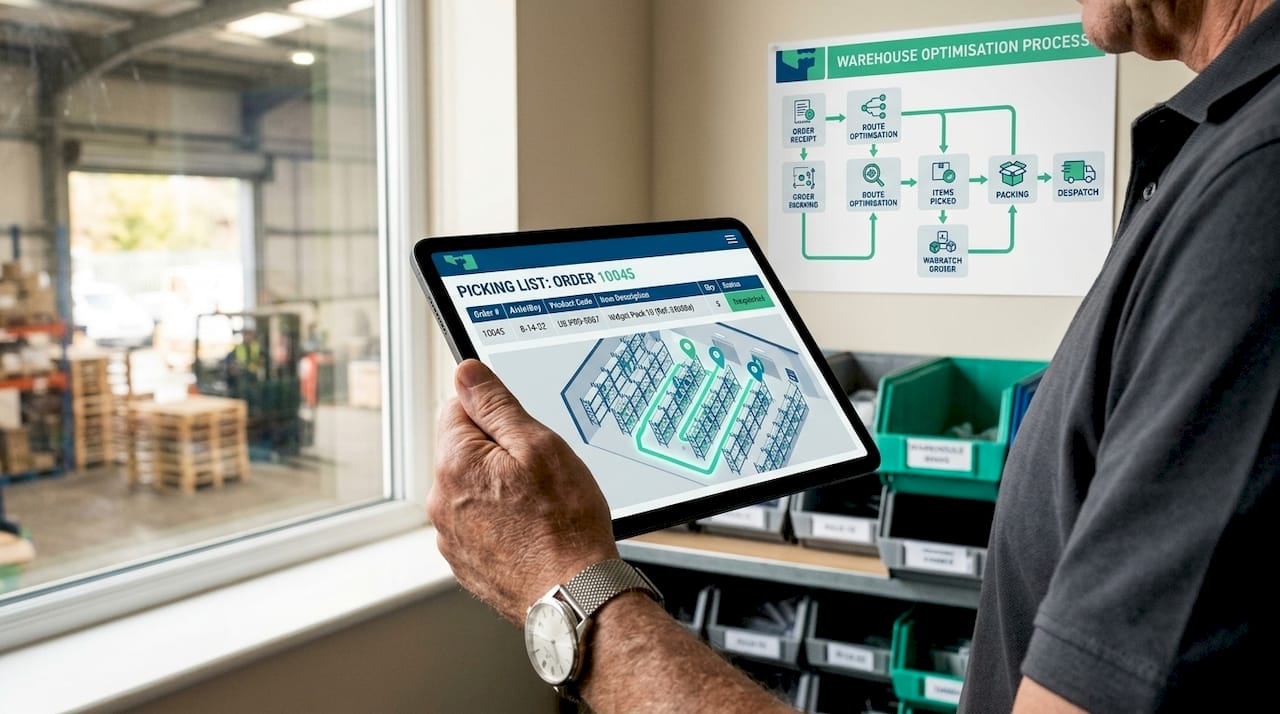
The entire workflow is guided by the WMS, which directs pickers along the most efficient route and keeps a live record of inventory levels. Without this system, accuracy and speed both suffer significantly.
Why pick and pack accuracy is everything
Explaining pick and pack as a physical process is straightforward. Understanding why accuracy is the defining variable is where most e-commerce entrepreneurs gain a genuine edge.
Median pick and pack accuracy for Shopify 3PLs is 99.1%, which sounds impressive until you consider what the remaining 0.9% means at volume. If your store ships 10,000 orders a month, that figure represents 90 incorrect parcels. Each wrong order generates a return, a replacement shipment, a customer service interaction, and possible reputational damage. The maths shifts the definition of “good enough” considerably.
There is also an important distinction in how errors are counted:
- Order-level accuracy measures whether a complete order is correct. One wrong item in a five-product order counts as one failed order.
- Line-level accuracy measures whether each individual product line within an order is correct. That same failed order counts as one error out of five lines.
Line-level error rate is the correct metric for monitoring operational quality. Order-level figures mask the true scale of errors and make performance look better than it is. For context, the benchmark for apparel brands is 0.1% to 0.3% errors per line picked, with 0.5% considered the hard ceiling before an operation is out of control.
Common causes of pick and pack errors include selecting the wrong SKU (particularly where similar products are stored close together), missing items from multi-line orders, and packaging failures that damage products in transit. Each error type carries different consequences. Wrong SKUs erode trust. Missing items trigger chargebacks. Packaging failures generate damage claims with carriers. Monitoring errors by type, not just by total count, tells you where to direct your corrective effort.
Warehouse design and operational efficiency
How a warehouse is physically arranged has a direct and measurable impact on pick and pack speed and cost. This is an area that often surprises e-commerce entrepreneurs who are accustomed to thinking about logistics at a software level.
Slotting, the practice of organising SKUs close to packing stations based on order frequency, is one of the highest-return operational improvements available. A best-selling product stored at the far end of a warehouse adds seconds to every single pick. At scale, those seconds become hours of wasted labour per week. Effective slotting places your fastest-moving products in the zone closest to packing stations, reducing travel time and increasing throughput.
Beyond layout, these factors shape operational efficiency:
- Scanning technology. Handheld scanners that verify each item against the order before it leaves the pick face are standard in well-run operations. They remove reliance on memory and manual checking.
- Digital picking lists. Paper lists are slow and error-prone. Digital lists displayed on scanners or mobile devices guide pickers along optimised routes and update in real time as inventory moves.
- Packing verification tools. Scales at packing stations that flag packages with incorrect weights are a simple, effective safeguard. If a three-item order weighs the same as a two-item order, something is missing.
- Staff training and SOPs. Technology supports people; it does not replace them. Clear standard operating procedures for every step, combined with regular training, maintain consistency across shifts.
Pro Tip: Review your warehouse fulfilment operations against a structured checklist at least quarterly. Layout and product mix both change over time, and a slotting strategy that made sense six months ago may be creating inefficiency today.
Balancing speed with care is the final operational challenge. Rushed packing damages products and generates carrier claims. Overly cautious packing slows throughput. The answer is well-designed packing stations with standardised materials, clear instructions, and weight verification, so speed and care are built into the process rather than left to individual judgement.
Pick and pack versus other fulfilment methods
Not every business needs pick and pack logistics. Understanding where it fits relative to other fulfilment approaches helps you make an informed decision for your specific model.
| Fulfilment method |
Best suited for |
Key trade-off |
| Pick and pack |
Individual e-commerce orders with varied SKUs |
Higher labour cost per unit but maximum flexibility |
| Bulk pallet shipping |
Wholesale or B2B orders of uniform products |
Low cost per unit but no individual order customisation |
| Batch picking |
High-volume e-commerce with repeated SKU combinations |
Faster throughput but less suited to highly varied orders |
| Dropshipping |
Businesses with no warehouse capacity |
Minimal overhead but limited control over quality and speed |
Pick and pack is the natural home for e-commerce businesses selling multiple product types to individual consumers. It is what enables a customer to order three different items in one transaction and receive them correctly packed in a single parcel. Bulk pallet shipping serves wholesale relationships, not individual consumers. Batch picking is a variation within the pick and pack family, where pickers collect items for multiple orders simultaneously to reduce travel time, but it still feeds into the same packing and verification steps.
What is a pick and pack service from a 3PL? It is the complete outsourced version of this workflow. A third-party logistics provider operates the warehouse, employs the staff, maintains the technology, and manages the entire process on your behalf. This is worth considering seriously if your business is growing beyond your current space or operational capacity. You gain access to built-in expertise in picking and packing for e-commerce growth without the capital investment of building your own operation.
Practical steps to improve your pick and pack process
Whether you are managing fulfilment in-house or evaluating a third-party provider, these steps directly improve accuracy and efficiency.
- Set line-level error rate targets. Do not rely on order-level figures. Agree on a benchmark (0.3% errors per line picked is a solid starting point) and measure against it weekly, not monthly. Weekly measurement keeps problems visible before they become embedded patterns.
- Audit your inventory accuracy separately. Pick and pack accuracy and inventory record accuracy are distinct KPIs. You can have excellent picking accuracy while your inventory records are drifting, which leads to stockouts and unfulfilled orders. Treat them as separate measurements.
- Require a verification step between picking and packing. Verification moments between picking and packing are where errors are caught. If your current process has no formal check at this point, you are relying on luck.
- Evaluate packing materials relative to your product mix. The wrong box size or insufficient protective material causes damage claims. Match materials to products, not to convenience.
- Integrate your e-commerce platform with your WMS. Manual order entry creates errors from the very start of the process. Platform integration eliminates that risk entirely.
Choosing a pick and pack provider requires asking specific questions about their error benchmarks, how they measure accuracy, what technology they use at the verification stage, and how they handle error resolution. Vague answers to these questions are informative in themselves.
My take on what pick and pack really demands
I have seen many e-commerce brands focus all their energy on picking speed and miss what actually drives accuracy. Picker speed matters, of course, but in my experience the single most important moment in the entire process is the verification check between picking and packing. That brief, structured pause is where errors get caught. When operations cut that step to save seconds, the resulting error costs are an order of magnitude more expensive than the time they saved.
There is also a misconception I encounter regularly: business owners assume that good pick and pack accuracy means their inventory is accurate. These are genuinely separate things. I have seen operations achieve 99% picking accuracy while their inventory records were running at 96%, meaning phantom stock and surprise stockouts were creating a steady background drain on revenue. Tracking both metrics independently is not optional if you want a clear picture of your fulfilment operation.
My honest advice is this. Measure more granularly than feels necessary, start with line-level error rates measured weekly, and never accept a provider’s claim of high accuracy without asking which metric they are using to define it. The answer tells you everything about how seriously they take process control.
— Lukasz
How Parcelplanet supports your pick and pack operations
If you are ready to take your order fulfilment seriously, Parcelplanet’s order fulfilment services are built precisely for e-commerce brands at this stage of growth. Parcelplanet manages the complete pick and pack workflow, from order receipt through picking, packing, verification, and carrier handoff, with accuracy standards and real-time tracking built into every step.

Whether you are scaling beyond your current warehouse capacity or starting fresh with a fulfilment partner, Parcelplanet offers tailored solutions that fit your product range, order volumes, and sales channels. The team handles the operational complexity so you can focus on growing your brand. Get in touch with Parcelplanet today to discuss your fulfilment requirements and request a quote.
FAQ
What is pick and pack in e-commerce?
Pick and pack is the warehouse process of locating specific products from inventory (picking), then preparing them with protective packaging, labels, and documentation before handing them to a carrier (packing). It is the core fulfilment operation that determines order accuracy and speed for e-commerce businesses.
How does pick and pack work in a warehouse?
A warehouse management system generates a picking list when an order is placed. Staff retrieve the items, transfer them to a packing station where accuracy is verified, and the parcel is sealed, labelled, and dispatched. Tracking information is created at the packing stage and sent to the customer.
What is a good pick and pack error rate?
For most e-commerce operations, a line-level error rate between 0.1% and 0.3% is considered good, with 0.5% being the upper limit before the operation requires immediate attention. Measuring errors per line picked rather than per order gives a more accurate picture of performance.
What are the main advantages of pick and pack for online sellers?
Pick and pack gives online sellers the flexibility to fulfil individual orders with varied products accurately and quickly. It supports high order volumes, enables customisation of packaging, and integrates with e-commerce platforms to keep inventory records current.
When should I use a pick and pack service from a 3PL?
Consider outsourcing to a third-party pick and pack service when your order volumes exceed your current warehouse capacity, your error rates are rising, or the operational cost of managing fulfilment in-house outweighs the cost of a specialist provider. A 3PL brings trained staff, established processes, and technology from the outset.
Recommended