Seventy per cent of online shoppers won’t return after a failed delivery. That single figure should stop any e-commerce brand manager in their tracks. Shipping accuracy is not a back-office concern reserved for warehouse teams. It sits at the very heart of customer retention, revenue, and brand reputation. Yet many growing businesses still treat speed as the primary logistics metric, overlooking the far more damaging consequences of getting the wrong item to the wrong person. This article will help you understand what shipping accuracy truly means, where errors originate, and how to build a fulfilment operation that keeps customers coming back.
Table of Contents
Key Takeaways
| Point |
Details |
| Accuracy drives retention |
Precise shipping is essential for repeat business and positive brand reputation. |
| Small errors cost big |
Even a minor drop in accuracy can result in significant financial losses at scale. |
| Customers trust reliability |
Customers value reliable, accurate delivery over mere speed every time. |
| Prevention is possible |
Investing in systems, training, and process checks directly reduces shipping errors. |
What does accurate shipping mean?
Shipping accuracy is straightforward in principle: delivering the right item, to the right customer, at the right address, on the promised date, every single time. In practice, it is one of the hardest operational standards to maintain consistently. Many brands confuse speed with precision, assuming that faster dispatch automatically means better service. It does not.
The key performance indicators (KPIs) you should track are your order accuracy rate (the percentage of orders fulfilled without error) and your on-time delivery rate (the percentage of orders arriving by the promised date). Both matter, but accuracy underpins everything. As accurate shipping data shows, even small improvements in order precision can reduce errors by 35%.
Here is where many brands get caught out: a 99% accuracy rate sounds impressive until you apply it to scale. At 10,000 orders per month, that 1% error rate means 100 unhappy customers every single month. At 100,000 orders, it is 1,000. The maths is unforgiving.
Pro Tip: Before you build any improvement plan, document your current accuracy metrics. You cannot fix what you have not measured. Pull your order accuracy and on-time delivery rates for the past 90 days and use that as your baseline.
| Metric |
What it measures |
Why it matters |
| Order accuracy rate |
Correct items shipped vs. total orders |
Directly linked to returns and refunds |
| On-time delivery rate |
Orders arriving by promised date |
Affects customer trust and repeat purchase |
| First-attempt delivery rate |
Successful first delivery vs. total deliveries |
Reduces rerouting costs |
| Return rate from errors |
Returns caused by fulfilment mistakes |
Reveals hidden operational costs |
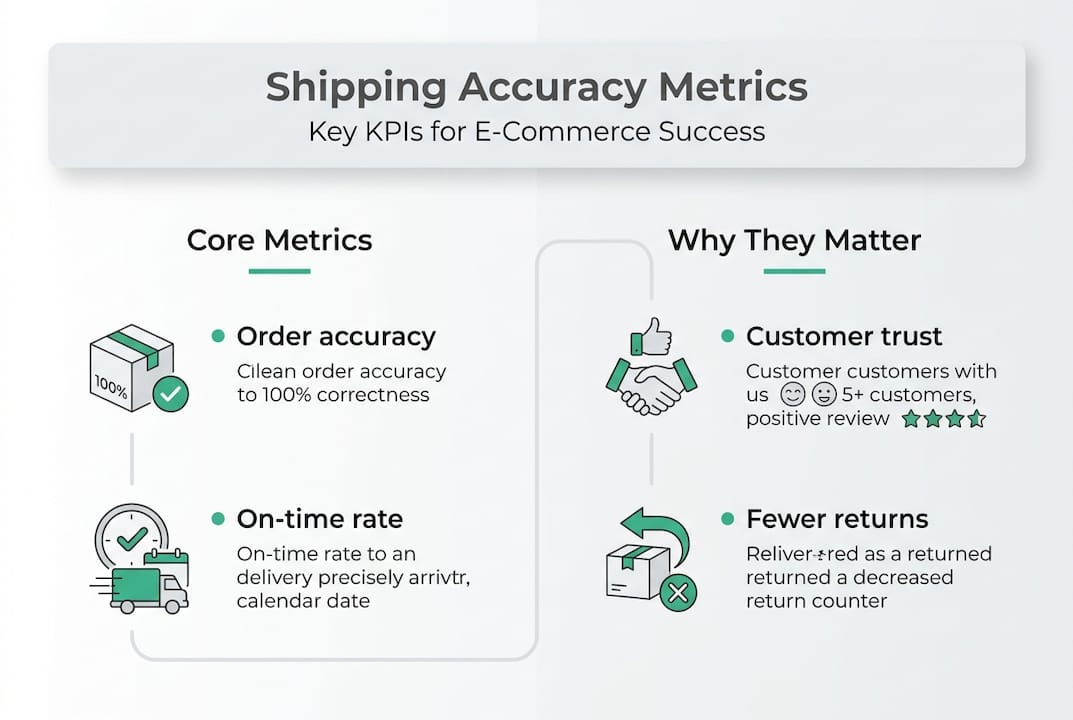
Note that 62% of shoppers prioritise accurate delivery dates over speed. Speed is a hygiene factor. Accuracy is a loyalty driver.
The business impact of shipping errors
A single shipping error costs more than the price of reshipping. There is the direct cost of rerouting or replacing the item, the refund if the customer demands one, and the staff time spent resolving the complaint. Then there are the hidden costs that rarely appear on a balance sheet.
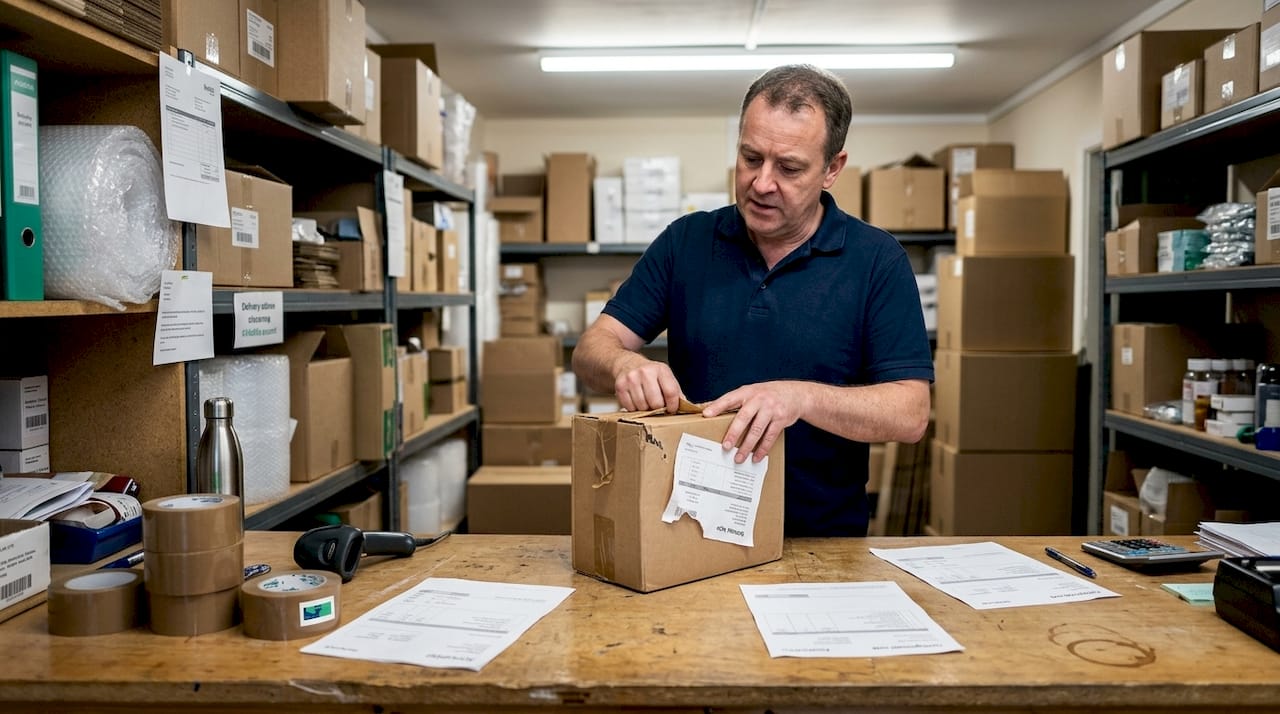
One failed delivery can trigger a negative review, a social media post, or a chargeback. Each of those events carries a multiplier effect that damages your brand well beyond the original order value. When you factor in customer lifetime value, losing one customer to a shipping error could mean losing hundreds of pounds in future revenue, not just the value of that single order.
The financial maths is stark. 99% vs 99.99% accuracy on 100,000 orders is the difference between 1,000 errors and 10. At an average cost of £100 per error (reshipping, refunds, and admin), that gap equates to roughly £99,000 in preventable losses. That is not a rounding error. That is a business risk.
“Shipping errors are not just operational failures. They are broken promises. And customers remember broken promises far longer than they remember a fast delivery.”
To help you optimise shipping accuracy and understand the full scope of risk, here are the top three business consequences of shipping errors:
- Revenue loss: Refunds, reshipping costs, and write-offs on damaged or lost goods eat directly into your margins.
- Customer attrition: 70% of shoppers will not return after a failed delivery, making every error a permanent customer loss.
- Reputational damage: Negative reviews and social media complaints reduce conversion rates for new customers who research your brand before buying.
| Error type |
Average direct cost |
Hidden cost |
| Wrong item shipped |
Reship + refund |
Lost customer lifetime value |
| Late delivery |
Discount or refund |
Negative review, reduced trust |
| Undeliverable address |
Rerouting fee |
Repeat contact, staff time |
| Damaged goods |
Replacement cost |
Chargeback risk |
Understanding logistics and customer retention as interconnected is the first step towards treating accuracy as a strategic priority rather than a warehouse problem. The logistics growth impact on your bottom line is real, measurable, and largely preventable.
Common causes of shipping inaccuracy
Most shipping errors do not happen by accident. They happen because of predictable, repeatable failures in process, technology, or training. Knowing where errors originate is the fastest route to fixing them.
The most frequent culprits, as identified across shipping error research, are:
- Human picking errors: Warehouse staff selecting the wrong SKU, size, or variant during fulfilment.
- Inventory mismatches: Stock levels in your system do not reflect what is physically on the shelf, leading to overselling or incorrect substitutions.
- Address input errors: Customers entering incorrect delivery addresses at checkout, contributing to 20% first-attempt failures across the industry.
- IT system integration faults: Disconnected platforms between your e-commerce store, warehouse management system, and courier mean data gets lost or corrupted in transit.
- Customs and HS code errors: For international shipments, incorrect commodity codes cause delays, returns, and additional charges.
Each of these errors has a direct fix. Here is a practical numbered approach to tackling the most common ones:
- Picking errors: Introduce barcode scanning at the pick stage so every item is verified against the order before it is packed. This single step eliminates the majority of human picking mistakes.
- Inventory mismatches: Run daily cycle counts on your fastest-moving SKUs and reconcile your system stock against physical stock weekly. Guidance on avoiding inventory errors can help you build a reliable process.
- Address errors: Add an address validation tool at checkout that flags incomplete or unrecognised addresses in real time. Detailed advice on fixing address mistakes is worth reviewing if this is a recurring issue for your brand.
- System integration faults: Audit your platform connections quarterly. Ensure your e-commerce store, inventory system, and courier integrations are syncing correctly and that error logs are reviewed regularly.
- Customs errors: Use a validated HS code library and review it whenever you add new product categories. A single incorrect code can hold an entire shipment at the border.
For a broader view of process improvements, e-commerce shipping tips provide a practical framework for reducing errors across your entire operation.
Accuracy versus speed: What customers value more
There is a persistent myth in e-commerce logistics that customers always want faster. Same-day delivery, next-day dispatch, two-hour windows. Speed has become the arms race of online retail. But the data tells a more nuanced story.
62% of online shoppers prefer accurate delivery dates over fast shipping. What customers actually want is reliability. They want to know that when they place an order, it will arrive as promised. A delivery that is two days slower but arrives exactly when expected creates far more satisfaction than an expedited delivery that turns up late or with the wrong item.
“A slow but reliable delivery creates more loyalty than a broken promise.”
This reframing has real commercial implications. If you position your brand around delivery accuracy rather than speed, you set expectations you can consistently meet. That consistency builds trust. Trust drives repeat purchases. Repeat purchases are the foundation of sustainable e-commerce growth.
Messaging accuracy also matters post-purchase. Customers who receive proactive, accurate tracking updates are significantly less likely to contact your support team and more likely to rate their experience positively. The accuracy versus speed debate is, in reality, not a debate at all for most brands. Accuracy wins.
Pro Tip: Make your promised delivery date a visible, prominent feature at checkout. Do not bury it in small print. Displaying a clear, accurate delivery window reduces cart abandonment and sets the right expectation from the very first interaction.
Strategies to improve shipping accuracy in your business
Improving accuracy is not a single project. It is an ongoing operational discipline. But there are clear, structured steps you can take right now to close the gap between what you promise and what you deliver.
System integration failures are among the most common causes of shipping mistakes, yet they are also among the most fixable with the right technology stack. Here is a step-by-step approach:
- Audit your fulfilment process end to end. Map every stage from order placement to delivery confirmation. Identify where errors have occurred in the past three months and categorise them by type.
- Upgrade your system integrations. Ensure your e-commerce platform, warehouse management system, and courier APIs are fully connected and tested. Gaps between systems are where data errors breed.
- Implement address verification at checkout. Use a real-time address validation tool to catch errors before the order is even processed. This is one of the highest-return investments you can make. More on resolving wrong address issues is available if you need a starting point.
- Train your warehouse team regularly. Run monthly briefings on the most common error types your operation is seeing. Staff who understand the customer impact of their work make fewer mistakes.
- Review your inventory management practices. Inaccurate stock data is a silent driver of fulfilment errors. Following e-commerce inventory best practices will help you maintain reliable stock visibility.
- Use data to drive continuous improvement. Review your accuracy KPIs monthly, not quarterly. The faster you spot a trend, the faster you can correct it. Detailed shipping optimisation tips can help you build a repeatable review process.
Pro Tip: Run test orders through your own system every month. Place an order as a customer would, using a real address, and track it through to delivery. This is the fastest way to catch system or address failures before your customers do.
Enhance your shipping accuracy with ParcelPlanet
Putting these strategies into practice requires more than good intentions. It requires the right infrastructure, the right technology, and a fulfilment partner who treats accuracy as a non-negotiable standard.

At ParcelPlanet, our order fulfilment expertise is built around minimising both human and system errors at every stage of the fulfilment process. From barcode-verified picking and packing to real-time inventory management, we give growing e-commerce brands the operational precision they need to keep customers loyal. Our software integrations connect seamlessly with your existing platforms, eliminating the data gaps that cause costly mistakes. We also provide structured support for inventory error avoidance, so your stock data and physical stock are always aligned. If you are ready to move from insight to action, get in touch with our team for a tailored consultation.
Frequently asked questions
What is a good shipping accuracy rate for e-commerce?
A rate of 99.9% or higher is considered excellent for e-commerce operations. Even a 99% accuracy rate can translate into thousands of errors and tens of thousands of pounds in losses at scale.
How does inaccurate shipping affect customer retention?
The impact is severe. Over 70% of shoppers will not place another order after experiencing a failed delivery, making every error a direct threat to long-term revenue.
What are the quickest ways to improve shipping accuracy?
Start with address verification at checkout, regular staff training on common error types, and a quarterly audit of your system integrations to catch data failures before they reach the customer.
Which shipping errors are most common for small businesses?
The most frequent are picking errors, inventory mismatches, and delivery address mistakes, all of which are preventable with the right processes and technology in place.
Recommended