Many e-commerce brands assume they can manage fulfilment internally as orders grow. This misconception often leads to costly bottlenecks, accuracy issues, and frustrated customers. Once you surpass 100 orders monthly, in-house logistics becomes a resource drain that prevents you from focusing on growth. Third-party logistics (3PL) providers offer a proven solution: they handle warehousing, picking, packing, and shipping with technology and scale that most brands cannot replicate. This guide explains why 3PL is essential for brands seeking operational efficiency, cost savings, and customer satisfaction.
Table of Contents
Key Takeaways
| Point |
Details |
| Scales beyond 100 orders |
3PL providers enable growth by handling warehousing, picking, packing and shipping with technology and scale that most brands cannot replicate. |
| Cost reductions via carrier negotiations |
They reduce logistics costs by 20 to 35 per cent through negotiated carrier rates and shared infrastructure. |
| Improves fulfilment accuracy |
3PLs improve accuracy by standardising processes and removing manual bottlenecks, which reduces errors and protects customer satisfaction. |
| Hybrid fulfilment models suit complexity |
Hybrid fulfilment models let brands combine in house and 3PL capacity to handle multi channel requirements and peak periods. |
The challenges of scaling in-house fulfilment
Managing logistics internally works well when you process a handful of orders daily. Once you reach 100 to 300 orders monthly, the strain on your team becomes evident. Picking, packing, and shipping consume hours that could be spent on marketing, product development, or customer service. Your staff juggles multiple roles, leading to errors that damage your brand reputation.
Brands that persist with in-house fulfilment often accumulate what industry experts call fulfilment debt. This backlog of unprocessed orders creates a cascade of problems: delayed shipments, incorrect items sent to customers, and mounting customer service complaints. Each mistake costs you money in returns, refunds, and lost repeat business. The time spent firefighting these issues prevents you from implementing growth strategies.
Consider these common pain points:
- Warehouse space limitations force you to reject bulk inventory discounts
- Manual processes increase picking errors and slow throughput
- Lack of carrier negotiating power means you pay retail shipping rates
- Staff absences or seasonal peaks overwhelm your small team
Scaling in-house logistics requires significant capital investment. You need larger warehouse space, warehouse management systems, trained staff, and relationships with multiple carriers. These fixed costs eat into your margins before you see any efficiency gains. Many brands discover too late that the total cost of ownership for in-house fulfilment exceeds what a 3PL would charge.
“Managing our own fulfilment seemed cost-effective until we calculated the true expenses: rent, utilities, staff wages, packaging materials, and technology. A 3PL would have saved us 30% whilst delivering faster service.”
The operational complexity multiplies when you sell across multiple channels. Each platform has different requirements for order formats, shipping labels, and tracking updates. Keeping systems synchronised manually creates opportunities for costly mistakes. You might oversell inventory on one channel whilst stock sits idle in your warehouse. When you consider switching to a 3PL provider, these pain points become the primary motivators.
How 3PL providers enable scalable and cost-effective logistics
3PL providers operate on a fundamentally different model than in-house fulfilment. When a customer places an order on your website, the order details automatically forward to the 3PL’s warehouse management system. Their trained staff pick the items from optimised storage locations, pack them according to your specifications, and hand them to carriers for delivery. This automated workflow eliminates the manual intervention that slows in-house operations.

The cost advantages come from several sources. 3PL providers reduce logistics costs by 20 to 35% through negotiated carrier rates and shared infrastructure. They ship thousands of parcels daily, giving them bargaining power that individual brands cannot match. You benefit from their volume discounts without needing to commit to minimum shipping volumes yourself.
Multi-node warehouse networks form another key advantage. Rather than shipping every order from a single location, 3PLs distribute your inventory across regional facilities. This strategy reduces delivery times and shipping costs. A customer in Manchester receives their order from a Midlands warehouse, whilst a Scottish customer’s parcel ships from a facility near Glasgow. Faster delivery improves customer satisfaction and reduces cart abandonment rates.
Pro Tip: Choose a 3PL offering tiered pricing that scales with your order volume. This structure ensures you pay proportionally as you grow, avoiding the steep fixed costs of in-house operations.
Technology integration delivers efficiency gains that manual systems cannot replicate. Modern 3PLs achieve 99.5% order accuracy and faster shipping with AI-driven demand forecasting. These systems analyse your sales patterns to predict inventory needs, preventing stockouts and overstock situations. Automated picking routes minimise warehouse travel time, whilst barcode scanning catches errors before parcels leave the facility.
Key benefits you gain from 3PL partnerships:
- Immediate access to enterprise-grade warehouse management systems
- Real-time inventory visibility across all sales channels
- Automated order routing to the optimal fulfilment location
- Carrier performance tracking and automatic service level adjustments
- Scalable capacity that flexes with seasonal demand peaks
The financial impact extends beyond shipping costs. Automation in e-commerce logistics eliminates labour costs associated with picking, packing, and shipping. You avoid hiring and training warehouse staff, managing their schedules, and covering sick leave or holidays. These labour savings often exceed the 3PL’s service fees, especially during peak seasons when temporary staff would be necessary.
| Cost category |
In-house |
3PL |
Savings |
| Warehouse rent |
£2,500/month |
Included in fees |
£30,000/year |
| Staff wages |
£3,200/month |
Included in fees |
£38,400/year |
| Shipping rates |
Retail rates |
15-40% discount |
£12,000/year |
| Technology |
£800/month |
Included in fees |
£9,600/year |
| Total annual cost |
£90,000 |
£60,000 |
£30,000 |
Strategies to save costs with 3PL fulfilment include negotiating flexible contracts, optimising packaging to reduce dimensional weight charges, and consolidating inventory in fewer locations. These tactics become easier to implement when working with an experienced 3PL partner who understands the nuances of carrier pricing and warehouse efficiency.
Choosing between in-house, 3PL, or hybrid fulfilment models
Not every brand benefits equally from outsourcing all fulfilment operations. Your optimal model depends on order volume, product characteristics, and customer expectations. Understanding the trade-offs helps you make an informed decision that aligns with your growth trajectory.
In-house fulfilment offers complete control over every aspect of the customer experience. You design custom packaging, include personalised notes, and handle special requests without coordinating with an external partner. This approach works well for brands processing fewer than 500 orders monthly or those selling high-value items requiring white-glove handling. In-house operations suit brands needing high-touch custom packaging or VIP treatment for every order.
3PL excels when scalability, cost efficiency, and speed matter most. Brands shipping 500 to 50,000 orders monthly gain the most value from outsourcing. The 3PL’s infrastructure absorbs demand fluctuations without requiring you to invest in additional warehouse space or staff. You pay variable costs tied to actual order volume rather than maintaining fixed overhead regardless of sales performance.
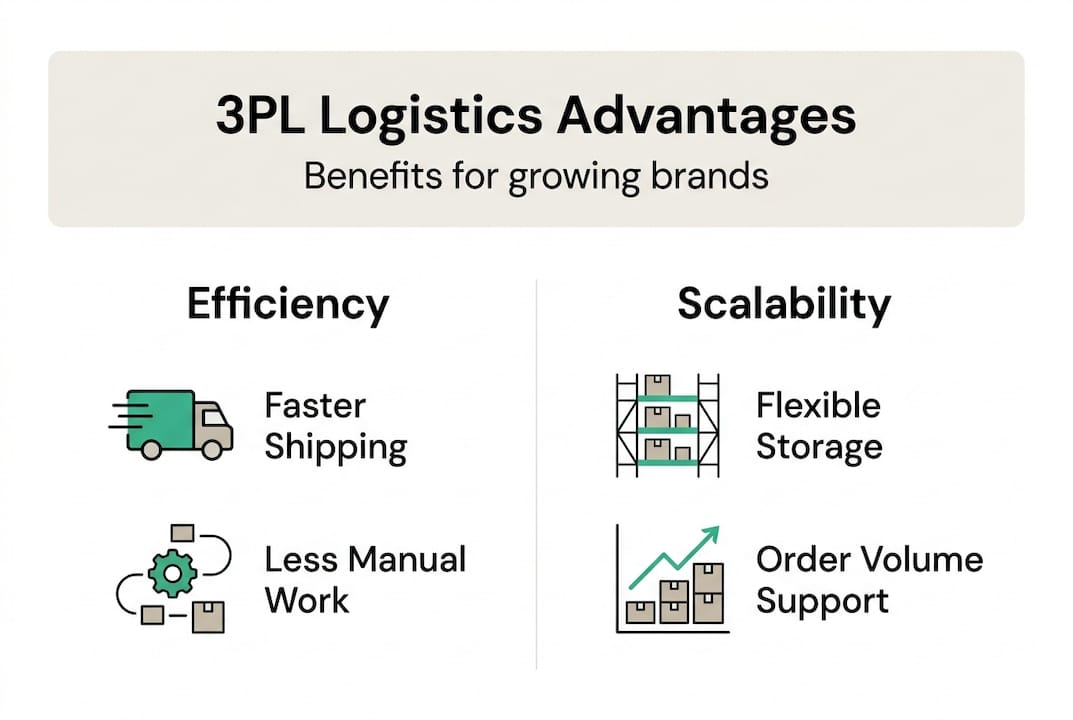
Hybrid models combine the strengths of both approaches. You might handle subscription boxes or limited-edition releases in-house whilst outsourcing standard catalogue items to a 3PL. This split allows you to maintain brand control for special products whilst leveraging 3PL efficiency for high-volume SKUs. Multi-channel brands selling through retail partners, their own website, and marketplaces often find hybrid models provide the flexibility they need.
| Model |
Best for |
Pros |
Cons |
| In-house |
Under 500 orders/month, custom packaging |
Complete control, immediate oversight |
High fixed costs, limited scalability |
| 3PL |
500-50,000 orders/month, standard products |
Low variable costs, instant scalability |
Less packaging customisation |
| Hybrid |
Multi-channel, mixed product types |
Flexibility, optimised costs |
Complex coordination, dual systems |
Pro Tip: Start with 3PL for your core products and keep limited-edition or personalised items in-house. This approach lets you test 3PL performance whilst maintaining control over your most brand-critical fulfilment.
Evaluating your specific situation requires honest assessment of your capabilities and constraints. Ask yourself these questions:
- Do you have dedicated warehouse space or are you using office corners and garages?
- Can your current team handle a 50% increase in orders without additional hires?
- Are shipping costs consuming more than 15% of your average order value?
- Do you spend more than 20 hours weekly on fulfilment tasks?
If you answered yes to two or more questions, strategies to reduce fulfilment costs through 3PL partnerships likely offer significant benefits. The transition might seem daunting, but most 3PLs provide onboarding support that simplifies the process.
Practical steps to implement 3PL for your growing brand
Transitioning to a 3PL partner requires careful planning to ensure smooth operations and avoid disruptions to customer service. Follow these steps to maximise success:
-
Assess your order volume and growth projections. Calculate your average monthly orders over the past six months and forecast the next 12 months based on marketing plans and seasonal patterns. This data helps you evaluate whether 3PL economics work for your business and what service level you need.
-
Evaluate 3PL candidates for integration capabilities. Prioritise providers offering Open API, multi-warehouse networks, and contracts without long commitments. Request demonstrations of their warehouse management system and ask how they handle your specific product types. Check their carrier partnerships to ensure they support your preferred shipping services.
-
Negotiate flexible contracts avoiding long commitments. Seek month-to-month agreements or maximum 12-month terms with clear exit clauses. Understand all fee structures including receiving, storage, picking, packing, and shipping charges. Ask about seasonal peak surcharges and minimum monthly commitments that might apply during slow periods.
-
Plan integration with e-commerce platforms and warehouse management systems. Your 3PL should connect directly to Shopify, WooCommerce, Magento, or whatever platform you use. Test the integration in a sandbox environment before going live. Verify that inventory levels update in real time and order status changes flow back to your customers automatically.
-
Monitor key performance indicators: accuracy, shipping speed, and costs. Establish baseline metrics before switching to 3PL, then track improvements. Review weekly reports on order accuracy rates, average time from order to shipment, and total fulfilment costs per order. Address any performance issues immediately through regular communication with your 3PL account manager.
Pro Tip: Request a trial period where the 3PL handles a subset of your orders whilst you maintain in-house operations for the remainder. This parallel approach lets you validate their performance before committing fully.
Understanding the role of 3PL providers in reducing logistics costs helps you set realistic expectations. Most brands see immediate improvements in shipping speed and accuracy, whilst cost savings accumulate over several months as you optimise inventory placement and eliminate in-house overhead.
How ParcelPlanet supports your 3PL logistics needs
Growing your e-commerce brand requires a logistics partner who understands the challenges you face. ParcelPlanet specialises in scalable 3PL solutions designed for brands transitioning from in-house fulfilment or switching from underperforming providers. Our expertise in carrier negotiations delivers measurable cost savings whilst our flexible contracts ensure you maintain agility as your business evolves.
Our multi-warehouse network positions inventory closer to your customers, reducing delivery times and shipping costs across the UK and internationally. Seamless technology integration connects ParcelPlanet’s systems with your e-commerce platform, marketplaces, and sales channels. Real-time inventory visibility prevents stockouts whilst our AI-driven forecasting optimises replenishment timing. Discover how 3PL providers reduce costs for SMEs through our proven methodologies and review case studies demonstrating tangible results. Whether you need full 3PL services or want to compare 3PL and 4PL options, ParcelPlanet provides tailored solutions that grow with your brand.
Frequently asked questions
What is a 3PL and why is it important for growing brands?
A third-party logistics (3PL) provider handles warehousing, order fulfilment, and shipping operations on behalf of e-commerce brands. This partnership allows you to focus on product development, marketing, and customer acquisition whilst experts manage the complex logistics that consume time and resources. 3PLs become essential when order volumes exceed your team’s capacity to maintain accuracy and speed, typically around 100 to 300 orders monthly.
At what order volume should a brand consider switching to 3PL?
Switching to 3PL becomes beneficial between 100 and 1,000 orders monthly, depending on your product complexity and available resources. Brands processing fewer than 100 orders often manage well in-house, whilst those exceeding 300 orders typically struggle with backlogs and errors. The transition point varies based on your team size, warehouse space, and growth trajectory, but persistent fulfilment challenges signal readiness for 3PL partnership.
Can 3PL providers handle bespoke packaging or custom orders?
Many 3PLs accommodate custom packaging, branded inserts, and special handling requirements, though capabilities vary significantly between providers. In-house fulfilment remains preferable for highly customised packaging under 500 orders monthly or when every order requires unique personalisation. Discuss your specific packaging needs during 3PL evaluation to ensure they can meet your brand standards without compromising efficiency.
What technology integrations are essential when partnering with a 3PL?
Open API integration and warehouse management system connectivity are critical for operational efficiency and cost savings. Your 3PL should connect directly to your e-commerce platform, automatically importing orders and updating inventory levels in real time. Look for providers offering integrations with Shopify, WooCommerce, Magento, and major marketplaces. Real-time tracking updates that flow back to customers through your platform improve satisfaction and reduce support enquiries about order status.
Recommended