TL;DR:
- Delivered Duty Paid shipping ensures sellers cover all duties and taxes until the goods reach the buyer. Regulatory changes in 2025 and 2026 make DDP essential to reduce customs delays, refusals, and penalties. Proper DDP operation improves customer experience and supports international growth while minimizing compliance risks.
Delivered Duty Paid (DDP) shipping is defined under Incoterms 2020 as the arrangement where the seller bears full responsibility for all freight, export clearance, import clearance, duties, and taxes until goods reach the buyer’s door. Understanding why DDP shipping matters globally has never been more urgent. 41% of cross-border shoppers abandoned their carts in 2023 due to unexpected duties and taxes, contributing to an estimated $1.2 trillion in annual retail losses. Regulatory changes in 2025 and 2026 have tightened customs rules across the US, EU, and UK, making non-DDP shipments riskier and more costly than ever before.
Why DDP shipping matters globally in 2026’s regulatory climate
The global trade environment has shifted sharply, and sellers who ignore DDP do so at their own financial risk. Three major regulatory changes have made DDP the default choice for serious cross-border sellers.
- US de minimis suspension. The US suspended the de minimis exemption for China-origin goods in may 2025. Parcels that previously entered duty-free now face full customs assessment, adding cost and delay to every shipment.
- EU duty threshold elimination. The EU will eliminate remaining duty de minimis thresholds as of july 2026. Every B2C shipment into the EU, regardless of value, becomes subject to duty, VAT, and processing fees. Sellers using the Import One-Stop Shop (IOSS) scheme must register and remit VAT correctly or face penalties.
- UK VAT on imports post-Brexit. Since Brexit, the UK requires VAT collection on all imports at the point of sale for goods under £135. Sellers who do not account for this at checkout push the liability onto buyers, creating friction and refusals.
- Penalties for non-compliance. When duties go unpaid or documentation is incorrect, customs authorities hold shipments, levy fines, and return parcels to origin. These delays damage your brand reputation and erode margins on individual orders.
- Customer refusal rates. Refusal rates on non-DDP shipments can reach 10–20% or higher in high-tax markets. A refused delivery is not just a lost sale. It is a return cost, a restocking cost, and a lost customer.
The combined effect of these changes is clear. Sellers who absorb customs complexity on behalf of their buyers protect revenue. Those who pass it on lose customers to competitors who do not.
What responsibilities does the seller take on under DDP?
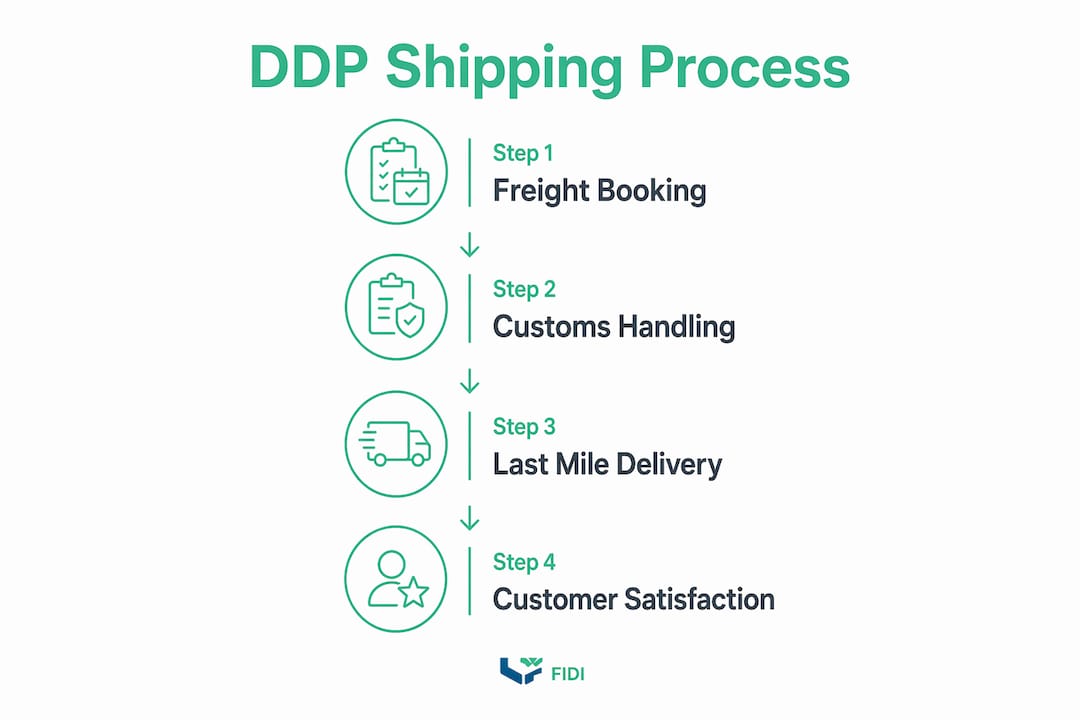
DDP requires the seller to manage every step from warehouse to buyer’s door. That includes freight booking, export documentation, import clearance, duty payment, and local delivery. The buyer receives the parcel with no additional payment demanded at the door.

This scope of responsibility transforms the international shopping experience into something that feels domestic. Platforms like Amazon have conditioned buyers to expect no surprises at delivery. DDP meets that expectation for cross-border orders.
The operational detail matters here. Sellers must:
- Assign accurate Harmonised System (HS) codes to every product. Misclassifying products with incorrect HS codes causes 18% of customs delays and 25% of fines.
- Work with licensed customs brokers in destination countries to handle import declarations correctly.
- Pay all applicable duties and taxes before the parcel clears customs, not after.
- Coordinate with carriers who have established customs clearance capabilities in each target market.
The payoff is significant. DDP reduces customs delays by up to 60% and improves customer satisfaction by over 30%. Those are not marginal gains. They represent the difference between a customer who reorders and one who never returns.
Pro Tip: Before entering a new market, audit your product catalogue for HS code accuracy. A single misclassification across a high-volume SKU can generate fines and delays that wipe out months of margin.
DDP shipping also removes hidden churn from delivery refusals. When customers never face a surprise payment demand at the door, refused deliveries drop sharply. That protects your margins and your brand reputation simultaneously.
What are the main challenges of implementing DDP shipping?
DDP is not simply a label you apply at checkout. Businesses often misunderstand it as a shipping option when it is, in fact, a full regulatory compliance strategy. Getting it wrong is expensive.
-
Landed cost calculation. The total cost of a DDP shipment includes freight, insurance, duties, VAT, and any local handling fees. Manual or flat-rate estimates cause margin erosion and mispricing. A product priced at £40 might carry £18 in landed costs to Germany that you have not accounted for.
-
Importer of Record (IOR) requirements. DDP requires the seller to have a registered business presence or an Importer of Record service in the destination country to legally clear goods. Many sellers discover this requirement only after their first shipment is held at customs.
-
DDP versus DAP confusion. Delivered at Place (DAP) leaves duty payment to the buyer. DDP does not. Logistics managers should differentiate DDP from DAP carefully, as confusion between the two causes costly disputes and unexpected buyer charges.
-
Documentation errors. Incorrect commercial invoices, missing certificates of origin, or inaccurate product descriptions trigger customs holds. Each hold adds days to delivery and may generate fines.
-
Tariff volatility. Duty rates change with trade policy. A rate that was accurate in january may be wrong by april. Static duty tables built into your checkout will eventually miscode a shipment.
The solution to most of these challenges is automation combined with expert partners. Real-time landed cost calculators tied to live tariff databases remove the guesswork from pricing. Experienced logistics providers handle IOR registration and customs documentation on your behalf.
Pro Tip: Never rely on a single carrier’s duty estimate. Cross-reference landed costs using a dedicated tariff tool that updates in real time. The difference between an accurate and an inaccurate estimate can be the difference between profit and loss on a single order.
How can e-commerce businesses use DDP shipping for growth?
DDP is a growth lever when executed well. The businesses that treat it as a compliance burden miss the commercial opportunity entirely.
Price transparency at checkout is now a key differentiator in cross-border e-commerce. Showing a customer the full landed cost before they confirm their order removes the single biggest reason for cart abandonment in international markets. That one change directly improves conversion rates.
Here is how to build a DDP operation that supports growth:
- Choose logistics partners with proven DDP capability. Not every carrier handles customs clearance in every market. Verify that your partner has established IOR services, licensed brokers, and experience with your product categories in your target countries. Parcelplanet’s carrier network is built specifically for this kind of cross-border complexity.
- Integrate automated landed cost calculation at checkout. Connect your e-commerce platform to a real-time tariff tool that calculates duties, VAT, and fees dynamically. This protects your margins and gives buyers a final, accurate price. For practical guidance on reducing shipping costs while maintaining DDP compliance, the approach starts with accurate cost modelling.
- Communicate the all-in price clearly. Label it as “duties and taxes included” at checkout. Buyers who see this are far less likely to abandon their cart or refuse delivery.
- Monitor regulatory changes continuously. Trade policy shifts quickly. Assign responsibility within your team for tracking changes in your key markets, or partner with a logistics provider who does this on your behalf.
- Use DDP to reduce cart abandonment. DDP strategically protects sellers against the costs and reputational harm from delivery refusals. Customers who never encounter additional payment demands at the door become repeat buyers.
Understanding cross-border shipping requirements in each target market is the foundation of a DDP strategy that scales. The sellers who invest in this knowledge early build a structural advantage over those who treat international shipping as an afterthought.
DDP is the customer experience benchmark for 2026 and beyond. Shifting customs complexity from shopper to seller is not just good service. It is the standard that buyers now expect.
Key takeaways
DDP shipping is the most effective way to protect international conversion rates, reduce delivery refusals, and meet the compliance demands of 2026’s tightened global trade regulations.
| Point |
Details |
| DDP definition |
Under Incoterms 2020, the seller pays all duties, taxes, and clearance costs before delivery. |
| Regulatory urgency |
EU de minimis thresholds end in july 2026, making DDP compliance non-negotiable for EU-bound shipments. |
| Customer impact |
DDP reduces customs delays by up to 60% and improves customer satisfaction by over 30%. |
| Key operational risk |
Incorrect HS codes cause 18% of customs delays and 25% of fines, making accurate classification critical. |
| Growth opportunity |
Showing a full landed cost at checkout removes the leading cause of cart abandonment in cross-border sales. |
DDP in 2026: my view from the logistics front line
The businesses I see struggling with international growth share one trait. They treat customs as someone else’s problem. They ship DAP, hope buyers pay the duty demand, and then wonder why their refusal rates are climbing and their reviews are deteriorating.
The regulatory changes of 2025 and 2026 have removed the option to stay passive. When the EU eliminates its duty de minimis threshold in july 2026, every small parcel entering the bloc becomes a compliance event. Sellers who are not ready will face held shipments, fines, and frustrated customers. Sellers who have already built DDP into their operations will barely notice the change.
What I find most telling is the customer expectation gap. Buyers who shop domestically on Amazon or any major platform never think about customs. They pay one price and receive their parcel. When a cross-border seller delivers that same experience, buyers do not credit it as exceptional. They simply trust the brand. That trust compounds into repeat purchases, positive reviews, and word-of-mouth referrals that no paid campaign can replicate.
The operational investment in DDP is real. You need accurate HS codes, a reliable IOR solution, real-time tariff data, and logistics partners who know what they are doing in each market. None of that is trivial. But the alternative, watching refusal rates climb and cart abandonment erode your international revenue, costs far more in the long run.
My honest advice: treat DDP not as a logistics upgrade but as a commercial decision. The sellers who make that shift in 2026 will be the ones with loyal international customer bases in 2028.
— ChiefPlaneteer
How Parcelplanet supports your DDP fulfilment operations
Managing DDP compliance across multiple markets requires more than good intentions. It requires a fulfilment partner with the carrier relationships, customs expertise, and technology to execute it reliably at scale.

Parcelplanet works with e-commerce brands to handle the full complexity of international order fulfilment, from accurate landed cost management and customs documentation to carrier selection and real-time tracking. Our network covers the markets where DDP compliance is most demanding, and our team stays current with regulatory changes so your operations do not have to. Whether you are entering a new market or scaling an existing one, our order fulfilment services are built to handle the detail that DDP demands. Get in touch to find out how we can support your international growth with a tailored fulfilment solution.
FAQ
What does DDP mean in shipping?
DDP stands for Delivered Duty Paid, an Incoterm under Incoterms 2020 where the seller is responsible for all freight, import clearance, duties, and taxes until the goods reach the buyer.
How does DDP shipping improve the customer experience?
DDP removes surprise fees at delivery, which reduces cart abandonment and delivery refusals. Customers receive their order with no additional payment demanded, creating a domestic-like shopping experience.
What is the difference between DDP and DAP shipping?
Under DAP (Delivered at Place), the buyer pays import duties and taxes on arrival. Under DDP, the seller pays all charges in advance. Confusing the two leads to unexpected buyer charges and costly disputes.
Is DDP shipping required for selling into the EU in 2026?
The EU eliminates remaining duty de minimis thresholds in july 2026, meaning all B2C shipments become subject to duty and VAT. While DDP is not legally mandated, it is the most practical way to meet compliance and protect the customer experience.
What are the biggest risks of getting DDP wrong?
Incorrect HS codes cause 18% of customs delays and 25% of fines. Failing to register as an Importer of Record in the destination country can result in shipments being held or returned, damaging both margins and brand reputation.
Recommended


