TL;DR:
- Flexible warehousing allows e-commerce brands to adapt capacity and labor dynamically according to real-time demand, reducing fixed costs and operational risk. Modern technology such as warehouse execution systems and mobile automation enables rapid scaling, making flexible models more efficient and resilient during demand fluctuations. This approach is especially beneficial for businesses with high demand variability, SKUs growth, or regional expansion plans.
Fixed warehousing made sense when retail was predictable. But e-commerce businesses today operate in a world of flash sales, seasonal spikes, and unpredictable demand shifts that make long-term warehouse leases feel more like anchors than assets. Understanding why flexible warehousing has become the preferred model for growing e-commerce brands is not just an academic exercise. It is a direct answer to the operational pressures you face when your storage needs in December bear no resemblance to your needs in March. The case for adaptable logistics solutions has never been more practical or more urgent.
Table of Contents
Key takeaways
| Point |
Details |
| Flexibility converts fixed costs |
Flexible warehousing turns large capital expenditures into variable operating costs, freeing cash for growth. |
| Scalability matches demand peaks |
You can scale storage and labour up or down based on real order volume, not annual forecasts. |
| Technology is central |
Warehouse execution systems and modular automation make flexible operations faster and more reliable. |
| Traditional leases carry hidden risks |
Fixed leases create overcapacity during slow periods and bottlenecks during peak ones. |
| Evaluation criteria matter |
Businesses with high demand variability, SKU proliferation, or new market ambitions benefit most from flexible models. |
What flexible warehousing actually is
Flexible warehousing is a storage and fulfilment model where capacity, labour, and operational resources scale according to your actual business requirements rather than fixed contractual commitments. Instead of locking into a 10-year lease on a warehouse sized for your busiest week of the year, you access space and services proportional to what you genuinely need at any given time.
The contrast with traditional warehousing is significant. A conventional fixed-lease model requires upfront capital investment, ongoing maintenance costs, and permanent staffing regardless of order volume. Flexible models, sometimes called on-demand or fractional warehousing, operate on shorter agreements with modular space allocation that adjusts as your business grows or contracts.
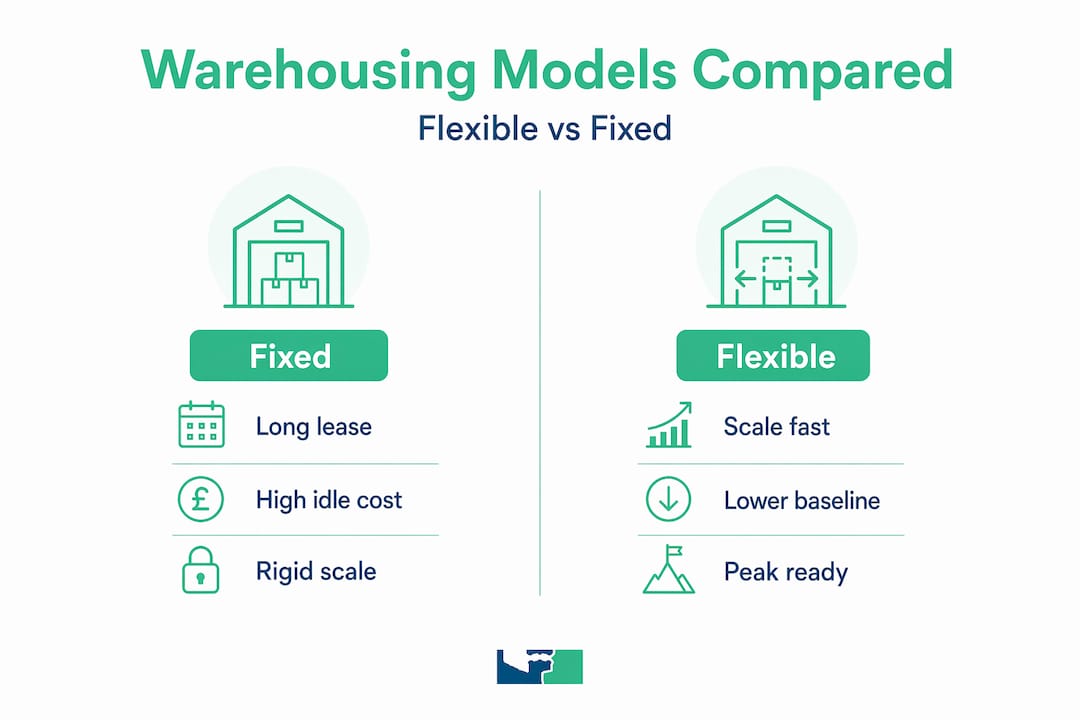
Here is how the two models compare across the factors that matter most to e-commerce operations:
| Factor |
Traditional warehousing |
Flexible warehousing |
| Contract length |
5 to 15 years |
Monthly or usage-based |
| Cost structure |
Fixed capital expenditure |
Variable operating expenditure |
| Capacity adjustment |
Costly and slow |
Rapid and modular |
| Labour model |
Permanent headcount |
Scalable on-demand workforce |
| Technology integration |
Often legacy systems |
Modern, software-defined operations |
| Market entry support |
High upfront commitment |
Test new regions with low risk |
Key characteristics that define flexible warehousing include:
- Modular space allocation that expands or contracts based on inventory levels
- Variable labour agreements that align staffing with daily or weekly order volumes
- Technology integration including real-time inventory tracking and warehouse execution systems
- Short-term or rolling contracts that reduce financial exposure during slow trading periods
- Distributed fulfilment network access enabling faster order delivery to customers across multiple regions
Understanding smart warehousing solutions is increasingly important as the gap between fixed and flexible models widens in practice.
The real benefits for e-commerce businesses
The most cited benefit of flexible warehousing is cost efficiency, but that framing actually undersells what is happening financially. Traditional fixed-lease warehousing forces you to plan for your peak. You sign a lease large enough to handle your Christmas trading surge, then pay for that empty space every other month of the year. Flexible warehousing eliminates that structural waste.
Fractional warehousing reduces baseline warehouse costs by nearly 40% compared to traditional leases and has delivered documented case examples showing an 81% ROI over a five-year period. That capital avoidance is money you can reinvest directly into product development, marketing, or technology. Converting a fixed capital expenditure into a variable operating cost is not just an accounting preference. It changes your cash flow dynamics entirely.
Beyond cost, the operational advantages are equally compelling:
- Scalable capacity lets you expand storage and fulfilment throughput during peak periods without paying for idle space year-round, since scaling labour and services adjusts based on real-time order volume
- Distributed inventory placement reduces transit times and delivery costs, directly improving the customer experience
- Reduced risk when testing new markets because you can store inventory in a new region without committing to permanent infrastructure
- Operational resilience during supply chain disruptions, since modular arrangements can be reconfigured quickly when circumstances change
- Support for SKU proliferation so you can introduce new product lines without worrying about whether your warehouse configuration can accommodate them
Pro Tip: When evaluating a flexible warehousing partner, ask specifically about their peak period capacity guarantees. Some providers offer “flexible” terms but cannot actually scale during Q4 without substantial lead times. Get this commitment in writing before you sign.
Warehousing as a strategic asset in uncertain global environments demands real-time inventory orchestration. That is exactly what flexible models are designed to deliver.
Technology and automation inside flexible warehousing
The reason flexible warehousing can deliver on its promises in 2026 is technology. Without the right systems, scaling capacity up or down would create chaos rather than efficiency. Modern flexible warehousing relies on several interconnected technology layers that make rapid adaptation possible.
Warehouse execution systems (WES) sit at the operational core. These platforms dynamically allocate resources across picking, packing, and despatch tasks in real time, rather than relying on pre-set daily plans. When an unexpected order surge arrives, a WES redistributes workflows across available staff and equipment within minutes.
The automation market is shifting from fixed conveyor systems to mobile robots and modular automation precisely because fixed installations cannot adapt to volatile e-commerce demand. Autonomous Mobile Robots (AMRs) are a prime example. Unlike fixed conveyor lines that require weeks of reconfiguration, AMRs can be redeployed to different zones in a warehouse within hours.

Modern warehouse operations now treat robots and human workers as interchangeable capacity pools, enabling rapid redeployment according to seasonal demand. This is a meaningful shift from how warehousing has historically worked, where headcount planning was done months in advance and automation assets sat idle outside peak season.
Other technology components that support flexible operations include:
- Real-time inventory visibility across multiple locations, giving you accurate stock data without manual counts
- Platform integrations connecting your warehouse management system to your e-commerce platform, courier services, and returns processing
- Robotics-as-a-Service (RaaS) models that let you access automation capacity without purchasing hardware outright
- Data-driven layout optimisation that plans for variability, not averages, improving picking efficiency and worker productivity
Pro Tip: Avoid treating automation as a series of isolated purchases. Integrated ecosystems combining robotics, software, and workflows consistently outperform fragmented investments. Ask your warehousing partner how their systems communicate with each other before committing.
You can explore how automation powers better fulfilment across e-commerce operations in more detail if you want to understand the specific technology stack involved.
Is flexible warehousing right for your business?
Not every e-commerce operation will benefit equally from flexible warehousing. The model is most powerful in specific circumstances, and understanding where it fits best will help you make a clear-headed decision.
Here are the key indicators that flexible warehousing is likely the right choice for you:
-
High demand variability. If your order volumes swing by 30% or more between your busiest and quietest months, a fixed-cost model will drain margin during slow periods while potentially failing to cope at peak.
-
Rapid SKU growth. Businesses adding new product categories regularly need warehouse configurations that can adapt. Fixed facilities often require costly reconfiguration when storage requirements change.
-
Geographic expansion plans. Testing a new regional market is far easier when you can place inventory in that location without signing a multi-year lease. Flexible models let you validate demand before committing infrastructure.
-
Limited internal logistics expertise. If warehousing is not your core competency, outsourcing to a flexible 3PL partner gives you access to operational expertise without building it internally.
-
Capital allocation priorities. If your business would benefit more from deploying capital in product, technology, or marketing rather than warehouse infrastructure, converting fixed costs to variable ones frees that capital.
To measure whether flexible warehousing is cost-effective for your specific situation, compare your current total warehousing spend including lease costs, utilities, maintenance, and permanent staff against the projected cost of a variable model at your average and peak volumes. The breakeven point is usually closer than most operators expect. These warehouse management tips will help you build a clearer picture of your current operational baseline before making any switch.
When selecting a flexible warehousing partner, prioritise those with demonstrated technology integration capabilities, transparent pricing that reflects actual usage, and a track record of supporting businesses at your growth stage.
Flexible vs fixed warehousing: real-world comparisons
Abstract comparisons only go so far. Consider two illustrative scenarios that reflect common e-commerce realities.
Scenario A: Seasonal retail brand. A homeware brand with 60% of annual revenue concentrated between October and January signs a traditional five-year warehouse lease large enough to handle peak demand. For eight months of the year, they pay for roughly 40% of unused space, plus fixed staffing costs. In a flexible model, they access additional capacity only during peak months and release it thereafter.
Scenario B: Fast-growing fashion retailer. A fashion e-commerce brand expanding into two new European markets needs regional inventory placement to compete on delivery speed. Under a fixed model, entering each market requires lease commitments before revenue is established. Under a flexible model, they place inventory in third-party fulfilment networks in each region, test performance, and scale or exit based on real data.
The operational and financial comparison across both scenarios consistently tells the same story:
| Metric |
Traditional warehousing |
Flexible warehousing |
| Idle capacity cost during off-peak |
High |
Minimal |
| Time to scale for peak demand |
Weeks to months |
Days |
| Market entry risk |
High upfront commitment |
Low, iterative investment |
| Order fulfilment speed improvement |
Dependent on single location |
Distributed, faster transit |
| Cost predictability |
Fixed but inflexible |
Variable but controllable |
Warehousing that blends operational efficiency with resilience through software, automation, and people creates long-term logistics safety. That is not a theoretical benefit. The brands that navigated supply chain disruptions in recent years with the least damage were overwhelmingly those with modular, adaptable warehousing arrangements. Explore the warehouse optimisation guide for a deeper look at how scalable operations translate into measurable fulfilment gains.
My take: flexibility is no longer a luxury
I have spent years working with e-commerce brands at various stages of growth, and one pattern I keep seeing is that businesses hold onto their fixed warehouse arrangements far longer than they should. The reasoning is usually the same: familiarity, sunk costs, or a belief that their operation is too complex to restructure.
What I have actually observed is that the brands who make the switch to flexible models consistently report one thing above all others. They wish they had done it sooner. The savings are real, but the strategic value is what surprises them most. When you are not locked into a physical footprint, your entire approach to market expansion, product testing, and seasonal planning changes. You make decisions based on market signals rather than infrastructure constraints.
The argument for traditional warehousing always assumes a degree of demand stability that modern e-commerce simply does not offer. Social commerce, influencer-driven demand spikes, algorithm changes on marketplaces, geopolitical disruption to supply chains. These are not edge cases. They are the operating environment. Fractional warehousing delivers capital avoidance by converting large fixed investments into contract-based storage, and that freed capital is what gives businesses room to respond when conditions shift.
My honest view is that treating warehousing as a strategic lever rather than a fixed overhead is the clearest competitive advantage available to e-commerce businesses right now. The technology exists. The providers exist. The only thing preventing more businesses from benefiting is inertia.
— Lukasz
How Parcelplanet supports your flexible warehousing needs
If the case for flexible warehousing resonates with how your business operates, the natural next question is who can deliver it reliably. Parcelplanet’s order fulfilment services are built specifically for e-commerce and omnichannel brands that need adaptable, technology-supported warehousing without long-term infrastructure commitments.

Parcelplanet offers modular storage capacity that scales with your order volumes, real-time inventory visibility, and direct integrations with leading e-commerce platforms and courier networks. Whether you are managing seasonal peaks, expanding into new markets, or simply looking to convert fixed warehousing costs into a more manageable variable model, the team at Parcelplanet can structure a solution around your actual requirements. As a trusted fulfilment partner for growing brands, Parcelplanet combines operational expertise with the technology backbone that makes flexible warehousing genuinely work at scale. Get in touch to discuss a tailored quote for your business.
FAQ
What is flexible warehousing?
Flexible warehousing is a storage and fulfilment model where capacity, labour, and services scale according to real business demand rather than fixed long-term leases. It allows e-commerce businesses to pay only for the space and resources they actually use.
How does flexible warehousing differ from traditional warehousing?
Traditional warehousing locks businesses into long-term leases with fixed costs regardless of order volumes. Flexible warehousing uses short-term or usage-based agreements that adjust capacity up or down as demand changes, converting fixed capital costs into variable operating expenditure.
What are the main benefits of flexible warehousing?
The primary benefits include lower baseline costs, the ability to scale during peak periods, reduced risk when entering new markets, and improved order fulfilment speed through distributed inventory placement.
Is flexible warehousing cost-effective for small e-commerce businesses?
Yes. Fractional warehousing models can reduce baseline warehouse costs by nearly 40% compared to traditional leases, making them particularly well-suited to smaller brands that cannot absorb the financial risk of idle fixed capacity.
What technology supports flexible warehousing operations?
Warehouse execution systems, Autonomous Mobile Robots, real-time inventory platforms, and e-commerce integrations all underpin flexible warehousing, allowing rapid reconfiguration and data-driven decision-making at scale.
Recommended


