TL;DR:
- Local couriers beat global providers on regional routes by removing hub delays through point-to-point transport. Their local knowledge increases delivery speed, reliability, and customer satisfaction, especially for same-day and quick returns. Brands should evaluate coverage, scheduling, and integration before choosing a courier to optimize delivery performance and retention.
Local couriers outperform global logistics providers on regional routes because they eliminate the structural delays that large hub-and-spoke networks create by design. For e-commerce brands, this distinction is not academic. Same-day or near-immediate delivery is only consistently achievable through local networks, where point-to-point transport, dispatcher proximity, and neighbourhood-level knowledge combine to produce faster, more reliable outcomes. Parcelplanet works with e-commerce brands that have already discovered this advantage, and the operational evidence is clear: regional expertise is not a secondary benefit. It is the primary one.
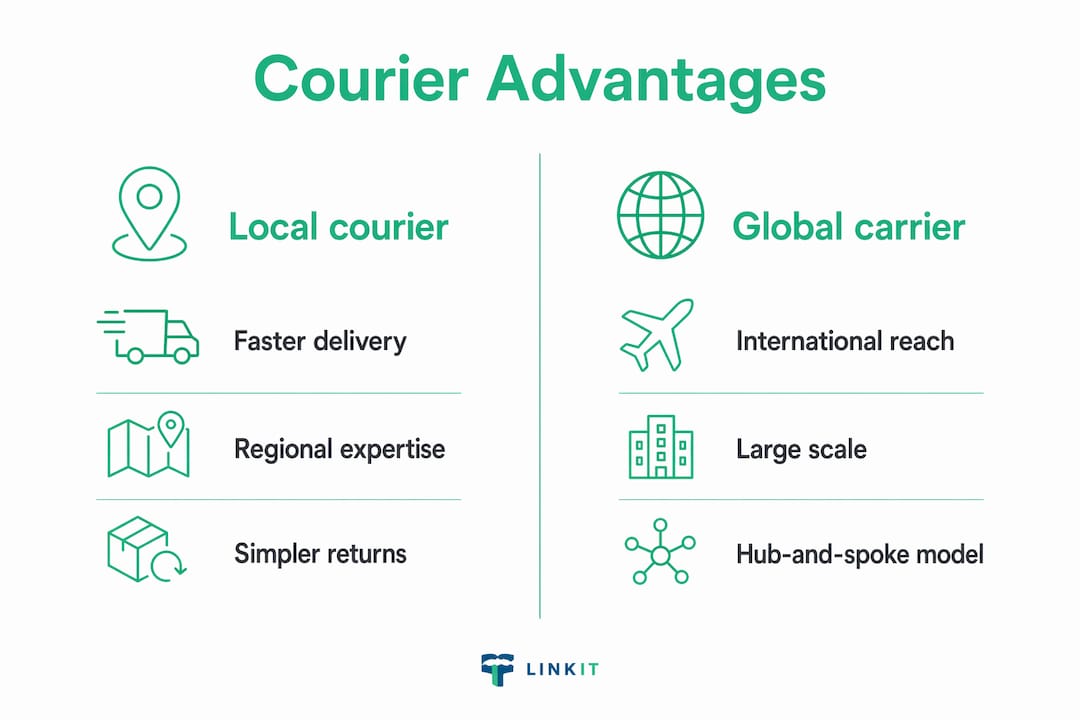
The core structural difference between local and global logistics is the hub-and-spoke model. Global providers route every parcel through centralised sorting facilities, which creates unavoidable dwell time at each node. A parcel travelling 200 km with a global carrier may pass through two or three sorting centres before reaching its destination. A local courier sends it directly.
Point-to-point transport removes these bottlenecks entirely. Local couriers run leaner operations with fewer decision layers, which means a driver can be rerouted in minutes rather than hours. That agility is not incidental. It is the structural reason local couriers consistently achieve faster door-to-door transit on routes under 500 km.
Pro Tip: If your brand ships the majority of orders within a 300 km radius, benchmark your current average transit time against a local courier’s published service window. The gap is often larger than expected.
The speed advantage compounds when you factor in pickup flexibility. Local couriers regularly accommodate late-day and weekend collections that national carriers’ automated schedules cannot support. For e-commerce brands processing orders throughout the day, that flexibility directly affects how quickly customers receive their goods.
Key structural advantages of local courier operations:
- No sorting centre delays on regional routes
- Dispatcher proximity to the fleet enables real-time rerouting
- Late-day and weekend pickups available as standard
- Fewer decision layers mean faster problem resolution
- Delivery speed improvements are achievable without infrastructure investment
Distributed local fulfilment also enables 1–3 day delivery windows versus the 5–10 or more days typical of centralised global shipping. That gap represents a significant competitive advantage for any brand competing on delivery experience.
How local knowledge drives delivery reliability
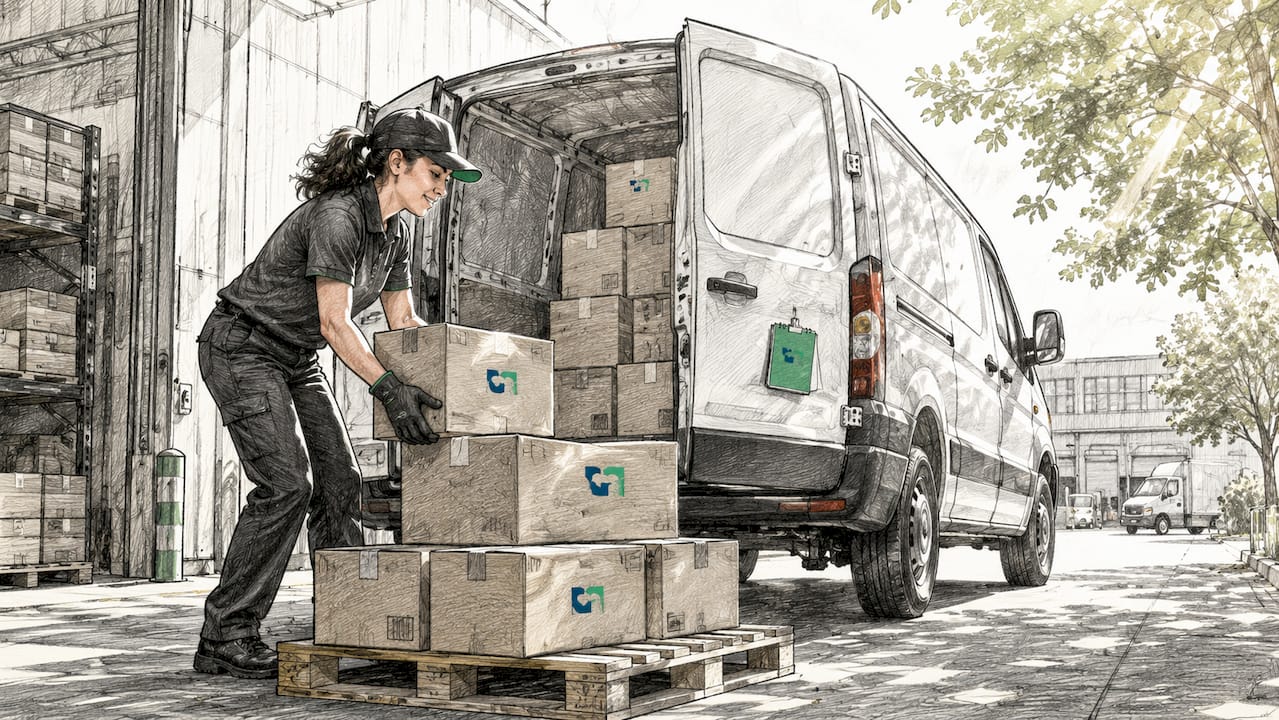
Local couriers carry what logistics professionals call institutional memory. This is the unwritten, accumulated knowledge of a specific delivery area: which blocks have access codes, where roadworks recur, which buildings have unreliable lifts, and which customers prefer rear-entrance deliveries. Algorithmic routing cannot capture this level of detail, and global carriers do not have the local presence to build it.
The practical result is a higher first-attempt delivery success rate. When a driver already knows that a particular address requires a gate code or that a business closes early on Fridays, they arrive prepared. Failed deliveries cost money and damage customer trust. Every avoided re-attempt is a direct saving.
“Institutional memory of local couriers — awareness of micro-level details like gated communities or elevator issues — improves first-attempt delivery success more than advanced tracking systems.”
Dispatcher proximity reinforces this advantage. Local dispatchers can respond to real-time field conditions instantly because they are geographically close to their drivers. A road closure or an unexpected access issue gets resolved in a phone call, not a support ticket routed through a national call centre.
The reliability benefit connects directly to customer loyalty. Shoppers who receive their orders on time, on the first attempt, with accurate communication, are more likely to return. Logistics and customer retention are more tightly linked than most brands realise, and local courier reliability is one of the clearest drivers of that connection.
Why local couriers excel at returns and reverse logistics
Returns are the hidden cost that global logistics models handle poorly. International returns require customs documentation, longer transit times, and higher carrier fees. The complexity often pushes brands towards refund-without-return policies, which protect the customer experience but erode margin.
Regional returns managed by local couriers are faster, cheaper, and simpler to process. A returned item collected locally can be back in your warehouse within 24–48 hours, assessed, restocked, and available for resale. That cycle is measured in days, not weeks.
| Returns factor |
Local courier |
Global carrier |
| Average return transit time |
1–2 days |
7–14 days |
| Customs documentation required |
No (domestic) |
Yes (international) |
| Restocking speed |
Fast |
Slow |
| Cost per return |
Lower |
Higher |
| Refund-without-return risk |
Reduced |
Elevated |
Simplified reverse logistics also reduces operational complexity for your fulfilment team. When returns arrive predictably and quickly, inventory planning becomes more accurate. You spend less time managing exceptions and more time managing growth.
Pro Tip: Track your refund-without-return rate separately from your overall return rate. If it is high, the root cause is often the complexity and cost of the return journey, not customer preference.
How local delivery improves customer satisfaction and retention
Local delivery is a customer retention strategy, not just a logistics choice. Shoppers associate local delivery with speed, reliability, and personal care. When a brand consistently delivers on time with clear communication, customers attribute that quality to the brand itself, not the courier.
Same-day delivery expectations have risen sharply among online shoppers. Local courier networks are the only infrastructure that can meet those expectations consistently. Global providers can offer same-day in a handful of major cities. Local couriers can offer it across a much wider geographic footprint, including suburban and semi-rural areas that global networks deprioritise.
The benefits for e-commerce brands include:
- Higher conversion rates when same-day or next-day delivery is offered at checkout
- Fewer customer service contacts related to delivery queries
- Stronger post-purchase satisfaction scores
- Reduced churn among repeat buyers who value delivery reliability
- Greater brand differentiation in competitive product categories
E-commerce brands see increased conversion rates when they integrate local courier networks into their fulfilment strategy. The checkout delivery promise is one of the last decisions a customer makes before purchasing. A credible, fast local delivery option removes a significant barrier to conversion.
Practical considerations when choosing local couriers
Choosing a local courier is not simply a matter of finding the cheapest regional option. E-commerce brands need to evaluate several operational factors before committing.
-
Assess regional coverage against your order geography. Map where your orders actually ship to. If the majority fall within a 300–500 km radius of your warehouse or fulfilment centre, a local courier network will almost certainly outperform a global carrier on both speed and cost.
-
Evaluate scheduling agility. Ask specifically about late-day cutoff times and weekend collection availability. These details determine whether a local courier can support your order processing schedule or whether you will still face next-day delays on afternoon orders.
-
Review the returns process end to end. Understand how the courier handles collections, what documentation is required, and how quickly items are returned to your facility. A courier with a clear, fast returns process reduces your operational overhead significantly.
-
Check platform integrations. Your courier needs to connect with your order management system and e-commerce platform. Gaps in integration create manual work and tracking errors that undermine the reliability advantage you are trying to gain.
-
Balance cost against service quality. Local couriers are often more cost-effective on regional routes than global carriers, but the comparison should include the full cost picture: failed delivery re-attempts, returns processing, and customer service contacts all carry a cost that cheap but unreliable shipping generates.
Parcelplanet supports brands in building a fulfilment model that combines distributed inventory with access to local courier networks, so that delivery speed and reliability work together rather than in tension.
Key takeaways
Local couriers outperform global providers on regional routes because their point-to-point model, institutional knowledge, and dispatcher agility produce faster, more reliable deliveries that directly improve customer satisfaction and retention.
| Point |
Details |
| Speed on regional routes |
Local couriers deliver door-to-door faster than global carriers on routes under 500 km. |
| Institutional memory |
Drivers’ local knowledge raises first-attempt delivery success beyond what algorithmic routing achieves. |
| Returns advantage |
Regional returns are processed in days, not weeks, reducing costs and refund-without-return rates. |
| Customer retention |
Consistent local delivery builds repeat purchase behaviour and reduces churn. |
| Operational fit |
Brands should assess coverage, scheduling agility, and platform integration before selecting a local courier. |
The shift I keep seeing brands get wrong in 2026
The most common mistake I see e-commerce brands make is treating courier selection as a cost decision rather than a customer experience decision. They compare headline rates, choose the cheapest option, and then spend the next quarter managing complaints about missed deliveries and slow returns. The maths never works out in their favour.
What I have observed consistently is that brands which switch to local courier networks for their core regional routes see a measurable improvement in post-purchase satisfaction scores within the first few months. The improvement is not driven by technology or tracking dashboards. It is driven by the fact that a local driver who knows your customer’s street simply delivers more reliably than a global network that treats every address as a data point.
The counterintuitive insight is this: global scale is a disadvantage on short routes. A global carrier’s strength is orchestrating complex international movements. On a 150 km domestic delivery, that same infrastructure creates friction. The sorting centre, the centralised dispatch, the standardised SOP — all of it slows down a journey that a local courier could complete in a single run.
I would also caution brands against assuming that global carriers will close this gap with technology. Local gateway specialists navigate specific port, airport, and border challenges that standardised global processes cannot replicate. The knowledge advantage is structural, not a feature that can be added to an app update.
If your brand is growing and you are evaluating your customer retention strategy, the courier question deserves more weight than most brands give it. The delivery experience is the last physical touchpoint your customer has with your brand. Make it count.
— ChiefPlaneteer
How Parcelplanet connects your brand to local courier networks
Parcelplanet’s order fulfilment services are built around the principle that fast, reliable regional delivery requires distributed inventory and the right local courier partnerships, not just a single national carrier contract.

Parcelplanet works with e-commerce brands to position stock closer to their customers, reducing transit distances and enabling the 1–3 day delivery windows that drive conversion. The platform integrates with your existing e-commerce systems, so orders flow directly to the right fulfilment location and the right local courier without manual intervention. If you want to understand how a distributed fulfilment model could work for your brand, get a tailored quote and see what regional delivery performance looks like when it is built around your actual order geography.
FAQ
Why do local couriers deliver faster than global carriers?
Local couriers use point-to-point transport, which removes the sorting centre delays built into global hub-and-spoke networks. On routes under 500 km, this structural difference produces consistently faster door-to-door transit times.
What is institutional memory in courier services?
Institutional memory refers to a driver’s accumulated, unwritten knowledge of a specific delivery area, including access codes, building quirks, and customer preferences. This knowledge raises first-attempt delivery success rates beyond what algorithmic routing can achieve.
Are local couriers more cost-effective than global carriers?
Local couriers are typically more cost-effective on regional routes when you account for the full cost picture, including failed delivery re-attempts, returns processing fees, and customer service contacts generated by unreliable shipping.
How do local couriers improve e-commerce returns?
Regional returns collected by local couriers can be back in your warehouse within 24–48 hours, compared to 7–14 days for international returns. Faster returns reduce refund-without-return rates and improve inventory accuracy.
What should e-commerce brands check before choosing a local courier?
Brands should assess regional coverage against their actual order geography, evaluate late-day and weekend pickup availability, review the end-to-end returns process, and confirm that the courier integrates with their order management and e-commerce platforms.
Recommended


