TL;DR:
- Effective order volume management is essential for scalable e-commerce operations, reducing errors and maintaining customer satisfaction. Implementing automation, real-time monitoring, and system integration before reaching critical capacity points enables brands to grow confidently without overwhelming their teams. Proactive system building ensures operational resilience, preventing crises during peak periods and supporting sustainable expansion.
Efficient order volume management is the practice of optimising how orders flow through your systems and operations to maintain accuracy, speed, and customer satisfaction as volumes rise. For e-commerce managers and business owners, understanding why manage order volumes efficiently is not a theoretical exercise. It is the difference between a business that scales with confidence and one that haemorrhages customers during its busiest periods. Platforms like Shopify, order orchestration tools like Pipe17, and inventory systems like Base have made sophisticated order management accessible to brands of all sizes. The question is no longer whether you need these systems. It is whether you have them in place before growth forces your hand.
Why managing order volumes efficiently matters
Efficient order processing is the operational backbone of any e-commerce business that intends to grow. When your fulfilment process cannot keep pace with incoming orders, the consequences compound quickly. Errors multiply, delays accumulate, and customer trust erodes in ways that are difficult to rebuild.
The numbers make this concrete. Brands that fail to automate order processing experience a 40% spike in error rates once daily order volume exceeds 500 units. That figure represents real customers receiving wrong items, missing parcels, and unanswered queries. At that scale, manual intervention is no longer a viable fix.
The importance of order management extends beyond accuracy. Controlled order flow protects your team from burnout, keeps your inventory data reliable, and gives you the visibility needed to make sound operational decisions. Businesses that treat order volume management as a reactive task, fixing problems as they arise, consistently underperform those that build proactive systems from the outset.
What happens when order volumes exceed processing capacity
The term “ops overload” describes what occurs when order intake outpaces the operational infrastructure designed to handle it. Most e-commerce brands hit a critical breaking point somewhere between 500 and 2,000 orders per day, at which point manual workarounds become unsustainable.
The mechanics of this breakdown follow a predictable pattern. Each additional order adds a small increment of manual work: checking stock, printing labels, updating records, resolving exceptions. That linear increase does not feel dangerous at low volumes. At high volumes, it overwhelms teams entirely.
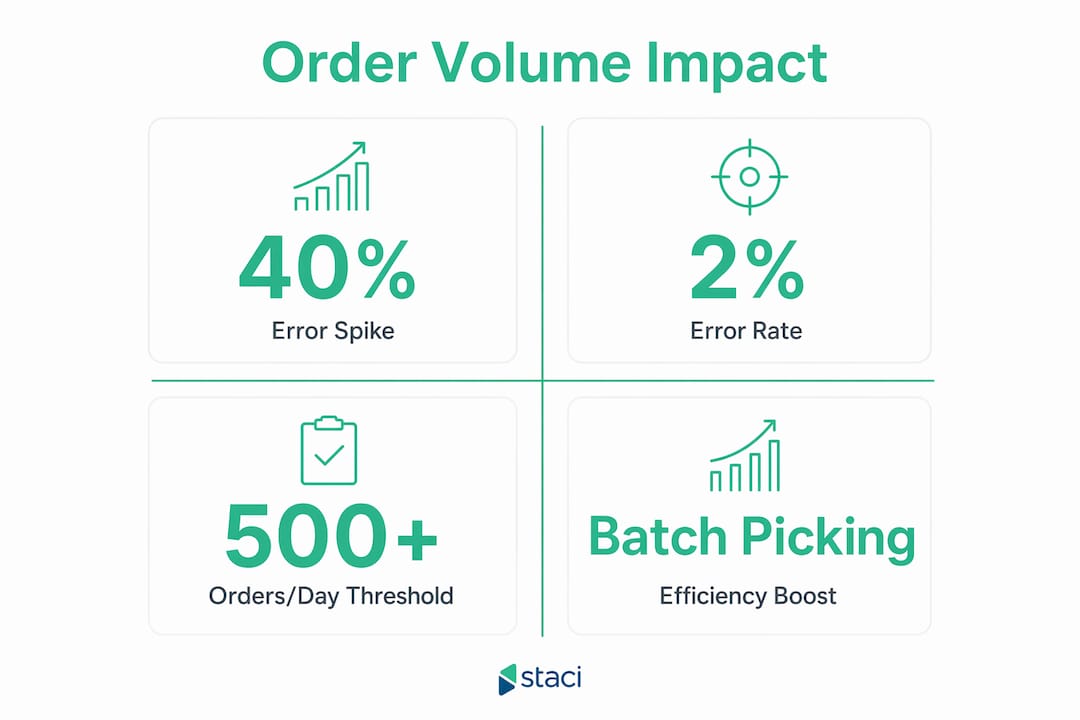
Consider the maths on error handling alone. At a 2% error rate, a team processing 100 orders per day handles 2 exceptions. The same error rate at 2,000 orders per day produces 40 exceptions, each requiring manual investigation and resolution. That is a 20-fold increase in correction workload from the same underlying error rate.
| Processing method |
Average time per order |
Error rate at 500+ orders/day |
Scalability |
| Manual processing |
4 to 8 minutes |
High (40% spike risk) |
Poor |
| Automated processing |
Under 1 minute |
Low (consistent) |
High |
Pro Tip: Track your exception rate weekly, not monthly. A rising exception count is the earliest warning sign that your process is approaching its capacity limit, well before customer complaints begin.
How automation and integration improve order volume management
Automation addresses the core problem of order volume scaling: the fact that manual processes do not scale proportionally with volume. Automated order management software generated nearly £1.3 billion (approximately $1.66 billion) globally in 2025, reflecting how widely businesses have recognised this reality. That level of market investment signals a clear industry consensus: automation is not optional for growth-stage e-commerce.
The benefits of automation in order management are specific and measurable. They include:
- Error reduction: Automated validation catches address mismatches, stock discrepancies, and payment issues before an order enters the fulfilment queue.
- Faster processing: Orders move from placement to pick-and-pack instruction in seconds rather than minutes, cutting fulfilment cycle times significantly.
- Inventory synchronisation: Real-time stock updates across all sales channels prevent overselling and reduce the manual reconciliation burden on your team.
- Cost control: Automation reduces manual errors, speeds processing, and lowers costs, allowing consistent performance during peak demand without increasing headcount.
- Courier selection: Automated shipping rules assign the correct carrier and service level based on destination, weight, and delivery promise, removing a decision point that slows manual workflows.
Order management systems like Pipe17 operate as an orchestration layer, governing the full order lifecycle through validation, routing, exception handling, and status propagation. This architecture means that order management systems keep orders flowing at scale without requiring a human to supervise each step.
Pro Tip: Implement batch picking rules in your warehouse management system before you need them. Grouping orders by zone or SKU similarity cuts pick times by 20 to 30% at moderate volumes, and the benefit compounds as volume grows.
What is the capacity illusion and why does it matter?
The capacity illusion is the mistaken belief that because you have sufficient inventory and storage space, you can fulfil any volume of orders that arrives. Many businesses fall into this trap, discovering during peak periods that fulfilment capacity depends on throughput, not stock levels.
Throughput is determined by picking speed, packing efficiency, despatch cut-off times, and the number of exceptions your team can resolve per hour. A warehouse holding 10,000 units of stock can still fail to fulfil 800 orders in a day if the pick rate is 60 orders per hour and the team works an eight-hour shift. The maths produce a ceiling of 480 orders. The remaining 320 slip into the next day, and the backlog begins.
Aligning order intake speed with real warehouse throughput prevents order pile-ups and maintains customer experience during demand surges.
Operations experts recommend shifting from passive order intake to active decision-making based on real-time fulfilment capacity. In practice, this means monitoring throughput metrics continuously and using that data to make deliberate choices about order flow.
The following strategies align order intake with actual fulfilment capability:
- Monitor throughput in real time. Track picking speed, packing efficiency, and exception rates by the hour, not the day. Hourly data reveals capacity constraints before they become backlogs.
- Use order routing rules. Distribute orders across fulfilment locations or 3PL partners based on current capacity, not just proximity to the customer.
- Prioritise high-value orders. Configure your order management system to process premium or time-sensitive orders first when capacity is constrained.
- Delay order release strategically. Holding orders in a queue until capacity is available is preferable to releasing them into a congested pick floor where errors multiply.
- Set realistic delivery promises. Displaying accurate estimated delivery dates at checkout, based on current throughput, reduces customer service contacts and manages expectations honestly.
Practical strategies for order volume scaling
Identifying where your process breaks is the prerequisite for fixing it. Most e-commerce operations have two or three specific bottlenecks that account for the majority of delays and errors. Common culprits include manual data entry between disconnected systems, single-carrier dependency, and the absence of exception-handling rules in the order management layer.

Connecting your systems is the highest-leverage improvement available to most growing brands. When your e-commerce platform, warehouse management system, and courier integrations share data in real time, you eliminate the manual synchronisation work that consumes team capacity and introduces errors. Tools like Pipe17 and Base are designed specifically to create this connected data flow across Shopify and other platforms.
Adopting automation early, even at low volumes, is the single most important order volume management idea that experienced operators consistently recommend. Building scalable order management is about creating controlled flow rather than increasing headcount, and the time to build that infrastructure is before you need it, not during a peak period when every hour counts.
The following practices produce measurable improvements across order volume scaling strategies:
- Batch picking by zone or SKU: Reduces warehouse travel time and increases pick rates without additional staff.
- Dynamic inventory updates: Prevents overselling across multiple channels by synchronising stock in real time after every transaction.
- Automated carrier selection: Assigns the optimal courier based on pre-set rules, removing a manual decision from every order.
- Performance dashboards: Track order cycle time, error rate, and exception volume daily to catch deterioration before it affects customers.
- Threshold alerts: Configure your order management system to flag when daily volume approaches your throughput ceiling, giving you time to respond proactively.
| Optimisation |
Impact on error rate |
Impact on processing speed |
| System integration |
High reduction |
Significant improvement |
| Batch picking |
Moderate reduction |
High improvement |
| Automated carrier selection |
Moderate reduction |
Moderate improvement |
| Real-time inventory sync |
High reduction |
Moderate improvement |
Scaling logistics operations requires that these improvements work together as a system, not as isolated fixes applied to individual pain points.
Key takeaways
Efficient order volume management requires automation, real-time throughput monitoring, and system integration to maintain accuracy and customer satisfaction as order volumes grow.
| Point |
Details |
| Automate before you need to |
Brands exceeding 500 orders per day without automation face a 40% error rate spike. |
| Throughput, not stock, sets capacity |
Fulfilment capacity is determined by picking and packing speed, not inventory levels. |
| Connect your systems |
Integrating your e-commerce platform, WMS, and courier tools eliminates manual data entry and reduces errors. |
| Monitor hourly, not daily |
Hourly throughput data reveals capacity constraints before they become customer-facing backlogs. |
| Scale process before headcount |
Automation empowers existing teams to handle significantly higher volumes without proportional staff increases. |
What I have learned from watching operations break under pressure
I have seen the same pattern repeat across growing e-commerce businesses. The team is capable, the product is strong, and the orders are coming in. Then a promotional period or a viral moment pushes volume beyond what the process was designed to handle, and everything that looked fine at 200 orders a day looks completely different at 800.
The instinct is always to add people. Hire a temp, ask the team to work late, manually push orders through. It works once. It does not work twice, and it certainly does not work at 2,000 orders a day. What I have found is that the businesses that scale well are not the ones with the largest teams. They are the ones that prioritised tech integration early, built their systems for the volume they intended to reach, and treated process design as a strategic investment rather than an operational afterthought.
The uncomfortable truth is that most operations crises are predictable. The error rate data, the exception counts, the throughput figures: they all signal the breaking point weeks before it arrives. The businesses that act on those signals build something durable. The ones that wait for the crisis spend months recovering from it.
My advice is direct: do not wait until your busiest week of the year to discover that your process cannot cope. Build the system now, at whatever volume you are currently handling, and you will find that growth becomes something you manage rather than something that manages you.
— Lukasz
How Parcelplanet supports your order volume management
Managing order volumes at scale requires more than good intentions. It requires the right fulfilment infrastructure behind your business.

Parcelplanet’s order fulfilment services are built for e-commerce brands that are growing and need a partner who can grow with them. From real-time inventory tracking and multi-channel integrations to automated pick, pack, and despatch operations, Parcelplanet handles the operational complexity so your team can focus on the business. Whether you are processing 200 orders a day or scaling towards 2,000, Parcelplanet’s fulfilment network and technology integrations give you the throughput capacity and accuracy your customers expect. Get in touch for a tailored quote and find out how Parcelplanet can support your next stage of growth.
FAQ
Why does order volume management matter for e-commerce?
Efficient order volume management prevents error spikes, fulfilment delays, and customer dissatisfaction as your business grows. Brands that fail to manage volume proactively face a 40% increase in error rates once daily orders exceed 500 units.
At what point does manual order processing become unsustainable?
Most e-commerce brands reach a breaking point between 500 and 2,000 orders per day, at which point manual workarounds cannot keep pace with volume and exception handling overwhelms the team.
What is the capacity illusion in e-commerce?
The capacity illusion is the mistaken belief that having sufficient inventory means you can fulfil any order volume. Fulfilment capacity is determined by throughput, specifically picking speed and packing efficiency, not stock levels.
How does automation improve order volume handling?
Automation reduces manual errors, speeds order processing, synchronises inventory in real time, and enables consistent performance during peak periods without requiring additional headcount.
When should a growing brand invest in order management automation?
The right time to invest in automation is before you reach your capacity limit, not after. Building scalable systems at lower volumes means growth does not trigger an operational crisis.
Recommended