Many fast-growing e-commerce brands assume that keeping fulfilment in-house gives them more control and saves money. In reality, the opposite is often true. Outsourcing fulfilment can cut costs by 20-40% and push order accuracy to 99.8%, figures that are difficult to match with internal operations alone. This guide breaks down the real costs of in-house fulfilment, explains how third-party logistics (3PL) providers work, and gives you a clear framework for deciding whether outsourcing is the right move for your brand right now.
Table of Contents
Key Takeaways
| Point |
Details |
| Lower costs |
Outsourcing fulfilment can cut costs by up to 40% per order compared to in-house solutions. |
| Greater accuracy and speed |
Third-party partners consistently deliver 99.8% accuracy and faster, more reliable deliveries. |
| Scalable growth |
3PLs enable brands to scale smoothly, handling spikes and global expansion with ease. |
| Mitigated risks |
Proper vetting and clear agreements mean you keep control while outsourcing logistics. |
| Freedom to focus |
With fulfilment handled, you can concentrate on growing your e-commerce brand. |
The real cost of in-house fulfilment
Running your own fulfilment operation feels straightforward at first. You rent a warehouse, hire staff, and ship orders. But the costs stack up quickly, and many of them are easy to overlook until they start hurting your margins.
Consider what you are actually paying for every month:
- Warehouse rent and utilities: Fixed costs that do not shrink when order volumes dip
- Staff wages and training: Picking, packing, and despatch teams, plus management overhead
- Technology and software: Warehouse management systems, barcode scanners, and integrations
- Packaging materials: Boxes, void fill, labels, and branded inserts
- Inventory shrinkage: Stock lost to damage, theft, or miscounting
- Returns processing: Often underestimated, returns handling adds significant labour cost
The numbers tell a clear story. Per-order cost for in-house fulfilment averages $4.00 (roughly £3.20), and that figure climbs as your order complexity or volume increases. During peak periods like Black Friday or Christmas, you either overstaff and overspend, or understaff and disappoint customers.
Scalability is another hidden risk. In-house operations are built around a fixed capacity. When demand spikes, accuracy drops and delivery times stretch. Understanding when to outsource order fulfilment is often the first step towards protecting both your margins and your customer relationships.
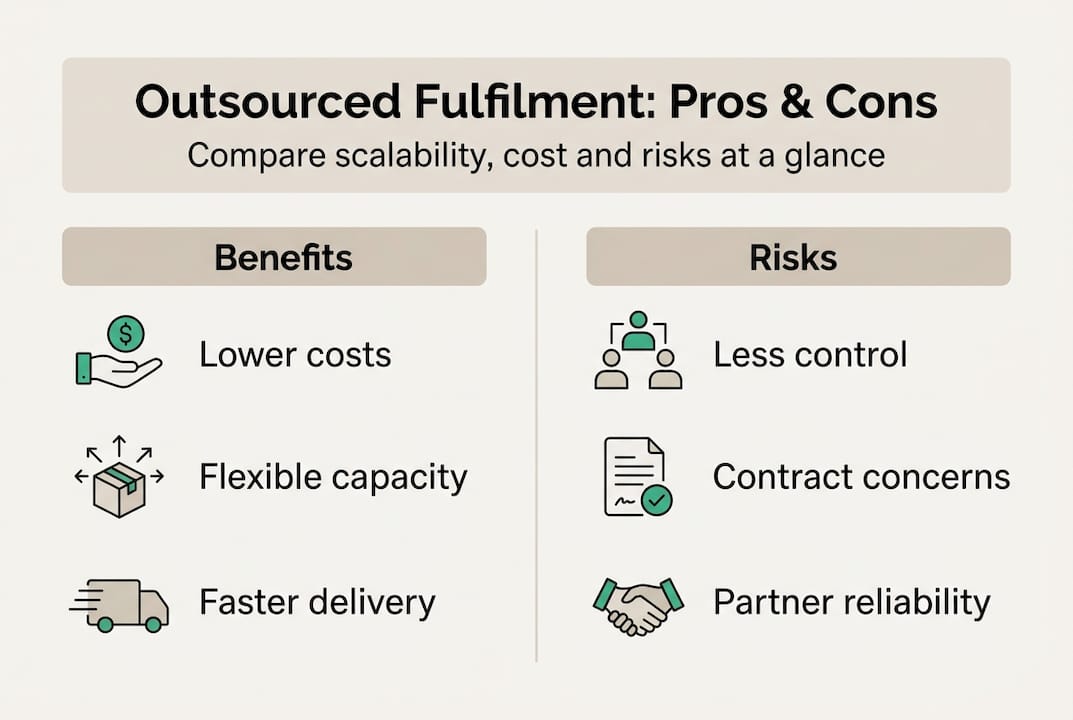
With in-house fulfilment costs and risks laid bare, it is time to examine what makes outsourcing, especially to specialist partners, a compelling alternative.
How outsourcing fulfilment works: The case for 3PL
A third-party logistics provider takes over your warehousing, picking, packing, and shipping operations. You send your stock to their facility, integrate your sales channels with their systems, and they handle the rest. Orders flow in, parcels go out, and you get real-time visibility throughout.
The performance data is striking. 3PLs deliver 15-40% shipping savings and achieve 99.8% order accuracy, driven by advanced warehouse management systems, barcode scanning, and rigorous quality checks. The average fulfilment cost via 3PL is just $2.50 (around £2.00) per order, roughly half the in-house equivalent.
“99.8% accuracy, 95% on-time delivery, and up to 40% savings for growth brands processing over 500 orders per month.”
Here is how in-house and 3PL fulfilment compare across the metrics that matter most:
| Metric |
In-house |
3PL partner |
| Average cost per order |
£3.20 |
£2.00 |
| Order accuracy |
96-98% |
99.5-99.8% |
| Delivery speed |
Variable |
Consistently fast |
| Scalability |
Limited |
High |
| Technology investment |
Your cost |
Included |
| Peak period flexibility |
Difficult |
Seamless |
Learn more about scaling e-commerce with 3PL and how specialist providers handle volume surges without compromising accuracy. You can also explore practical ways of saving costs with 3PL to understand the full financial picture.
Pro Tip: When reviewing 3PL contracts, look specifically for guaranteed accuracy rates, on-time delivery SLAs, and clear terms around peak surcharges. A provider unwilling to commit to measurable KPIs in writing is a provider worth avoiding.
Understanding the basics of outsourced fulfilment unlocks the crucial cost and performance differences compared to doing it yourself.
When does outsourcing make sense?
Not every brand is ready to outsource from day one, and that is perfectly fine. The decision depends on where your business is right now and where you want it to go.
3PL outsourcing generally breaks even at 500-1,000 monthly orders and becomes increasingly cost-efficient as volume grows. Below that threshold, in-house may still be viable, though the operational burden can still be significant.
Here are the top five signs your brand is ready to make the move:
- Recurring delays: Orders are regularly leaving late, and your team is stretched thin
- Warehouse strain: You are running out of space or paying for storage you do not fully use
- Staff burnout: Your team is spending more time packing boxes than growing the business
- International ambitions: You want to sell across borders but lack the logistics infrastructure
- Rising per-order costs: Your cost per shipment keeps climbing despite no significant volume increase
Here is a simple break-even view based on monthly order volume:
| Monthly orders |
In-house cost estimate |
3PL cost estimate |
Recommended approach |
| Under 300 |
£960 |
£600 |
Evaluate carefully |
| 300-500 |
£1,600 |
£1,000 |
Consider outsourcing |
| 500-1,000 |
£3,200-£6,400 |
£1,500-£3,000 |
Strong case for 3PL |
| Over 1,000 |
£6,400+ |
£3,000+ |
Outsource for efficiency |
Pro Tip: Around 40% of mid-market brands use a hybrid model, keeping some fulfilment in-house for bespoke or high-value items while outsourcing standard orders to a 3PL. This approach gives you flexibility without fully relinquishing control.
For a structured approach to making this decision, the choosing a fulfilment partner guide is a useful starting point. You can also find specific tactics to reduce fulfilment costs as your volume grows.
Having covered the criteria for when outsourcing pays off, it is vital to understand the main advantages that go far beyond just cost.
Benefits that go beyond cost savings
Cost reduction is the headline benefit, but it is far from the only one. Outsourcing fulfilment changes how your entire business operates, and the downstream effects on customer satisfaction and brand growth are substantial.

3PL-led fulfilment achieves 99.5%+ accuracy and a 95% perfect order rate, meaning customers receive the right item, in good condition, on time. That consistency builds trust and reduces the volume of customer service queries your team has to handle.
Here is what else outsourcing delivers:
- Faster delivery: Multi-location warehousing puts stock closer to your customers, cutting transit times
- Improved accuracy: Automated scanning and quality checks eliminate the human errors common in manual operations
- Global reach: 3PLs with international networks make cross-border selling far more accessible
- Focus on growth: Your team can concentrate on marketing, product development, and customer acquisition instead of packing boxes
- Technology access: You benefit from enterprise-grade warehouse management systems without the capital investment
- Seamless peak handling: Seasonal surges are absorbed by the 3PL’s existing infrastructure and staffing
“Outsourcing transforms fulfilment from a costly distraction into a strategic advantage for e-commerce brands determined to grow.”
Explore how 3PL for efficient logistics supports brands at every stage of growth, and discover how scalable logistics for growth can future-proof your operations as you expand into new channels and markets.
Now that you see the breadth of benefits outsourcing brings, let us consider potential risks and how to mitigate them for best results.
Risks of outsourcing and how to mitigate them
Outsourcing is not without risk. Choosing the wrong partner, agreeing to vague contracts, or failing to monitor performance can create problems that are harder to fix than the ones you started with. The good news is that these risks are entirely manageable with the right approach.
Careful vetting and the right partnership are the foundation of a successful 3PL relationship. The three most common pitfalls are inadequate vetting, unclear service levels, and inflexible contracts that lock you in without accountability.
Follow this step-by-step process to protect your business:
- Define your requirements: Document your order volumes, SKU count, storage needs, and delivery expectations before approaching any provider
- Request references: Speak to existing clients in a similar sector to understand real-world performance
- Audit the facility: Visit the warehouse if possible, or request a virtual tour and process walkthrough
- Review the SLA in detail: Ensure accuracy rates, on-time delivery targets, and escalation procedures are clearly written into the agreement
- Agree on KPI review cadence: Set monthly or quarterly performance reviews from the outset, with clear consequences for underperformance
- Plan your onboarding: A structured transition period reduces disruption and gives both parties time to align systems and processes
Pro Tip: Establish a dedicated point of contact at your 3PL from day one. Regular communication, even a brief weekly check-in, prevents small issues from becoming costly problems.
Retaining visibility is also critical. Most reputable 3PLs offer real-time dashboards and inventory tracking, so you always know where your stock is and how orders are progressing. Use the fulfilment partner selection guide to build a robust shortlist and ask the right questions before you commit.
Having addressed potential risks, you are ready to take the next step.
Optimise your fulfilment with expert support
If the evidence in this article resonates with where your business is right now, the logical next step is finding a fulfilment partner who can deliver on the promises that matter. Accuracy, speed, flexibility, and genuine transparency are not optional extras. They are the baseline.

At ParcelPlanet, we specialise in tailored order fulfilment services for e-commerce and omnichannel brands at every stage of growth. Whether you are processing 500 orders a month or 50,000, our team provides the infrastructure, technology, and expertise to keep your customers happy and your costs under control. Not sure whether a 3PL or a more integrated model suits your needs? Our 3PL vs 4PL comparison breaks down the options clearly. Get in touch today to request a personalised quote and see exactly how we can support your growth.
Frequently asked questions
What is the main advantage of outsourcing fulfilment?
The main advantage is reduced costs, typically 20-40% lower per order, combined with improved accuracy and faster delivery speeds that are difficult to replicate in-house.
At what order volume does outsourcing make sense?
Most brands see clear cost and performance benefits once monthly orders exceed 500 per month, with the financial case strengthening significantly beyond 1,000 orders.
How can I avoid common outsourcing mistakes?
Thoroughly vet potential 3PL partners, insist on clear SLAs and KPIs written into the contract, and schedule regular performance reviews to catch issues early.
Can outsourcing fulfilment help with international expansion?
Absolutely. 3PLs with multi-location inventory networks make cross-border selling far more accessible, offering faster international delivery and simplified border logistics without requiring you to build your own overseas infrastructure.
Recommended


