Many e-commerce owners believe managing logistics internally preserves control and reduces costs. This misconception often leads to operational bottlenecks, hidden expenses, and stunted growth. As order volumes increase, internal logistics teams struggle with warehousing capacity, shipping complexities, and technology demands. Outsourcing logistics to specialised third-party providers offers a proven solution. By leveraging expert resources, advanced technology, and established carrier networks, growing brands can streamline operations, reduce costs, and focus on core business activities. This guide explores why outsourcing logistics is essential for sustainable e-commerce growth and how to implement it successfully.
Table of Contents
Key Takeaways
| Point |
Details |
| Outsourcing reduces complexity |
Outsourcing logistics to specialist third party providers reduces bottlenecks, hidden costs and frees internal teams to focus on core activities. |
| Technology and expertise access |
Outsourcing provides access to technology and expertise plus established carrier networks to streamline operations and support growth. |
| Right partner choice |
Choosing the right partner is essential to maintain service quality and achieve cost efficiency. |
| Clear communication integration |
Clear communication and seamless integration between internal systems and the provider improve outsourcing success. |
Common challenges e-commerce businesses face managing logistics in-house
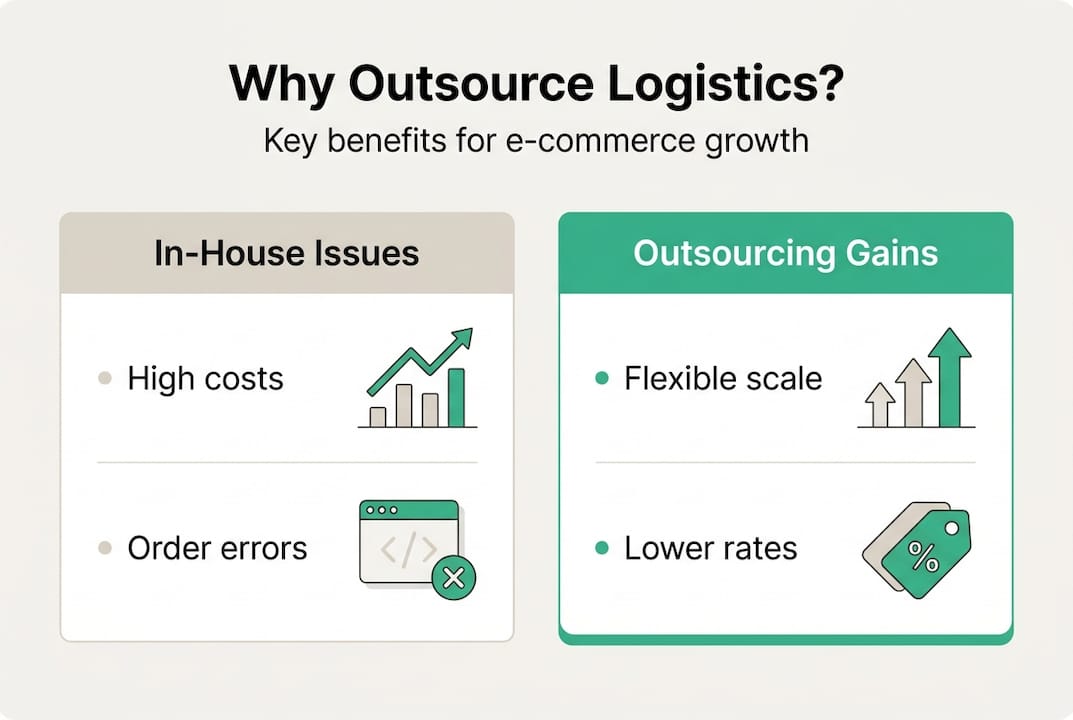
Growing e-commerce brands encounter significant obstacles when managing fulfilment operations internally. Rising logistics costs and complexity strain internal resources for small and medium enterprises, making it difficult to maintain profitability whilst scaling. Inventory management becomes increasingly challenging as product catalogues expand and sales channels multiply. Warehousing capacity limitations force businesses to choose between expensive facility expansions or turning away orders during peak periods.

Labour costs escalate quickly as fulfilment demands grow. Hiring, training, and retaining warehouse staff requires substantial investment in recruitment, onboarding programmes, and ongoing management. Managing shipping logistics internally demands expertise across multiple carriers, customs regulations, and delivery zones. Without dedicated logistics professionals, businesses struggle to optimise routes, negotiate favourable rates, or handle international shipments efficiently.
Order accuracy suffers when internal teams lack specialised picking and packing systems. Manual processes increase error rates, leading to costly returns, refunds, and damaged customer relationships. Delivery speed becomes a competitive disadvantage when businesses cannot match the two-day or next-day shipping expectations customers now demand. Bottlenecks in processing orders during promotional periods or seasonal peaks result in delayed shipments and negative reviews.
Negotiating power with carriers remains limited for businesses shipping moderate volumes. Larger competitors secure preferential rates and priority service, whilst smaller operations pay premium prices for standard delivery. This cost disparity directly impacts margins and pricing competitiveness. Understanding increasing logistics costs on ecommerce fulfilment helps businesses recognise when internal management becomes unsustainable.
Compliance requirements add another layer of complexity. Tracking regulatory changes across different markets, managing product safety standards, and maintaining accurate documentation consume valuable time and resources. Technology investments required for modern logistics operations, including warehouse management systems, inventory tracking software, and integration platforms, represent significant capital expenditure that many growing businesses cannot justify.
Pro Tip: Regularly audit logistics costs and inefficiencies to identify when internal management becomes unsustainable. Track metrics like cost per order, error rates, and delivery times monthly to spot deteriorating performance before it impacts customer satisfaction.
The benefits of outsourced order fulfilment become apparent when businesses calculate the total cost of ownership for internal logistics operations. Hidden expenses in facility maintenance, equipment depreciation, insurance, and administrative overhead often exceed initial projections. These challenges compound as businesses grow, creating a ceiling that prevents further expansion without fundamental operational changes.
How outsourcing logistics addresses these challenges
Outsourcing logistics operations to third-party providers directly solves the problems that constrain internal fulfilment capabilities. 3PL providers reduce costs and complexity by leveraging specialised resources and expertise that individual businesses cannot economically replicate. These providers operate at scale, distributing fixed costs across multiple clients to deliver efficiencies that smaller operations cannot achieve independently.
Advanced technology platforms form the foundation of modern 3PL services. Real-time inventory tracking systems provide complete visibility across multiple warehouses and sales channels. Order management platforms integrate seamlessly with e-commerce systems, marketplaces, and point-of-sale solutions to automate processing from purchase to delivery. This technology investment, which would cost individual businesses hundreds of thousands of pounds, becomes accessible through outsourcing relationships.
Scalability represents perhaps the most significant advantage of logistics outsourcing. Providers maintain flexible capacity to handle volume fluctuations without requiring clients to invest in permanent infrastructure. During peak shopping periods like Black Friday or Christmas, 3PLs deploy additional staff and resources to maintain service levels. When demand normalises, businesses pay only for actual usage rather than maintaining excess capacity year-round.
Established carrier relationships enable 3PL providers to secure preferential shipping rates that individual businesses cannot negotiate. Volume commitments across their entire client base give providers leverage to obtain discounts of 20 to 40 percent compared to standard commercial rates. Faster delivery options become economically viable when providers consolidate shipments and optimise routing across their network.
Outsourcing frees internal teams from operational logistics to focus on revenue-generating activities. Marketing teams can concentrate on customer acquisition rather than coordinating shipments. Product development accelerates when resources shift from warehouse management to innovation. Customer service quality improves when staff address enquiries instead of tracking missing parcels.
Five key ways 3PLs benefit e-commerce logistics
-
Cost savings through economies of scale: Shared warehousing, labour, and technology infrastructure reduce per-unit costs significantly compared to internal operations.
-
Seamless scalability: Flexible capacity adjusts to seasonal peaks and business growth without capital investment in facilities or permanent staff increases.
-
Advanced technology access: Enterprise-grade warehouse management systems, inventory tracking, and integration platforms become immediately available without development costs.
-
Preferential shipping rates: Volume-based carrier agreements deliver substantial discounts on domestic and international shipping services.
-
Strategic focus: Leadership teams concentrate on core competencies like product innovation, marketing, and customer experience rather than logistics operations.
Pro Tip: Evaluate potential 3PL partners for technology compatibility and cultural fit to ensure smooth integration. Request demonstrations of their systems and speak with existing clients about communication responsiveness and problem-solving approaches.
Exploring the benefits of outsourcing ecommerce order fulfilment reveals additional advantages beyond cost reduction. Quality improvements emerge from specialised expertise and proven processes. Risk mitigation occurs through geographic diversification and professional insurance coverage. Understanding when to start using a 3PL fulfilment service helps businesses time the transition for maximum impact.
Comparing logistics outsourcing options: 3PL vs 4PL
Understanding the distinction between third-party logistics (3PL) and fourth-party logistics (4PL) providers helps businesses select the appropriate outsourcing model for their specific needs. Choosing between 3PL and 4PL depends on control needs and operational complexity, with each model offering distinct advantages for different business profiles.
3PL providers focus on executing specific logistics functions like warehousing, order fulfilment, and transportation. Businesses retain strategic control over supply chain decisions whilst delegating operational execution to specialists. This model suits companies that want to maintain oversight of logistics strategy whilst benefiting from professional execution and technology platforms.
4PL providers assume broader responsibility for managing the entire supply chain on behalf of clients. Acting as integrators and consultants, they coordinate multiple service providers, optimise end-to-end processes, and make strategic decisions aligned with business objectives. This comprehensive approach appeals to larger organisations with complex, multi-channel operations requiring sophisticated coordination.
| Feature |
3PL Provider |
4PL Provider |
| Service scope |
Warehousing, picking, packing, shipping |
Complete supply chain management and coordination |
| Control level |
Client retains strategic decisions |
Provider manages strategy and execution |
| Technology |
Warehouse and order management systems |
Enterprise supply chain platforms and analytics |
| Cost structure |
Pay for specific services used |
Higher fees for comprehensive management |
| Ideal for |
Growing e-commerce brands needing operational support |
Large enterprises with complex, global supply chains |
| Integration complexity |
Moderate, focused on fulfilment systems |
Extensive, across entire supply chain ecosystem |
| Scalability |
Flexible capacity for volume changes |
Strategic scaling across multiple markets and channels |
Several factors influence the choice between these models:
- Business size and complexity: Smaller businesses with straightforward fulfilment needs typically benefit most from 3PL partnerships, whilst larger organisations managing global operations may require 4PL capabilities.
- Control preferences: Companies wanting to maintain strategic oversight prefer 3PL relationships, whereas those seeking comprehensive outsourcing favour 4PL arrangements.
- Budget considerations: 3PL services generally cost less than 4PL management, making them more accessible for growing brands with limited budgets.
- Growth trajectory: Rapidly scaling businesses may start with 3PL services and transition to 4PL models as complexity increases and strategic coordination becomes valuable.
Evaluating 3PL vs 4PL fulfilment options requires honest assessment of current capabilities, growth plans, and resource constraints. Most e-commerce businesses find 3PL partnerships deliver optimal value during their growth phase, providing professional fulfilment operations without requiring complete supply chain delegation. The flexibility to maintain strategic control whilst accessing specialised execution capabilities makes 3PL the preferred choice for brands scaling from startup to established market presence.
Practical tips for successfully outsourcing your logistics operations
Implementing logistics outsourcing effectively requires careful partner selection and ongoing management to ensure long-term success. Vetting potential providers thoroughly prevents costly mistakes and ensures alignment with business objectives. Evaluate experience within your specific industry and product categories, as specialised knowledge significantly impacts service quality. Assess scalability capabilities by reviewing how providers handle volume fluctuations and growth trajectories similar to your projections.
Technology compatibility determines integration success and operational efficiency. Request detailed demonstrations of warehouse management systems, inventory tracking platforms, and reporting dashboards. Verify that provider systems integrate seamlessly with your e-commerce platform, marketplace channels, and accounting software. Data exchange capabilities must support real-time synchronisation to maintain accurate inventory levels and order status visibility.
Service level agreements establish clear performance expectations and accountability mechanisms. Define specific metrics for order accuracy, shipping timeframes, and customer communication standards. Include provisions for handling exceptions, managing returns, and resolving disputes. Transparent pricing structures prevent unexpected costs and enable accurate financial planning.
Establishing robust communication channels ensures smooth day-to-day operations and rapid problem resolution. Clear communication and integration with 3PL partners are critical success factors that determine whether outsourcing relationships thrive or deteriorate. Designate primary contacts on both sides and schedule regular check-ins to review performance, address concerns, and plan for upcoming promotions or seasonal peaks.
Monitoring key performance indicators provides objective evidence of service quality and identifies improvement opportunities. Track delivery times, order accuracy rates, damage frequencies, and cost per shipment monthly. Compare actual performance against agreed service levels and industry benchmarks. Use data insights to guide discussions with providers about process optimisation and technology enhancements.
Contingency planning protects business continuity when disruptions occur. Develop backup procedures for technology failures, natural disasters, or capacity constraints. Clarify provider responsibilities during emergencies and establish communication protocols for crisis situations. Geographic diversification through multiple warehouse locations reduces risk from localised disruptions.
Checklist of best practices for outsourcing success
- Comprehensive partner vetting: Evaluate experience, technology, scalability, financial stability, and client references before committing to relationships.
- Transparent communication protocols: Establish regular meetings, clear escalation paths, and shared performance dashboards for continuous alignment.
- Robust system integration: Ensure seamless data exchange between your platforms and provider systems for real-time inventory and order visibility.
- Performance monitoring: Track delivery times, accuracy rates, costs, and customer satisfaction metrics to maintain service standards.
- Continuous improvement culture: Schedule quarterly business reviews to assess performance, identify optimisation opportunities, and align on strategic priorities.
- Risk mitigation strategies: Develop contingency plans for disruptions and maintain backup options to ensure business continuity.
Pro Tip: Schedule regular performance reviews with your logistics provider to align goals and anticipate challenges. Quarterly meetings create opportunities to discuss growth plans, seasonal preparations, and process improvements before issues impact customers.
Understanding the top benefits of outsourcing order fulfilment helps set realistic expectations and measure success objectively. Recognising the role of a 3PL provider in reducing logistics costs enables businesses to quantify return on investment and justify outsourcing decisions to stakeholders. Successful partnerships evolve through open communication, shared objectives, and mutual commitment to delivering exceptional customer experiences.
Streamline your logistics with ParcelPlanet’s expert 3PL solutions
Growing your e-commerce business requires logistics partners who understand the unique challenges of scaling operations efficiently. ParcelPlanet delivers specialised order fulfilment services designed specifically for ambitious brands ready to streamline their logistics and accelerate growth.

Our advanced technology platforms integrate seamlessly with your existing e-commerce systems, providing real-time inventory visibility and automated order processing across all sales channels. Flexible warehousing solutions scale with your business, handling volume fluctuations without requiring capital investment in facilities or permanent staff increases. Established carrier relationships deliver competitive shipping rates and faster delivery options that improve customer satisfaction whilst reducing costs.
Whether you’re evaluating 3PL vs 4PL fulfilment options or ready to transition from internal operations, ParcelPlanet’s team brings the expertise and resources to support your growth objectives. Understanding the role of a 3PL provider in reducing logistics costs helps you recognise how professional fulfilment partnerships create competitive advantages in crowded markets.
Frequently asked questions
Why is outsourcing logistics beneficial for growing e-commerce businesses?
Outsourcing logistics enables growing businesses to access enterprise-grade technology, warehousing capacity, and shipping rates without capital investment. This allows brands to scale operations quickly whilst maintaining focus on core activities like marketing and product development.
When should an e-commerce business consider outsourcing fulfilment?
Businesses should consider outsourcing when internal logistics operations consume excessive management time, when growth outpaces warehousing capacity, or when shipping costs significantly impact margins. Typically, brands shipping 100 or more orders monthly benefit from professional fulfilment services.
How do 3PL providers reduce shipping costs?
Third-party logistics providers leverage volume commitments across their entire client base to negotiate preferential carrier rates. These discounts, often 20 to 40 percent below standard commercial rates, make faster delivery options economically viable for growing brands.
What should businesses look for when selecting a logistics partner?
Evaluate potential partners based on industry experience, technology compatibility, scalability capabilities, transparent pricing, and client references. Ensure their systems integrate seamlessly with your e-commerce platforms and that communication protocols support responsive problem-solving.
Can outsourcing logistics improve customer satisfaction?
Professional fulfilment providers typically achieve higher order accuracy rates and faster delivery times than internal operations. Real-time tracking, proactive communication, and efficient returns processing contribute to improved customer experiences and increased retention rates.
Recommended


