TL;DR:
- Outsourcing warehousing offers growing e-commerce businesses scalability, access to advanced technology, and improved inventory accuracy. However, it involves risks like reduced operational control, data integration issues, and potential vendor dependency, requiring thorough testing and clear contracts. The decision depends on your volume stability, operational pressures, and strategic growth stage, with ongoing reassessment crucial for optimal logistics management.
Growing an e-commerce business is genuinely exciting until the warehouse becomes the bottleneck. Whether you are tripping over stock in a rented unit or watching order accuracy slip during peak season, the question of why outsource warehousing tends to arrive fast and with real urgency. The honest answer is not simply “to save money.” Outsourcing your warehousing can improve scalability, unlock specialist technology, and free your team to focus on selling. It can also introduce new risks if approached without a clear strategy. This guide walks through the benefits, the trade-offs, and how to decide what is right for your business.
Table of Contents
Key takeaways
| Point |
Details |
| Outsourcing converts fixed costs |
Moving from owned facilities to variable 3PL costs improves financial agility during growth phases. |
| Integration is the hidden risk |
Weak data sync between your sales channels and a provider’s WMS causes stockouts and fulfilment errors. |
| Exit planning matters |
Define data ownership, inventory transfer rights, and exit timelines in every contract before signing. |
| Ownership has a tipping point |
As volumes stabilise, owning your facility can reduce annual costs by 8 to 15% compared to 3PL pricing. |
| Outsourcing is a strategic lever |
The best operators treat warehousing outsourcing as a flexible, stage-specific decision, not a permanent default. |
Core benefits of outsourcing warehousing
The global contract logistics market is projected to reach USD 503.3 billion by 2030, growing at a CAGR of 7.8%. That growth is not driven by laziness. Businesses are outsourcing because the advantages are genuinely compelling, particularly for e-commerce brands that need to move quickly without committing to large capital expenditures.
Here is what outsourcing warehousing actually delivers for growing businesses:
- Scalability without capital spending. You can increase storage capacity during peak periods and scale back when demand drops, without signing a long-term property lease or hiring permanent staff. This is the single biggest advantage for seasonal or fast-growing brands.
- Access to specialist infrastructure. Contract logistics providers are investing heavily in automation, AI-driven demand forecasting, and robotics. Your business gets access to that technology without the capital investment it requires.
- Improved stock accuracy. Outsourcing inventory management improves stock accuracy, reduces working capital tied up in deadstock, and accelerates fulfilment cycles. Provider WMS platforms typically offer better visibility than spreadsheet-driven in-house tracking.
- Variable cost structure. Fixed overheads like building leases, utilities, and permanent warehouse staff become variable expenses. That shift matters significantly for cash flow management and EBITDA visibility.
- Faster delivery through multi-node networks. Multi-location fulfilment networks reduce transit times, which directly improves customer satisfaction and repeat purchase rates.
- Internal focus on core operations. When your team stops managing pallet counts and courier collections, they can concentrate on product development, marketing, and customer service.
Pro Tip: Before signing with any 3PL provider, ask specifically about their real-time inventory visibility tools and how they sync with your sales platform. Vague answers about “integration” almost always mean manual reconciliation later.
Understanding how 3PLs power growth goes beyond cost savings. The right provider becomes an extension of your fulfilment operation, not just a storage unit you rent by the pallet.
Risks and trade-offs to consider
Outsourcing your warehousing is not a clean handover where all problems disappear. There are real operational trade-offs that deserve honest attention before you commit.
The most common risks include:
- Reduced operational control. When a 3PL picks, packs, and ships your orders, you rely entirely on their performance standards. A bad week for them is a bad week for your customers.
- Data integration failures. Weak WMS synchronisation with your sales channels is one of the most common pitfalls, leading to stockouts, overselling, and delayed inventory updates.
- Hidden fees. Many 3PL contracts carry variable charges for labelling, returns handling, kitting, and peak surcharges. The headline rate rarely reflects the true cost.
- Contract lock-in. Businesses frequently overlook exit strategy terms, which creates dependency on a provider even when service quality declines. Contracts should define data ownership, inventory transfer procedures, and exit timelines from the outset.
- Customer experience risk. Fulfilment errors and shipping delays land on your brand reputation, not the provider’s. Customers do not know or care who picked the wrong item.
- Vendor dependency. If your provider loses a key warehouse location, faces industrial action, or raises rates significantly, your ability to respond quickly is limited.
Pro Tip: Request a full fee schedule in writing before signing any contract. Ask for a worked example using your actual order volumes and SKU mix. That exercise reveals the real cost far more accurately than a quoted per-order rate.
Knowing when to use a 3PL is as important as knowing how to use one. Timing matters enormously.
Outsourcing vs owning your own warehouse
This comparison is where most guides oversimplify. The real picture depends heavily on your volume, growth stage, and operational maturity.
| Factor |
Outsourcing (3PL) |
Owning your facility |
| Upfront cost |
Low. Variable pricing with no capital required |
High. Property purchase or long-term lease plus fit-out |
| Annual running costs |
Higher per unit due to provider margin of 10 to 25% |
Lower per unit once established. Ownership can reduce costs by 8 to 15% annually |
| Scalability |
Flexible and rapid |
Limited by fixed capacity |
| Control over operations |
Indirect. Dependent on provider SLAs |
Full control over layout, process, and staffing |
| Throughput performance |
Standardised 3PL processes |
Custom design can deliver 10 to 20% throughput gains |
| Technology access |
Immediate access to provider’s systems |
Requires own investment in WMS and automation |
| Risk exposure |
Operational and contractual dependency |
Capital risk and fixed overhead during downturns |
The financial case for outsourcing is strongest when your volumes are growing unpredictably or when you are entering a new market. Standard 3PL rates bundle rent, labour, management, and overhead into a single margin. That is genuinely convenient and genuinely expensive per unit compared to owning your own operation.
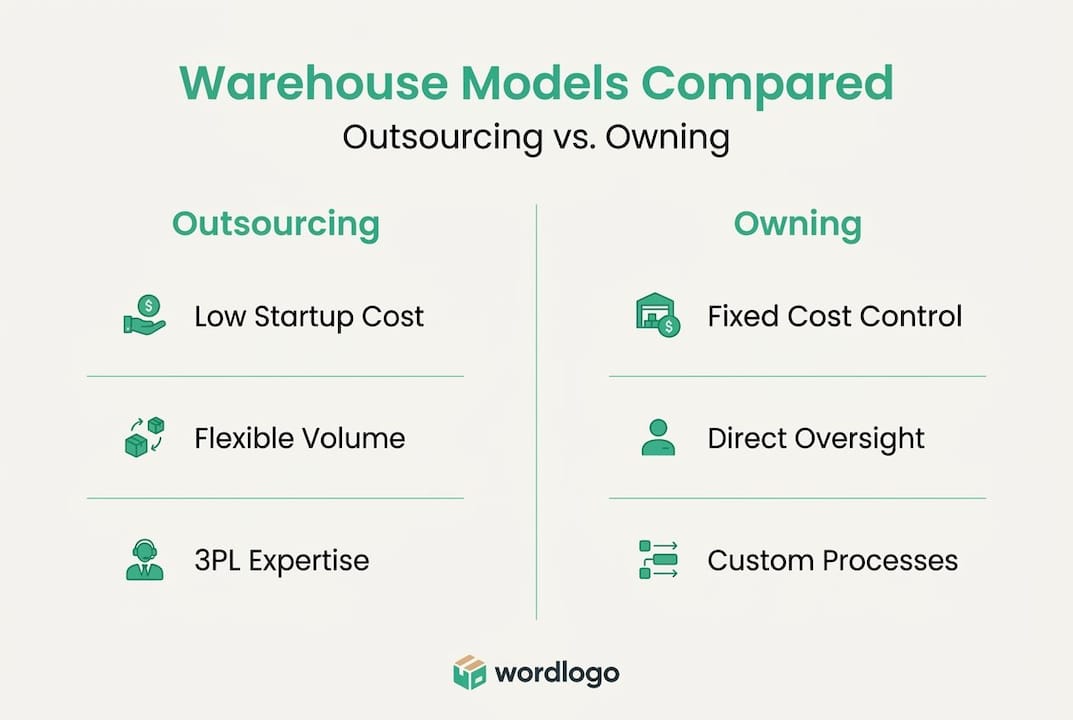
The calculus shifts when volumes stabilise. At that point, ownership often proves more cost-efficient and gives you far greater control over throughput, cycle times, and staff productivity. Purpose-built warehouse design, tailored to your specific SKU mix and order profiles, can deliver significant operational performance improvements that a standardised 3PL layout simply cannot match.

Businesses regularly reassess this decision as their needs evolve, and the smartest operators do so at defined intervals rather than waiting for a crisis to force a review. The warehouse optimisation strategies that work at 500 orders per day look very different to those needed at 5,000.
Deciding when to outsource warehousing
If you are trying to work out whether now is the right time to outsource, there are clear signals worth looking for. The decision framework below is practical, not theoretical.
- Identify your operational pressure points. Are you running out of storage space? Are order error rates climbing? Are your fulfilment team’s hours increasing without a proportional rise in output? These are concrete indicators that your current setup is not scaling.
- Calculate your true total cost of ownership. Include labour, property costs, utilities, equipment depreciation, packaging materials, and the management time spent on warehouse operations. Many businesses are shocked to discover how close their internal costs are to 3PL rates, once everything is counted.
- Test integration compatibility early. Before committing to a provider, rigorously test WMS sync with your e-commerce platforms. Confirm that inventory updates are real-time, not batched, and that returns are handled with full visibility.
- Negotiate SLAs with teeth. Define acceptable error rates, dispatch cut-off times, and what happens when performance falls short. Vague SLAs protect the provider, not your business.
- Clarify exit terms upfront. Who owns the inventory data? What is the transition timeline if you want to move to another provider or bring fulfilment in-house? These questions are far easier to answer before you sign than after.
- Match provider geography to your customer base. A single warehouse in a central location suits some businesses. Others benefit from multi-node networks that put stock closer to their customers and reduce last-mile costs.
Pro Tip: Treat your first 3PL contract as a trial, not a commitment. Negotiate a shorter initial term with renewal options. This gives you leverage and real performance data before locking in longer terms.
For advice on choosing the right partner, the 3PL selection guide from Parcelplanet covers the key criteria in detail.
My perspective on outsourcing warehousing
I have seen businesses treat outsourcing as the answer to every logistics problem, and I have seen businesses avoid it for far too long out of a desire for control. Both mistakes are expensive.
In my experience, outsourcing warehousing is genuinely well-suited to two specific stages: early growth, where flexibility matters more than margin, and market entry, where building your own infrastructure in a new region is simply not viable. Outside of those stages, the case becomes much more nuanced.
What I find consistently underestimated is the importance of integration testing. Businesses spend weeks negotiating rates and almost no time confirming that their WMS and sales channels will actually talk to each other reliably. That oversight causes more operational pain than any contract clause.
The other thing I would push back on is the idea that outsourcing is a long-term fix. It is a strategic tool. As your volumes grow and your operational needs become more predictable, the case for owning more of your supply chain compounds. The businesses I have seen manage this transition well are the ones who planned for it from the beginning, rather than treating outsourcing as a permanent state.
— Lukasz
How Parcelplanet supports your warehousing decisions

If you are weighing up whether to outsource your warehousing, Parcelplanet is built specifically to support growing e-commerce and omnichannel brands at exactly this stage. Our order fulfilment services cover picking, packing, and shipping across multiple sales channels, with real-time inventory visibility and direct integration with your e-commerce platforms.
What sets Parcelplanet apart is flexibility without the typical 3PL rigidity. We handle a wide range of SKUs and order volumes, support multi-location fulfilment, and work with you to build a logistics setup that scales as your business grows. Whether you need to manage seasonal peaks, expand into new regions, or simply get your fulfilment off your hands so you can focus on growth, our team is ready to help.
You can also explore inventory planning tools through Parcelplanet to improve stock accuracy and reduce the working capital tied up in your warehouse. Get in touch for a tailored quote and see how we can support your next stage of growth.
FAQ
What is warehouse outsourcing?
Warehouse outsourcing means contracting a third-party logistics provider to store, manage, and fulfil your inventory on your behalf. The provider handles operations including receiving stock, picking, packing, and shipping orders to your customers.
What are the main benefits of outsourced warehousing?
The key benefits include flexible scalability, conversion of fixed costs to variable expenses, access to advanced fulfilment technology, and improved order accuracy. Multi-node provider networks also reduce delivery times and improve customer satisfaction.
Why outsource warehousing instead of owning a facility?
Outsourcing makes most sense during periods of rapid growth or market expansion, when volume unpredictability makes committing to a fixed facility financially risky. Once volumes stabilise, owning your own warehouse can reduce annual costs by 8 to 15% compared to 3PL pricing.
What risks should I plan for when outsourcing warehousing?
The main risks are poor data integration between your WMS and sales channels, hidden contract fees, and weak exit terms that create vendor dependency. Rigorously testing integrations and negotiating clear SLAs and exit clauses before signing are the most effective safeguards.
How do I know when to outsource my warehousing?
Signs that outsourcing is worth considering include space constraints, rising fulfilment error rates, difficulty scaling during peak periods, and internal management time being diverted from core business activities to warehouse operations.
Recommended


