TL;DR:
- Online retail logistics involves managing individual parcel shipments directly to customers with real-time inventory and flexible networks. Traditional retail focuses on pallet movements to stores and batch inventory updates, making online logistics far more complex and technology-dependent. Strategic use of distributed fulfillment centers, automation, and integrated partners is essential to meet demand surges, high returns, and customer expectations.
Online retail logistics is defined as the end-to-end management of individual parcel fulfilment from warehouse to customer doorstep, a process fundamentally different from the bulk replenishment flows that power traditional retail. Understanding why retail logistics differ online is not a minor operational concern. It is the difference between a supply chain that scales and one that collapses under its own complexity. E-commerce logistics involve unit-level, direct-to-customer shipments requiring complex sorting and last-mile coordination, unlike pallet deliveries to stores. The ecommerce supply chain demands real-time inventory visibility, distributed fulfilment networks, and technology integrations that traditional retail never required.
What are the main operational differences between online and traditional retail logistics?
Online retail logistics operates at the unit level. Every order is a single transaction, picked individually, packed to specification, and dispatched to a unique address. Traditional retail logistics, by contrast, moves pallets of identical stock to a fixed set of store locations on predictable schedules. The operational gap between these two models is enormous.
Order picking and packing is the clearest point of divergence. A traditional distribution centre (DC) might dispatch 50 pallets to 10 stores in a morning. An online fulfilment centre processes thousands of individual orders in the same window, each requiring its own pick path, packaging decision, and carrier label. The labour intensity per unit is substantially higher online.
Returns are the second major difference. Returns rates in fashion and electronics can reach 20–30% of units sold. That volume creates a reverse logistics operation that traditional retail simply does not face at the same scale. Each returned item must be received, inspected, graded, and either restocked or written off. This adds cost, warehouse space, and process complexity that most traditional retail networks were never designed to absorb.
Inventory visibility requirements also diverge sharply. Traditional retail uses periodic stock counts and batch inventory updates. Online retail requires real-time stock accuracy because a customer purchasing at 11:00 PM expects the item to be available and dispatched the next morning. Any discrepancy between system stock and physical stock creates a failed order and a damaged customer relationship.
- Order volume and variability: Online channels generate thousands of small orders daily, with demand that spikes sharply during promotions and peak seasons.
- Carrier complexity: Online fulfilment requires relationships with multiple carriers to cover residential last-mile delivery, whereas traditional retail uses fewer, larger freight contracts.
- Packaging requirements: Individual parcels need protective packaging, branded inserts, and accurate labelling at scale. Store deliveries use bulk packaging with minimal individual handling.
- Returns processing: Online returns require a dedicated inbound workflow. Traditional retail handles returns at store level, keeping them largely invisible to the central DC.
Pro Tip: Map your returns flow before you design your fulfilment network. Returns processing is often overlooked in network design but can change the optimal DC location and adds significant cost if handled reactively.
How does supply chain network design differ for online retail?
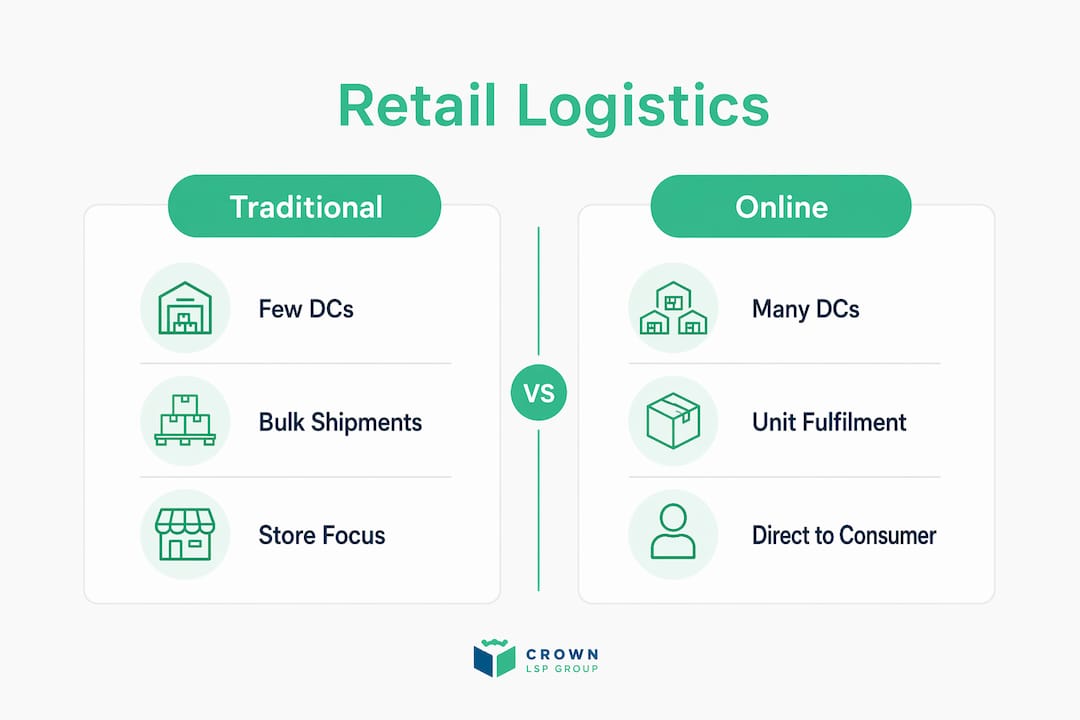
The physical structure of a supply chain built for online retail looks nothing like one built for stores. Traditional retail networks centre on a small number of large DCs positioned to replenish stores efficiently. Online retail networks require a distributed set of fulfilment nodes positioned closer to end customers to reduce last-mile costs and meet delivery speed expectations.
Online demand is geographically diffuse and speed-sensitive, which means a single centralised DC optimised for store replenishment is structurally wrong for online channels. A parcel travelling 400 miles from a central DC costs more and takes longer than one dispatched from a regional node 80 miles away. That difference compounds across millions of orders per year.
The table below shows the core structural contrasts between the two network models.
| Design factor |
Traditional retail network |
Online retail network |
| DC count |
Few, large, centralised |
Multiple, smaller, distributed |
| Delivery destination |
Fixed store locations |
Residential addresses nationwide |
| Inventory positioning |
Store-level replenishment |
Proximity to customer demand clusters |
| Returns flow |
Store-handled, minimal DC impact |
Dedicated inbound reverse logistics |
| Demand modelling |
Aggregate, channel-level |
Channel-specific, postcode-level |
Retail supply chains built for in-store sales fail to address omnichannel demand complexity, leading to costly inefficiencies and service failures. The root cause is that most legacy planning tools aggregate demand across channels and miss the specific signals that online retail generates. Wrong DC placement is the result, and it is an expensive mistake to correct after the fact.
Managing forward and reverse flows simultaneously is another design challenge unique to online retail. Optimising ecommerce logistics requires modelling both directions for each node type and channel. A DC that handles high outbound volume but receives significant returns needs different staffing, dock capacity, and system logic than one handling outbound only.
What role does technology play in differentiating online retail logistics?
Technology is not an enhancement in online retail logistics. It is the foundation. Without real-time system integration, the entire operation breaks down. Real-time API integrations between e-commerce platforms and logistics systems reduce delays by up to 40% and improve forecasting accuracy by 30–50%. That is a material operational advantage, not a marginal gain.

The role of AI in ecommerce extends well beyond chatbots. Demand forecasting models trained on historical order data, promotional calendars, and external signals allow fulfilment teams to pre-position stock before demand arrives rather than reacting after it peaks. This reduces both stockouts and excess inventory simultaneously.
Automation in warehousing, such as robotic picking arms and automated sorting systems, accelerates order processing and supports peak season scalability. A manual pick operation has a ceiling determined by headcount. An automated operation scales with throughput demand, which is exactly what online retail requires during Black Friday or seasonal peaks.
- Platform integrations: Direct API connections between your sales channels, warehouse management system (WMS), and carrier networks are non-negotiable for accurate, real-time order tracking.
- Demand forecasting: AI-driven forecasting tools reduce the guesswork in inventory positioning and help avoid the costly consequences of being under-stocked during promotions.
- Warehouse automation: Robotic picking, conveyor sorting, and automated packing lines increase throughput without proportional increases in labour cost.
- Carrier management systems: Multi-carrier platforms allow dynamic carrier selection based on cost, speed, and service level, reducing dependency on any single provider.
Pro Tip: If your logistics integration was built for traditional retail, do not assume it will handle online volumes. Legacy systems that aggregate demand and batch-update inventory are structurally incompatible with real-time online fulfilment requirements.
Most legacy supply chain tools aggregate demand and miss critical channel-specific signals, leading to wrong DC placement and network design mistakes. Replacing or augmenting these tools is not optional for brands serious about online growth.
What are the key challenges in managing online retail logistics?
The challenges in digital retail logistics are distinct from those in traditional retail, and they compound quickly if left unaddressed.
Promotional demand spikes can be 3–5 times baseline and destabilise logistics networks not designed for online retail demand patterns. A network calibrated for average daily volume will fail during peak periods. The consequences are delayed shipments, carrier rejections, and customer complaints that damage brand reputation.
High return rates increase reverse logistics complexity and cost in ways that are difficult to predict. A 25% return rate on a fashion range means one in four outbound shipments generates an inbound return. Each return consumes warehouse labour, system processing time, and physical space. Without a dedicated returns workflow, the inbound volume competes with outbound fulfilment for the same resources.
Carrier capacity constraints are a recurring pressure point. During peak seasons, carrier networks reach capacity limits and prioritise their largest volume customers. Brands without diversified carrier relationships find themselves unable to dispatch orders on time, regardless of how well their internal operations perform.
Practical solutions that address these challenges include:
- Carrier diversification: Maintaining active relationships with multiple carriers reduces dependency and provides fallback options during peak capacity constraints.
- Inventory precision: Accurate, real-time inventory management reduces both stockouts and overstock, cutting the cost of holding excess safety stock.
- Flexible network capacity: Using third-party logistics providers (3PLs) as overflow capacity during peaks avoids the capital cost of building permanent infrastructure for peak-only demand.
- Dedicated returns processing: Separating inbound returns from outbound fulfilment operations prevents the two flows from competing for the same resources.
89% of retailers expect their 3PL partners to be embedded directly into planning rather than just execution. This shift reflects a recognition that 3PLs are no longer just warehouses for hire. They are operational partners who contribute to network design, carrier strategy, and demand planning. Brands that treat their 3PL as a transactional supplier miss the strategic value available from a deeper relationship. You can reduce fulfilment costs significantly by aligning your 3PL partner with your planning cycle rather than your despatch schedule.
Key takeaways
Online retail logistics requires a fundamentally different network design, technology stack, and operational model compared to traditional retail, driven by unit-level orders, high return rates, and real-time customer expectations.
| Point |
Details |
| Unit-level fulfilment |
Online orders require individual picking, packing, and carrier labelling at scale, unlike bulk store replenishment. |
| Distributed network design |
Online retail needs regional fulfilment nodes close to customers, not a single centralised DC. |
| Returns complexity |
Return rates of 20–30% in fashion and electronics demand a dedicated reverse logistics workflow. |
| Technology integration |
Real-time API integrations reduce delays by up to 40% and are non-negotiable for online fulfilment accuracy. |
| Strategic 3PL partnerships |
Embedding 3PL partners in planning rather than just execution improves resilience and reduces cost. |
The uncomfortable truth about online retail logistics
The most common mistake I see retail managers make is treating online logistics as a variation of what they already do. It is not. Forcing online fulfilment through traditional bulk-retail infrastructure without dedicated processes creates permanent capacity bottlenecks. I have seen brands spend months trying to make their existing DC work for online volumes before accepting that the network physics simply do not allow it.
Returns logistics is the area that surprises managers most. They plan for outbound volume and forget that a meaningful percentage of it comes straight back. When returns arrive without a dedicated process, they pile up in corners of the warehouse, blocking racking and confusing stock counts. The customer experience suffers because refunds are delayed and restocking is slow.
My practical advice for retail managers aligning logistics with omnichannel demand is this: model your online and store channels separately from the start. Do not let aggregate demand figures hide the channel-specific signals that determine where your stock should sit and how your network should be structured. Invest in 3PL partnerships that bring planning capability, not just warehouse space. And treat your technology stack as infrastructure, not a nice-to-have. The brands winning in online retail logistics in 2026 are not the ones with the biggest warehouses. They are the ones with the best data and the most integrated partners.
— ChiefPlaneteer
How Parcelplanet supports your online retail logistics
Running online retail logistics well requires the right fulfilment partner, not just the right intentions.
Parcelplanet provides order fulfilment services built specifically for e-commerce and omnichannel brands, with real-time platform integrations, distributed network capability, and dedicated returns handling. Whether you are managing seasonal peaks, expanding into new regions, or trying to reduce the cost of your current fulfilment operation, Parcelplanet’s team works directly within your planning cycle to deliver results. Get in touch with Parcelplanet today to receive a tailored quote and find out how an integrated 3PL partnership can improve your service levels and reduce your logistics costs.
FAQ
Why do retail logistics differ for online versus in-store sales?
Online retail logistics manages individual parcel shipments to residential addresses, requiring real-time inventory systems, last-mile carrier networks, and dedicated returns processing. Traditional retail logistics moves bulk pallets to fixed store locations on predictable schedules, which demands a fundamentally different network design and operational model.
What is the biggest challenge in digital retail logistics?
Demand unpredictability is the primary challenge. Promotional spikes can reach 3–5 times baseline volume, and networks not designed for online retail demand patterns will fail under that pressure.
How do return rates affect ecommerce supply chain design?
Return rates of 20–30% in categories like fashion and electronics require a dedicated reverse logistics workflow. Without one, inbound returns compete with outbound fulfilment for warehouse space and labour, increasing costs and slowing refunds.
What technology is non-negotiable for online retail logistics?
Real-time API integrations between your e-commerce platform, warehouse management system, and carrier network are the minimum requirement. These integrations reduce delays by up to 40% and provide the inventory accuracy that online fulfilment depends on.
When should a brand partner with a 3PL for online fulfilment?
A brand should consider a 3PL partner when its order volume exceeds its internal warehouse capacity, when peak seasons create unmanageable spikes, or when it needs to expand into new regions without building permanent infrastructure.
Recommended