TL;DR:
- Small e-commerce sellers outsource shipping mainly to reduce costs and increase operational flexibility. They leverage 3PL partnerships for faster delivery, better customer satisfaction, and to handle surges like viral spikes. Successful outsourcing involves active management of KPIs, clear contracts, and maintaining customer service ownership.
Third-party logistics (3PL) outsourcing is the practice of handing warehousing, picking, packing, and shipping to a specialist provider so your business can focus on selling. The question of why small sellers outsource shipping has a clear answer: cost control, operational flexibility, and faster delivery are the three forces driving the decision. According to the 2026 Miebach study, cost variability (80%), investment avoidance (79%), and focusing on core competencies (77%) are the top three drivers for logistics outsourcing. Those numbers tell a consistent story: small sellers are not outsourcing because it is fashionable. They are outsourcing because the maths and the operational reality demand it.
Why small sellers outsource shipping: the core financial case
The financial argument for outsourcing shipping is direct. 3PL partnerships reduce overall fulfilment costs by 15% or more, largely because providers negotiate bulk carrier rates that individual small sellers cannot access. That saving compounds quickly when you factor in the costs you are currently absorbing without realising it.
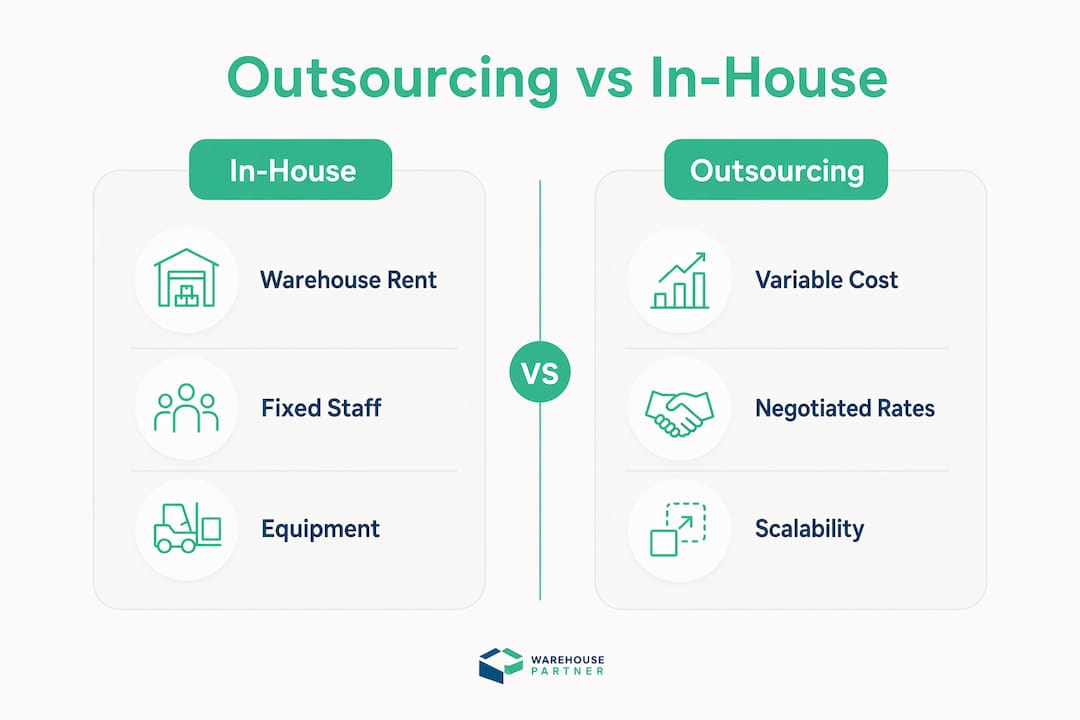
Outsourcing converts fixed internal costs like warehouse rent, equipment, and permanent staff wages into variable expenses that rise and fall with your order volume. For a small seller, that shift is significant. You stop paying for capacity you do not use in quiet months, and you gain access to capacity you could not afford to build in busy ones.
The hidden costs of in-house shipping are where most sellers underestimate the true price of doing it themselves. Staff time spent packing orders is time not spent on product development, marketing, or customer acquisition. Add the opportunity cost of a founder spending three hours a day at the post office, and the real expense of in-house fulfilment becomes clear.
| Cost category |
In-house shipping |
3PL outsourcing |
| Warehouse space |
Fixed monthly rent |
Charged per pallet or unit stored |
| Labour |
Permanent or agency staff |
Included in fulfilment fee |
| Carrier rates |
Standard retail rates |
Negotiated bulk rates |
| Technology |
Separate investment required |
Included in platform |
| Scaling during peak |
Hire temporary staff, risk delays |
Capacity available on demand |
Pro Tip: Before requesting a 3PL quote, calculate your fully loaded cost per order in-house. Include staff wages, packaging materials, postage, and the time you personally spend on fulfilment. The comparison is almost always more compelling than sellers expect.
How does outsourcing shipping improve delivery speed and customer satisfaction?
Delivery speed is now a brand selection criterion, not just a convenience. For Gen Z consumers, fast delivery ranks among the top three factors when choosing where to buy. That expectation is reshaping what small sellers must offer to compete.

A 3PL provider solves the speed problem through geography and automation. Providers with distributed warehouse networks can store your stock closer to your customers. An order placed in Manchester gets despatched from a nearby fulfilment centre rather than your spare bedroom in Bristol. The result is shorter transit times without any additional effort on your part.
Faster delivery directly affects conversion rates and repeat purchases. A customer who receives their order the next day is far more likely to leave a positive review and return. A customer who waits five days with no tracking update is far more likely to contact your support inbox, leave a negative review, or request a refund. The shipping strategy for e-commerce success is built on this principle: reliable, fast fulfilment is a retention tool, not just a logistics function.
The operational advantages of outsourcing delivery speed include:
- Distributed warehouse locations reducing average transit distances
- Automated pick-and-pack processes cutting despatch time to same-day or next-day
- Real-time tracking updates sent directly to customers, reducing inbound enquiries
- Carrier integrations giving access to multiple courier options at competitive rates
- Consistent packing standards reducing damage rates and returns
Pro Tip: Ask your 3PL provider whether they offer custom branded packaging or eco-friendly packaging options. Maintaining your brand identity through the unboxing experience protects the customer relationship even when a third party handles fulfilment.
When should small e-commerce sellers consider outsourcing their shipping?
The right moment to outsource is earlier than most sellers think. The common trigger points are order volume bottlenecks, limited warehouse capacity, and labour constraints that slow despatch times. When order volume creates bottlenecks that hinder your focus on growth, the business has already outgrown in-house fulfilment.
The viral sales spike is the scenario that catches sellers off guard most often. A product featured on a popular social media account can generate hundreds of orders within hours. A seller packing from home cannot fulfil that volume without delays, errors, and damaged customer relationships. The reputational risk of failing during a viral spike is severe. A 3PL absorbs that surge without breaking.
Operational signs that outsourcing is overdue:
- Orders regularly despatch more than 48 hours after purchase
- You are spending more than two hours per day on packing and posting
- Your home or office no longer has adequate storage for stock
- You have missed despatch deadlines during a busy period
- Customer complaints about delivery times are increasing
The broader strategic shift matters here too. The logistics industry is moving from transaction-focused outsourcing to relationship-driven partnerships with shared accountability and aligned KPIs. Sellers who engage a 3PL early build that partnership before growth pressure forces a rushed decision. You can read more about logistics trends shaping e-commerce in 2026 to understand how this shift affects your planning.
What challenges do small sellers face when outsourcing shipping?
Outsourcing shipping does not remove all problems. It replaces one set of challenges with another, and sellers who go in unprepared often find the new challenges equally frustrating. The most common issue is pricing transparency. Many businesses struggle with unclear 3PL pricing and poorly defined contract terms. A detailed tender document describing your exact processes, SKU count, order volumes, and packaging requirements is the most effective way to get accurate, comparable quotes.
Active KPI monitoring is the second discipline that separates successful outsourcing from failed partnerships. A 3PL will meet the standards you measure and enforce. If you do not track despatch accuracy, on-time delivery rates, and return processing times, you will not know when performance slips until customers tell you.
Sellers remain responsible for the customer experience regardless of who packs the box. Visible tracking updates, proactive communication about delays, and a responsive support process are all still your responsibility. Outsourcing fulfilment is not outsourcing accountability.
Common pitfalls to address before signing a 3PL contract:
- Vague pricing structures with undisclosed surcharges for returns, labelling, or peak periods
- No agreed service level agreements covering despatch times and accuracy rates
- Insufficient integration between the 3PL’s warehouse management system and your sales channels
- No escalation process for damaged goods or lost parcels
- Assuming the 3PL will manage customer communication on your behalf
Pro Tip: Retain your customer service function internally even after outsourcing fulfilment. High-touch customer service alongside a reliable 3PL is the combination that protects your brand reputation and drives repeat purchases.
Key takeaways
Small sellers outsource shipping primarily to convert fixed costs into variable ones, access negotiated carrier rates, and free internal capacity for growth-focused work.
| Point |
Details |
| Core outsourcing drivers |
Cost variability, investment avoidance, and core competency focus are the top three reasons businesses outsource logistics. |
| Financial savings |
3PL partnerships reduce fulfilment costs by 15% or more through bulk carrier rates and shared warehousing. |
| Delivery speed matters |
Fast delivery is a top brand selection criterion for Gen Z consumers and directly affects conversion rates. |
| Know when to act |
Despatch delays over 48 hours, storage constraints, and viral spike risk are clear signals to outsource. |
| Manage the partnership actively |
Monitor KPIs, define contract terms clearly, and retain customer service internally to protect brand reputation. |
The outsourcing decision is simpler than sellers make it
I have worked with enough small e-commerce businesses to know that the hesitation around outsourcing shipping is almost never about cost. It is about control. Sellers worry that handing fulfilment to a third party means losing the personal touch that built their brand in the first place.
That concern is legitimate, but it is also based on a misunderstanding of what good outsourcing looks like. The sellers I have seen struggle with 3PL partnerships are the ones who treated it as a set-and-forget arrangement. They signed a contract, sent their stock, and assumed the rest would take care of itself. It does not work that way.
The sellers who benefit most from outsourcing are the ones who treat the 3PL as an operational partner with shared goals. They set clear KPIs from day one. They review performance monthly. They stay close to the customer experience even though someone else is packing the boxes. That combination of outsourced logistics and retained customer ownership is what sustainable e-commerce growth actually looks like in practice.
The viral spike scenario is the one that convinces most sceptics. A single TikTok feature can generate more orders in 24 hours than a small seller typically processes in a month. Without a 3PL, that moment of success becomes a crisis. With one, it becomes a milestone. That shift in how you experience growth is worth more than any cost-per-order calculation.
My honest advice: do not wait until you are drowning in orders to start the conversation. The best time to find a 3PL partner is when you have the bandwidth to evaluate them properly, not when you are already behind on despatch.
— ChiefPlaneteer
How Parcelplanet supports small sellers with outsourced fulfilment
Small sellers who are ready to hand off fulfilment need a partner that understands e-commerce from the ground up.
Parcelplanet provides order fulfilment services built specifically for growing e-commerce and omnichannel brands. The service covers warehousing, picking, packing, and despatch, with real-time tracking and direct integration with major e-commerce platforms. Parcelplanet’s carrier network delivers the negotiated rates that small sellers cannot access independently, and the flexible model means you pay for what you use rather than maintaining fixed infrastructure. Whether you sell on WooCommerce, BigCommerce, or your own storefront, Parcelplanet connects directly to your e-commerce platform integrations to keep orders moving without manual intervention. Get in touch for a tailored quote.
FAQ
Why do small sellers outsource shipping rather than handle it in-house?
Small sellers outsource shipping to reduce costs, convert fixed overheads into variable expenses, and free time for growth-focused work. The 2026 Miebach study identifies cost variability (80%) and investment avoidance (79%) as the leading drivers.
How much can a small seller save by using a 3PL?
Brands using a 3PL provider can reduce overall fulfilment costs by 15% or more through negotiated carrier rates and shared warehousing infrastructure.
What are the signs that a small seller needs to outsource shipping?
Key signs include orders despatching more than 48 hours after purchase, storage running out, and fulfilment delays during busy periods or viral sales spikes.
Does outsourcing shipping mean losing control of the customer experience?
No. Sellers remain responsible for customer communication, tracking visibility, and service quality. Outsourcing fulfilment means a 3PL handles the physical process; the brand relationship stays with you.
What questions should small sellers ask a 3PL provider before signing?
Ask about pricing structure and any peak-period surcharges, service level agreements for despatch accuracy and speed, platform integrations, and the process for handling damaged or lost parcels.
Recommended