TL;DR:
- Inefficient logistics silently erodes e-commerce profit margins by increasing costs through siloed systems and manual processes.
- Adopting automation, AI, and multi-node networks enhances speed, accuracy, and resilience, enabling scalable growth.
Shipping costs are quietly eating your margins, and the brands that ignore it pay the price later. For small to medium e-commerce businesses, logistics is rarely the first thing that gets attention, but it is almost always one of the first things that breaks under growth. Understanding why streamline logistics thinking matters, and acting on it before you hit capacity limits, is one of the clearest competitive decisions you can make in 2026. This guide breaks down exactly where the money goes, which tools and structures change the equation, and how to build an operation that grows with you rather than against you.
Table of Contents
Key Takeaways
| Point |
Details |
| Significant cost savings |
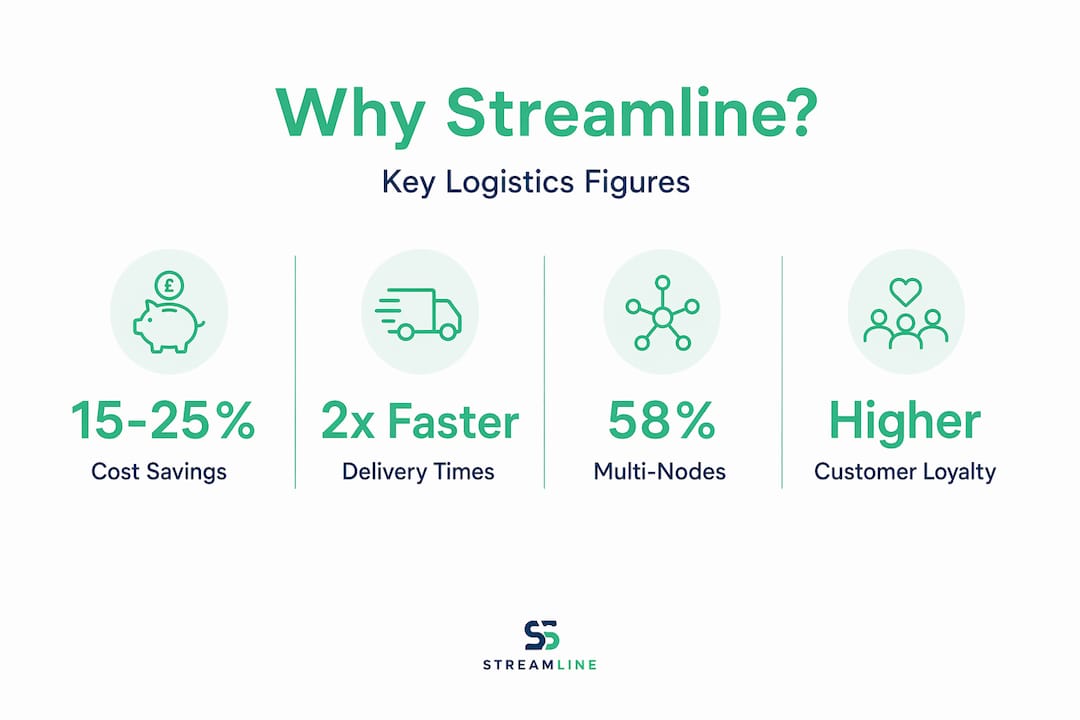
Streamlining logistics can cut shipping costs by 15-25% even amid rising carrier rates. |
| Technology drives efficiency |
AI and automation reduce errors, stockouts, and fulfilment costs while speeding delivery. |
| Multi-centre networks scale well |
Positioning inventory across multiple centres slashes delivery times and cross-border costs. |
| Carrier diversity is key |
Using multiple carriers simultaneously captures better rates and improves reliability. |
| Strategic value beyond operations |
Streamlined logistics acts as an insurance policy and growth enabler for scaling e-commerce brands. |
The cost challenge: why inefficient logistics drains profits
Logistics is not a background function. For most e-commerce brands, it is one of the largest cost categories on the balance sheet. Shipping consumes 15-20% of margins for e-commerce merchants, making it a financial lever that cannot afford to be ignored. That figure alone should reframe how you think about logistics efficiency.
The problem is that inefficiencies rarely look dramatic. They accumulate quietly through siloed systems, manual carrier selection, poor inventory placement, and reactive rather than proactive decision-making. Each one adds cost and friction.
Common sources of logistics inefficiency in e-commerce SMBs include:
- Carrier lock-in: Relying on a single carrier means no rate competition and no fallback when service fails.
- Disconnected systems: When your warehouse management, order management, and carrier systems do not talk to each other, manual errors and delays multiply.
- Poor demand forecasting: Overstocking ties up cash; understocking causes stockouts and lost sales.
- Manual exception handling: Delayed shipments, failed deliveries, and returns eat hours of staff time when there is no automated workflow in place.
- Non-optimised packaging: Shipping air in oversized boxes raises dimensional weight charges across every single order.
The financial consequences compound fast. A brand processing 500 orders per day at even a modest per-order inefficiency of £1.50 loses over £270,000 annually. That is not a logistics problem. That is a profitability problem.
“Streamlined shipping operations can reduce logistics costs by 15-25% amid rising carrier rates, according to ParcelPath analysis in 2026.”
Carrier rates continue to rise in 2026, meaning brands that have not yet addressed their logistics structure are facing a widening gap. The good news is that the path to reduce fulfilment costs is well-documented, and the gains are material.
Once you understand where the money leaks, the next question is what actually plugs those leaks. Technology is the most direct answer, and the gap between brands using it well and those still relying on manual processes is growing every quarter.
Artificial intelligence, for those not yet using it in logistics, refers to software that learns from historical data to make predictions and automate decisions. In a fulfilment context, this means smarter inventory positioning, more accurate demand forecasting, and faster exception management. AI reduces stockouts by 35-45% and fulfilment costs by 10-15%, according to Accenture. Those are not incremental gains; they are structural improvements to your cost base.
Warehouse automation compounds those benefits further. Automated picking systems, barcode scanning workflows, and integrated conveyor routing do not just speed things up. Automation improves accuracy by up to 15% and productivity by up to 20%. For a brand seeing growth in order volumes, that accuracy improvement alone can prevent the customer service fallout that comes with mispicks and incorrect shipments.
Key technologies worth prioritising in your logistics operation include:
- Real-time tracking systems: Give both your team and your customers live visibility into shipment status, reducing inbound “where is my order” enquiries significantly.
- AI-driven demand forecasting: Predict which SKUs need replenishment, in which location, and at what quantity, before you run out.
- Carrier rate optimisation tools: Automatically select the best carrier for each shipment based on cost, delivery speed, and service area.
- Automated exception alerts: Flag delayed, held, or returned shipments immediately so your team can act before the customer notices.
Understanding automation in ecommerce logistics goes beyond simply adopting new software. It requires integrating your technology stack so that data flows freely between systems without manual intervention. That integration is where most brands either unlock the full benefit or fall short.
Pro Tip: Before investing in new logistics technology, audit your current data flows. If your order management system and warehouse management system are not sharing data in real-time, that is the first gap to close. No amount of AI investment delivers its full value on top of disconnected infrastructure.
The broader picture is this: technology does not just make logistics faster. It makes how you automate and transform fulfilment a source of competitive advantage, because your competitors who are still running manual processes are absorbing costs and delays you are not.
Multi-node networks: scaling your logistics across multiple centres
Technology solves a great deal, but geography is a constraint that software alone cannot overcome. If all your inventory sits in a single fulfilment centre, every long-distance delivery carries a higher shipping cost and a longer transit time. As your order volume grows and your customer base spreads, that single-node model works against you.
Over 58% of brands now use more than one fulfilment centre, with nearly 44% planning to add more in 2026. That is not a coincidence. Distributed inventory is becoming the standard for brands serious about multi-channel logistics and delivery performance.
| Fulfilment model |
Average delivery time |
Shipping cost impact |
Omnichannel readiness |
| Single central warehouse |
3 to 5 days nationally |
Higher per-order cost |
Limited |
| Two regional centres |
1 to 3 days nationally |
Moderate reduction |
Good |
| Multi-node national network |
Next day or same day |
Significant reduction |
Strong |
| Global fulfilment network |
2 to 5 days internationally |
Up to 71% lower cross-border cost |
Full omnichannel |
The case for regional inventory placement goes beyond speed. When stock is positioned closer to end customers, you move down the shipping zone tiers that carriers use to calculate rates. A parcel shipping from Zone 1 instead of Zone 7 can cost 30 to 50% less per unit. At volume, that difference is transformative.
Benefits of a multi-node logistics network for growing e-commerce brands:
- Shorter last-mile distances reduce both cost and transit time.
- Regional inventory buffers protect against supply disruptions at a single location.
- Customers across different regions experience consistent delivery performance.
- Omnichannel fulfilment becomes viable, with stock accessible for in-store, click-and-collect, and online orders from the same pool.
Brands with international ambitions should pay particular attention here. The combination of scalable logistics strategies and a global network can dramatically reduce the cost and complexity of cross-border shipping, which has historically been a barrier for smaller brands.
Best practices for streamlining logistics operations
Strategy and technology only produce results when paired with sound operational practice. Here are the specific actions that make the most consistent difference for e-commerce brands working to improve their supply chain operations.
-
Diversify your carrier portfolio. Using a multi-carrier platform that compares 50+ carriers in real-time helps SMEs save 15-25% without requiring volume commitments. Rate-shopping at the point of dispatch, rather than locking into a single annual contract, gives you flexibility as your volumes and delivery requirements change.
-
Integrate your technology stack end to end. Your inventory management, warehouse management, and carrier systems should share data in real-time. A fragmented stack means manual re-keying, delayed updates, and errors. Proper logistics integration connects every layer so that an order placed on your website triggers picking, packing, carrier selection, and tracking updates automatically.
-
Automate your returns process. This is the area most brands underinvest in. Automated returns portals cut return processing time to 30-60 seconds per order, saving £2,000 to £4,000 monthly on 200 daily returns. The customer experience benefit is equally significant: a smooth returns process is one of the strongest drivers of repeat purchase behaviour.
-
Set up proactive exception management. Exceptions (delayed shipments, carrier failures, customs holds) are inevitable. What differentiates good logistics operations is how quickly you respond. Build alert workflows that notify your team and trigger customer communications before complaints arrive.
-
Review carrier performance monthly. Rate negotiation and carrier selection should not be annual events. Monitor on-time delivery rates, damage rates, and cost per zone regularly, and use that data in your carrier conversations.
| Practice |
Time to implement |
Cost saving potential |
Customer experience impact |
| Multi-carrier rate shopping |
1 to 4 weeks |
15-25% on shipping spend |
Indirect |
| Full tech stack integration |
4 to 12 weeks |
10-20% on operational costs |
High |
| Automated returns portal |
2 to 6 weeks |
£2,000-4,000/month at scale |
Very high |
| Exception management workflow |
1 to 3 weeks |
Variable |
High |
| Regional inventory positioning |
8 to 24 weeks |
20-40% on last-mile cost |
Very high |
Pro Tip: When evaluating shipping optimisation tools, prioritise platforms that offer both rate comparison and tracking in a single interface. Switching between tools to manage dispatch and monitor delivery adds unnecessary friction and creates gaps in your exception visibility.
Rethinking logistics: the deeper impact of streamlining on brand growth
Here is the view most operational articles stop short of: streamlining logistics is not fundamentally about cost reduction. Cost reduction is the outcome. The real driver is risk management and brand resilience.
Every e-commerce brand operating in 2026 faces supply chain uncertainty as a permanent condition, not a temporary disruption. Rate surges, carrier capacity constraints, customs complications, and demand volatility are structural features of the market. Brands that have built flexible, integrated logistics operations absorb these shocks far better than those still running on single-carrier, single-location, manually managed models.
As ShipBob CEO Dhruv Saxena put it in their 2026 report, the right fulfilment strategy “has become an insurance policy for SMBs scaling globally.” That framing is exactly right. An efficient logistics operation gives you options when conditions change. An inefficient one locks you into costs and constraints at precisely the moment you need flexibility.
There is also a loyalty dimension that often goes unacknowledged. Customers do not remember that your product arrived on time; they remember when it did not. Consistent, visible, reliable delivery builds the kind of trust that turns one-time buyers into repeat customers. When you invest in optimising logistics for growth, you are investing in your customer relationship as much as your cost structure.
The brands we see struggling with international expansion are almost always the ones that treated logistics as something to sort out later. By the time they try to scale globally, the complexity of managing multiple carriers, customs processes, and regional inventory across disconnected systems is overwhelming. Getting the foundation right early, even if it means outsourcing to a specialist, is a far less costly decision than retrofitting it at scale.
How ParcelPlanet can help streamline your logistics
If the steps above feel significant to tackle alone, that is because they are. Building a multi-carrier platform, integrating your technology stack, distributing inventory across fulfilment centres, and automating returns all require expertise, infrastructure, and time. Most growing e-commerce brands do not have all three in abundance.
ParcelPlanet’s order fulfilment services are built specifically for e-commerce and omnichannel brands that need a dependable, scalable logistics operation without the overhead of building it from scratch. From multi-centre fulfilment that places your inventory closer to your customers, to real-time tracking and carrier integration, every part of the service is designed to give your brand the operational capability of a much larger business. Our logistics integration solutions connect your sales channels, inventory, and courier services into a single, clear view, so you always know what is in stock, where it is, and when it will arrive. Get in touch to find out what a tailored fulfilment solution could mean for your margins and your customers.
Frequently asked questions
What are the primary benefits of streamlining logistics for e-commerce SMBs?
Streamlined logistics reduces shipping costs by 15-25%, improves delivery speed and accuracy, and enhances customer satisfaction, creating a foundation for sustainable growth without proportional increases in operational overhead.
Multiple fulfilment centres reduce shipping distances and transit times, distribute inventory risk, and support omnichannel fulfilment. Over 58% of brands already use more than one centre, with nearly 44% planning to expand their network in 2026.
What role does AI play in streamlining logistics?
AI optimises carrier routing, forecasts demand to prevent stockouts, and automates replenishment decisions. AI reduces stockouts by 35-45% and lowers fulfilment costs by 10-15%, making it one of the highest-return investments available to e-commerce brands today.
How can smaller brands benefit from carrier diversification?
Multi-carrier platforms enable brands to compare rates across 50 or more carriers in real-time, capturing savings of 15-25% without requiring volume commitments, whilst also providing service redundancy when a single carrier experiences disruptions.
What is the impact of automating returns on logistics efficiency?
Automated returns portals reduce return processing time to 30-60 seconds per order, saving up to £4,000 monthly for brands handling significant daily return volumes, whilst simultaneously improving the customer experience at one of the most sensitive points in the purchase journey.
Recommended